← All episodes
Episode 89 · Sleep, Recovery & the Body
Why Sleep Locks In Learning
You study at night, it feels solid, then by morning it is fuzzy again. That gap is not a memory flaw. It is a missing step.
The Science
- Walker et al. (2002), Nature Neuroscience: sleep-dependent processing strengthens new learning across the sleep-wake cycle.
- In deep non-REM sleep, the brain fires quick bursts called sleep spindles.
- Each burst helps move new learning from short-term holding into long-term storage, so sleep decides what sticks.
- Studying at night that feels solid can be fuzzy by morning.
The Protocol
- Close the loop before bed: review the single hardest idea once.
- Put the phone away so it cannot steal the storage window.
- Keep your wake-up time steady, even on weekends.
- Notice the signal, name the mechanism, and change one input before autopilot.
One-page summary
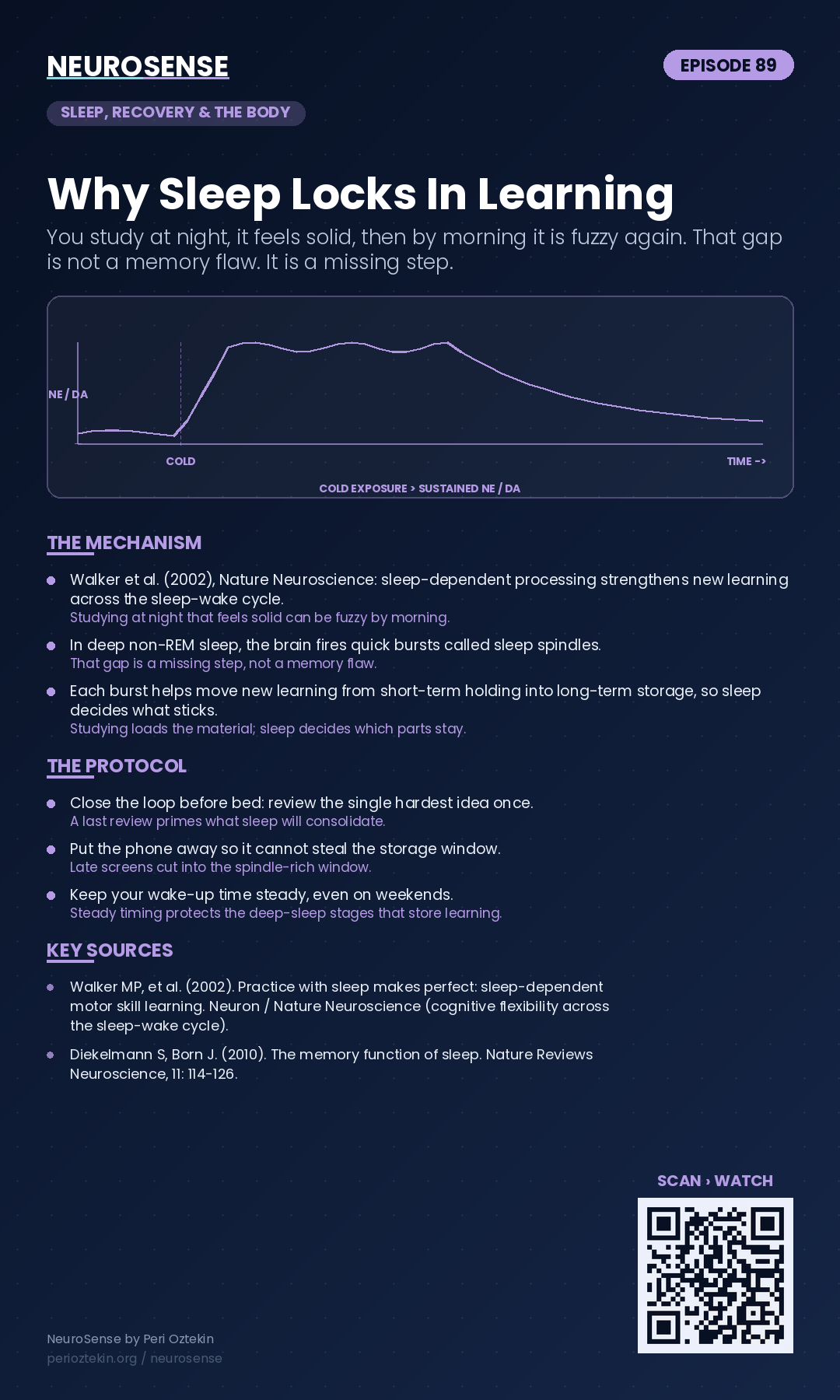
Right-click → Save As to download. Or scan the QR code in the corner to come back here from print.
The science beat (5-sec loop)
Sources
- Walker MP, et al. Cognitive flexibility across the sleep-wake cycle. Nature Neuroscience. 2002.
Educational content only. Not medical advice.
Also on Instagram: @neurosensebrain
← Back to all episodes