← All episodes
Episode 83 · The Social Brain
Why Reaching Out Gets Harder Alone
When loneliness makes reaching out feel harder, that does not mean you are broken. Isolation can change the signals that make contact feel worth the effort.
The Science
- Matthews et al. / Tye (2016), Cell: specific dorsal raphe neurons encode the experience of social isolation and drive social seeking.
- So loneliness can register like a need state, heavy and urgent at once.
- The trap is that the longer you avoid contact, the more the brain scans for threat instead of welcome.
- Reaching out feeling hard does not mean you are broken.
The Protocol
- One low-pressure contact: sit near people before you have to talk.
- Send one simple message or take a short walk with someone safe.
- Say one honest sentence instead of performing fine.
- Notice the signal, name the mechanism, and change one input before autopilot.
One-page summary
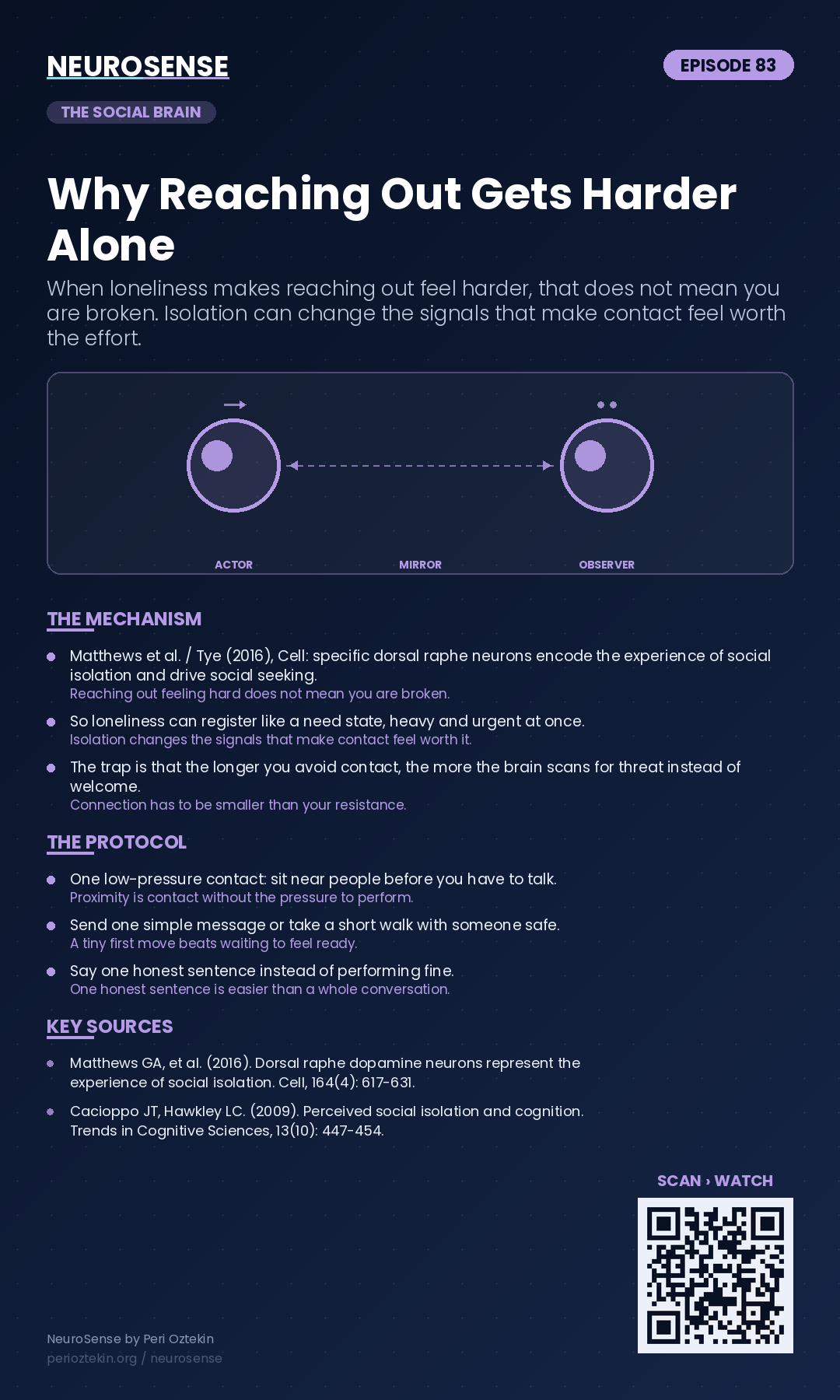
Right-click → Save As to download. Or scan the QR code in the corner to come back here from print.
The science beat (5-sec loop)
Sources
- Matthews GA, et al. (Tye KM). Dorsal raphe dopamine neurons represent the experience of social isolation. Cell. 2016;164(4):617-631.
Educational content only. Not medical advice.
Also on Instagram: @neurosensebrain
← Back to all episodes