← All episodes
Episode 73 · Stress & Emotion
Why Naming the Feeling Can Help You Pause
When anger hits in a chat, hallway, car, or kitchen, the next sentence can arrive too fast. The body can act before the better choice gets a turn.
The Science
- LeDoux (2000), Annual Review of Neuroscience: the amygdala detects threat fast and can make the alarm feel louder than the plan.
- Arnsten (2009), Nature Reviews Neuroscience: under high stress, top-down prefrontal control gets weaker, so reasoning struggles first.
- Lieberman et al. (2007), Psychological Science: putting feelings into words (affect labeling) reduces amygdala activity.
- Net effect: the body can act before the better choice gets a turn, so lowering intensity comes first.
The Protocol
- Lower intensity first: exhale slowly and name three safe details.
- Unclench your jaw and put both feet on the floor.
- Then label the emotion simply: I feel angry.
- Notice the signal, name the mechanism, and change one input before autopilot.
One-page summary
Right-click → Save As to download. Or scan the QR code in the corner to come back here from print.
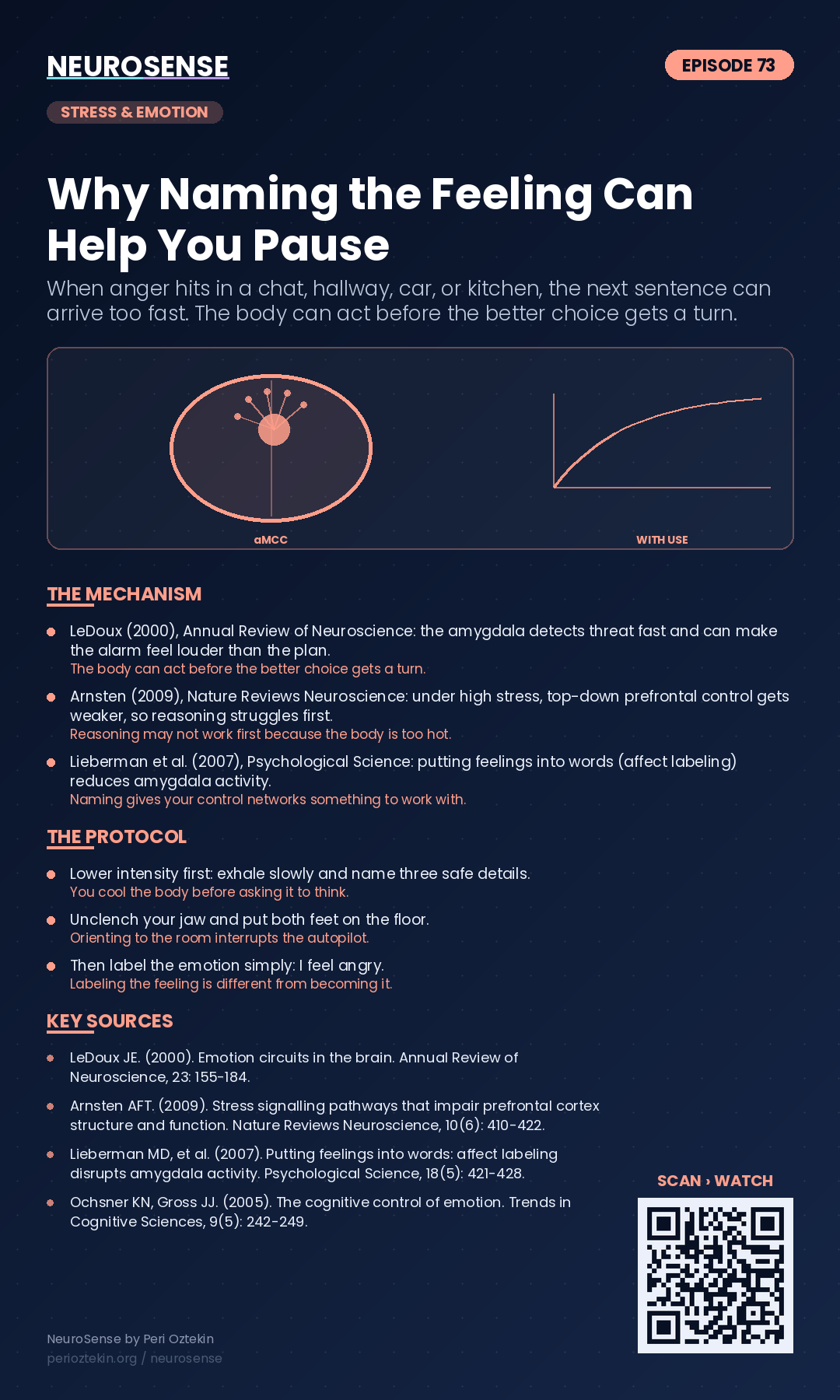
The science beat (5-sec loop)
Sources
- LeDoux JE. Emotion circuits in the brain. Annual Review of Neuroscience. 2000;23:155-184.
- Arnsten AFT. Stress signalling pathways that impair prefrontal cortex structure and function. Nature Reviews Neuroscience. 2009;10(6):410-422.
- Ochsner KN, Gross JJ. The cognitive control of emotion. Trends in Cognitive Sciences. 2005;9(5):242-249.
- Lieberman MD, et al. Putting feelings into words: affect labeling disrupts amygdala activity in response to affective stimuli. Psychological Science. 2007;18(5):421-428.
Educational content only. Not medical advice.
Also on Instagram: @neurosensebrain
← Back to all episodes