← All episodes
Episode 72 · Motivation & Habits
Why Scrolling Makes Normal Tasks Feel Flat
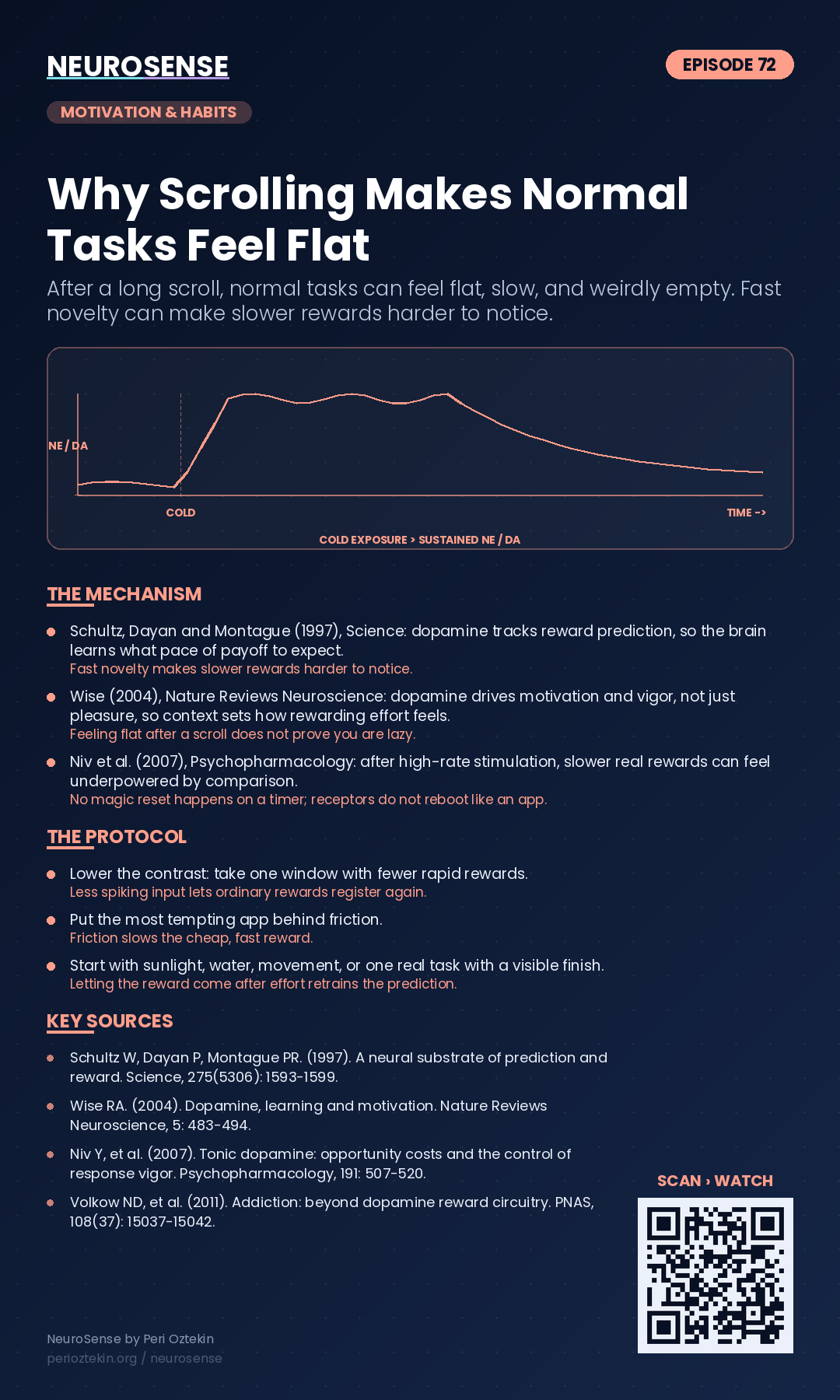
After a long scroll, normal tasks can feel flat, slow, and weirdly empty. Fast novelty can make slower rewards harder to notice.
The Science
- Schultz, Dayan and Montague (1997), Science: dopamine tracks reward prediction, so the brain learns what pace of payoff to expect.
- Wise (2004), Nature Reviews Neuroscience: dopamine drives motivation and vigor, not just pleasure, so context sets how rewarding effort feels.
- Niv et al. (2007), Psychopharmacology: after high-rate stimulation, slower real rewards can feel underpowered by comparison.
- Net effect: fast novelty makes slower rewards harder to notice, and no timer resets your dopamine.
The Protocol
- Lower the contrast: take one short window with fewer rapid rewards.
- Put the most tempting app behind friction.
- Start with sunlight, water, movement, or one real task with a visible finish.
- Notice the signal, name the mechanism, and change one input before autopilot.
One-page summary
Right-click → Save As to download. Or scan the QR code in the corner to come back here from print.
The science beat (5-sec loop)
Sources
- Schultz W, Dayan P, Montague PR. A neural substrate of prediction and reward. Science. 1997;275(5306):1593-1599.
- Berridge KC, Robinson TE. What is the role of dopamine in reward: hedonic impact, reward learning, or incentive salience? Brain Research Reviews. 1998;28(3):309-369.
- Wise RA. Dopamine, learning and motivation. Nature Reviews Neuroscience. 2004;5:483-494.
- Niv Y, Daw ND, Joel D, Dayan P. Tonic dopamine: opportunity costs and the control of response vigor. Psychopharmacology. 2007;191:507-520.
Educational content only. Not medical advice.
Also on Instagram: @neurosensebrain
← Back to all episodes