← All episodes
Episode 71 · Focus & Attention
Why Focus Feels Effortless Sometimes
In music, sports, games, skating, coding, or art, focus sometimes locks in and time feels different. Flow usually arrives from the task conditions, not from yelling at your brain.
The Science
- Nakamura and Csikszentmihalyi (2002), Handbook of Positive Psychology: flow depends on a match between challenge, skill, feedback, and attention.
- Dietrich (2004), Consciousness and Cognition: during flow, self-monitoring gets quieter, so mistakes feel less personal.
- Engeser and Rheinberg (2008), Motivation and Emotion: the useful zone is just above comfortable, where the task is hard enough to matter.
- Flow arrives from task conditions, not from yelling at your brain.
The Protocol
- Invite flow: choose one measurable task and remove one interruption.
- Set ten to twenty minutes with no multitasking.
- Keep the challenge slightly above routine and check feedback as you go.
- Notice the signal, name the mechanism, and change one input before autopilot.
One-page summary
Right-click → Save As to download. Or scan the QR code in the corner to come back here from print.
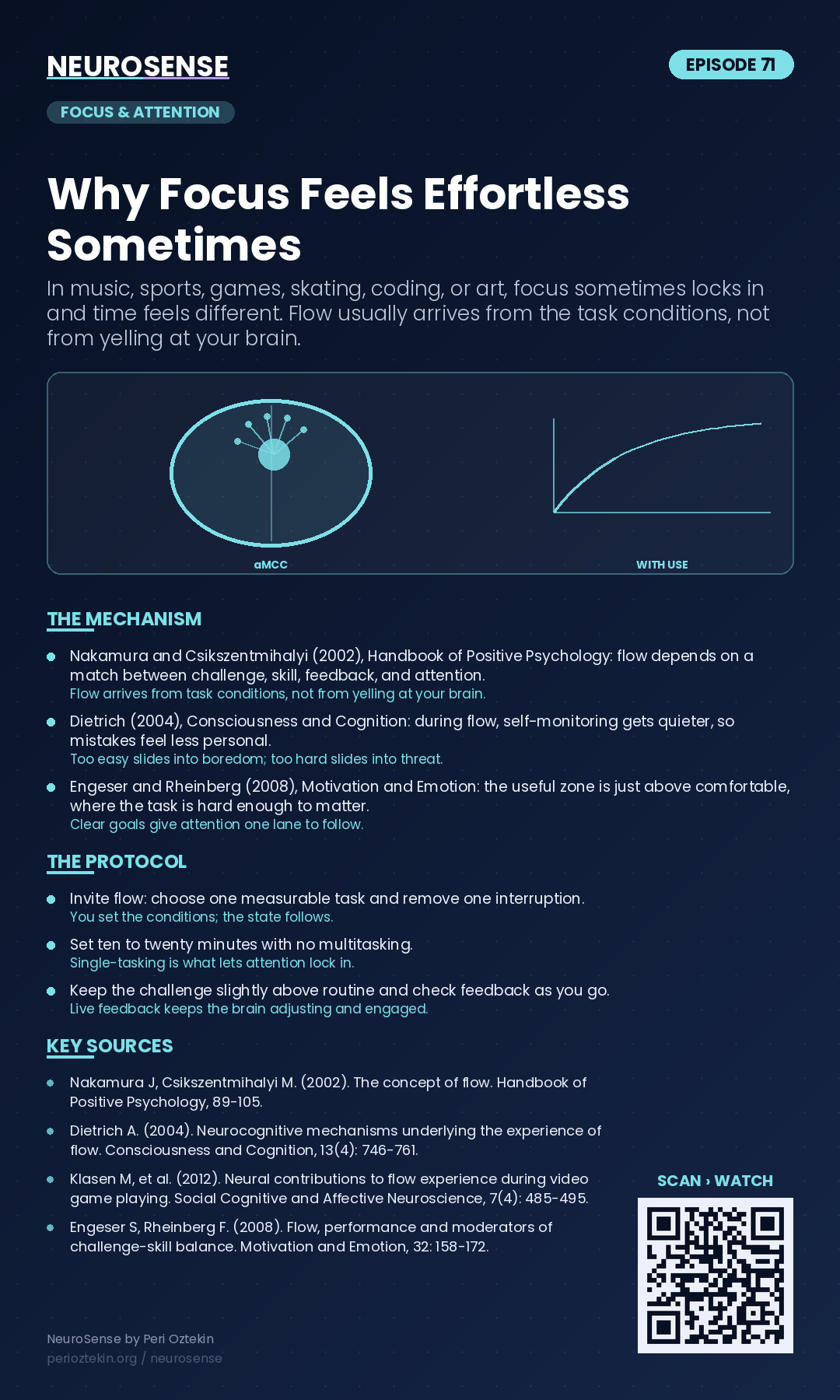
The science beat (5-sec loop)
Sources
- Nakamura J, Csikszentmihalyi M. (2002). The concept of flow. Handbook of Positive Psychology, 89-105.
- Dietrich A. (2004). Neurocognitive mechanisms underlying the experience of flow. Consciousness and Cognition, 13(4): 746-761.
- Klasen M, et al. (2012). Neural contributions to flow experience during video game playing. Social Cognitive and Affective Neuroscience, 7(4): 485-495.
- Engeser S, Rheinberg F. (2008). Flow, performance and moderators of challenge-skill balance. Motivation and Emotion, 32: 158-172.
Educational content only. Not medical advice.
Also on Instagram: @neurosensebrain
← Back to all episodes