← All episodes
Episode 70 · How the Brain Works
Why Saying It Out Loud Can Help
You can reread a sentence three times and still not feel it click. Meaning can stay blurry when it only sits silently on the page.
The Science
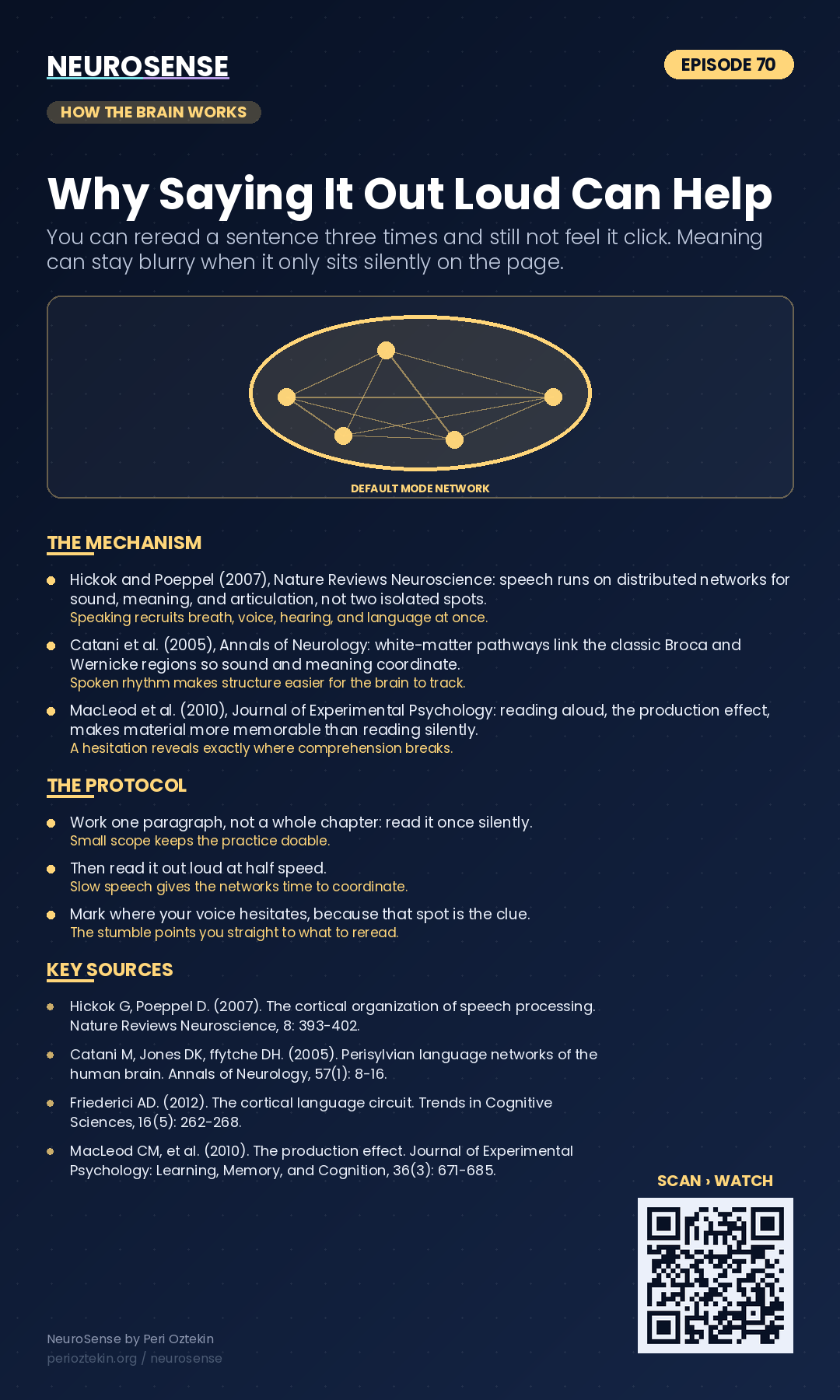
- Hickok and Poeppel (2007), Nature Reviews Neuroscience: speech runs on distributed networks for sound, meaning, and articulation, not two isolated spots.
- Catani et al. (2005), Annals of Neurology: white-matter pathways link the classic Broca and Wernicke regions so sound and meaning coordinate.
- MacLeod et al. (2010), Journal of Experimental Psychology: reading aloud, the production effect, makes material more memorable than reading silently.
- Speaking recruits breath, voice, hearing, and language at once.
The Protocol
- Work one paragraph, not a whole chapter: read it once silently.
- Then read it out loud at half speed.
- Mark where your voice hesitates, because that spot is the clue.
- Notice the signal, name the mechanism, and change one input before autopilot.
One-page summary
Right-click → Save As to download. Or scan the QR code in the corner to come back here from print.
The science beat (5-sec loop)
Sources
- Hickok G, Poeppel D. (2007). The cortical organization of speech processing. Nature Reviews Neuroscience, 8: 393-402.
- Catani M, Jones DK, ffytche DH. (2005). Perisylvian language networks of the human brain. Annals of Neurology, 57(1): 8-16.
- Friederici AD. (2012). The cortical language circuit. Trends in Cognitive Sciences, 16(5): 262-268.
- MacLeod CM, et al. (2010). The production effect. Journal of Experimental Psychology: Learning, Memory, and Cognition, 36(3): 671-685.
Educational content only. Not medical advice.
Also on Instagram: @neurosensebrain
← Back to all episodes