← All episodes
Episode 69 · How the Brain Works
Why Practice Shapes the Teen Brain
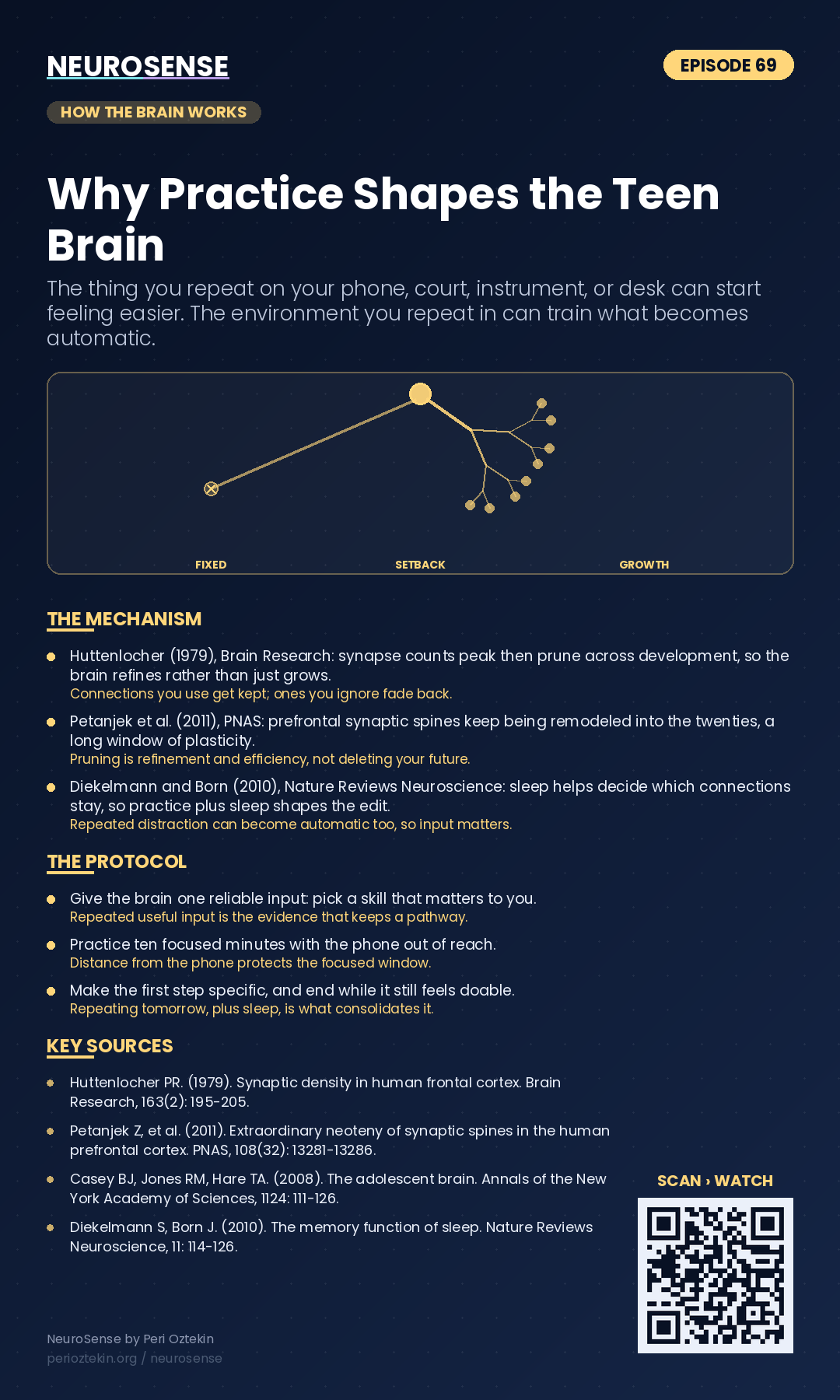
The thing you repeat on your phone, court, instrument, or desk can start feeling easier. The environment you repeat in can train what becomes automatic.
The Science
- Huttenlocher (1979), Brain Research: synapse counts peak then prune across development, so the brain refines rather than just grows.
- Petanjek et al. (2011), PNAS: prefrontal synaptic spines keep being remodeled into the twenties, a long window of plasticity.
- Diekelmann and Born (2010), Nature Reviews Neuroscience: sleep helps decide which connections stay, so practice plus sleep shapes the edit.
- Connections you use get kept; ones you ignore fade back.
The Protocol
- Give the brain one reliable input: pick a skill that matters to you.
- Practice ten focused minutes with the phone out of reach.
- Make the first step specific, and end while it still feels doable.
- Notice the signal, name the mechanism, and change one input before autopilot.
One-page summary
Right-click → Save As to download. Or scan the QR code in the corner to come back here from print.
The science beat (5-sec loop)
Sources
- Huttenlocher PR. (1979). Synaptic density in human frontal cortex. Brain Research, 163(2): 195-205.
- Petanjek Z, et al. (2011). Extraordinary neoteny of synaptic spines in the human prefrontal cortex. PNAS, 108(32): 13281-13286.
- Casey BJ, Jones RM, Hare TA. (2008). The adolescent brain. Annals of the New York Academy of Sciences, 1124: 111-126.
- Diekelmann S, Born J. (2010). The memory function of sleep. Nature Reviews Neuroscience, 11: 114-126.
Educational content only. Not medical advice.
Also on Instagram: @neurosensebrain
← Back to all episodes