← All episodes
Episode 68 · How the Brain Works
Why Effort Can Feel Better Later
After practice, dancing, laughing, or a hard walk, your body may feel lighter later. Effort can feel rough at first, then leave the body lighter afterward.
The Science
- Pert and Snyder (1973), Science: the brain has opioid receptors, the docking sites for internal relief signals.
- Hughes et al. (1975), Nature: the brain makes its own opioid peptides (endorphins) that act on those receptors.
- Boecker et al. (2008), Cerebral Cortex: endurance exercise releases opioids in the human brain, but the runner's high is multi-system, not endorphins alone.
- Effort can feel rough at first, then leave the body lighter later.
The Protocol
- Aim for safe effort, not chasing pain: about ten to twenty minutes.
- Walk briskly, dance, cycle, swim, or do bodyweight work.
- Keep it challenging, not punishing, because pain is a stop signal.
- Notice the signal, name the mechanism, and change one input before autopilot.
One-page summary
Right-click → Save As to download. Or scan the QR code in the corner to come back here from print.
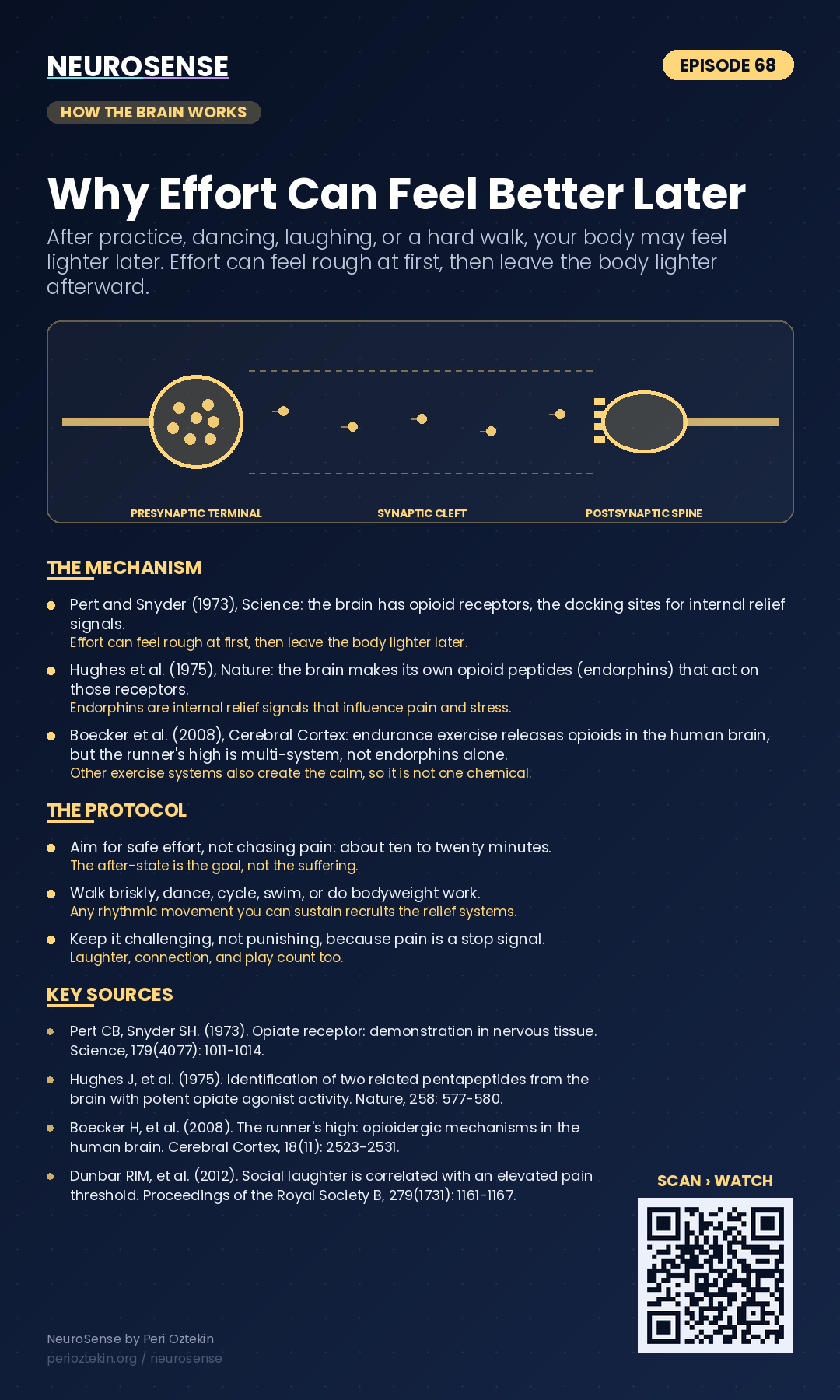
The science beat (5-sec loop)
Sources
- Pert CB, Snyder SH. (1973). Opiate receptor: demonstration in nervous tissue. Science, 179(4077): 1011-1014.
- Hughes J, et al. (1975). Identification of two related pentapeptides from the brain with potent opiate agonist activity. Nature, 258: 577-580.
- Boecker H, et al. (2008). The runner's high: opioidergic mechanisms in the human brain. Cerebral Cortex, 18(11): 2523-2531.
- Dunbar RIM, et al. (2012). Social laughter is correlated with an elevated pain threshold. Proceedings of the Royal Society B, 279(1731): 1161-1167.
Educational content only. Not medical advice.
Also on Instagram: @neurosensebrain
← Back to all episodes