← All episodes
Episode 65 · Focus & Attention
Why Alertness Has a Dial
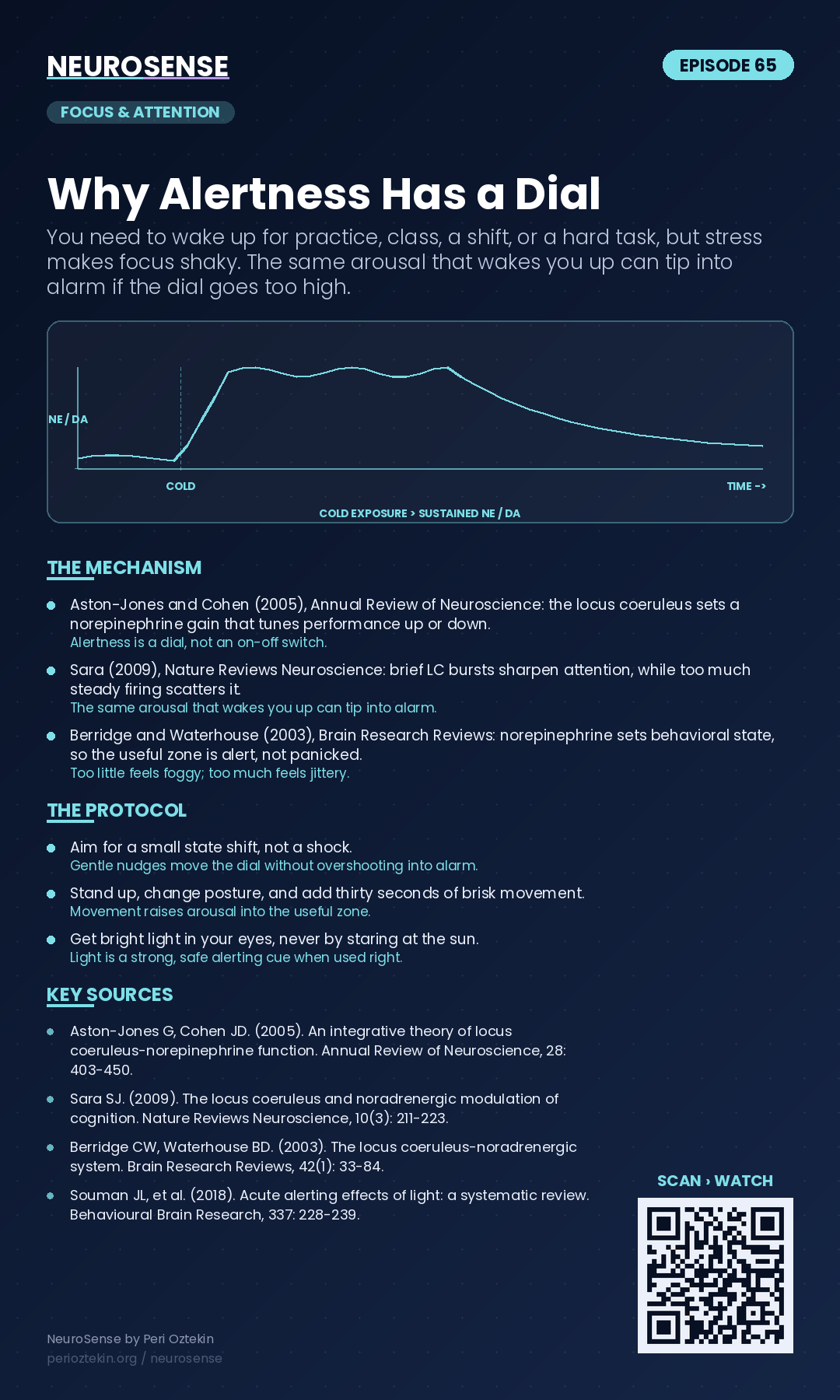
You need to wake up for practice, class, a shift, or a hard task, but stress makes focus shaky. The same arousal that wakes you up can tip into alarm if the dial goes too high.
The Science
- Aston-Jones and Cohen (2005), Annual Review of Neuroscience: the locus coeruleus sets a norepinephrine gain that tunes performance up or down.
- Sara (2009), Nature Reviews Neuroscience: brief LC bursts sharpen attention, while too much steady firing scatters it.
- Berridge and Waterhouse (2003), Brain Research Reviews: norepinephrine sets behavioral state, so the useful zone is alert, not panicked.
- Alertness is a dial, not an on-off switch.
The Protocol
- Aim for a small state shift, not a shock.
- Stand up, change posture, and add thirty seconds of brisk movement.
- Get bright light in your eyes, never by staring at the sun.
- Notice the signal, name the mechanism, and change one input before autopilot.
One-page summary
Right-click → Save As to download. Or scan the QR code in the corner to come back here from print.
The science beat (5-sec loop)
Sources
- Aston-Jones G, Cohen JD. (2005). An integrative theory of locus coeruleus-norepinephrine function. Annual Review of Neuroscience, 28: 403-450.
- Sara SJ. (2009). The locus coeruleus and noradrenergic modulation of cognition. Nature Reviews Neuroscience, 10(3): 211-223.
- Berridge CW, Waterhouse BD. (2003). The locus coeruleus-noradrenergic system. Brain Research Reviews, 42(1): 33-84.
- Souman JL, et al. (2018). Acute alerting effects of light: a systematic review. Behavioural Brain Research, 337: 228-239.
Educational content only. Not medical advice.
Also on Instagram: @neurosensebrain
← Back to all episodes