← All episodes
Episode 64 · How the Brain Works
How Your Brain Turns the Volume Down
When noise, pressure, or a group chat makes your mind feel loud, trying harder can backfire. When the system is already loud, the useful move is often a brake, not another push.
The Science
- Farrant and Nusser (2005), Nature Reviews Neuroscience: GABA is the brain's main inhibitory transmitter, making some neurons less likely to fire.
- Petroff (2002), The Neuroscientist: inhibition is not shutdown; it shapes sleep, movement, attention, and stress by balancing excitation.
- Zaccaro et al. (2018), Frontiers in Human Neuroscience: slow breathing shifts arousal through body-brain pathways, a route you can actually use.
- When the system is already loud, a brake helps more than another push.
The Protocol
- Aim for arousal downshifting, not forcing silence.
- Breathe with a longer exhale: about four seconds in, six seconds out, for one minute.
- Drop the shoulders, unclench the jaw, then choose one small next action.
- Notice the signal, name the mechanism, and change one input before autopilot.
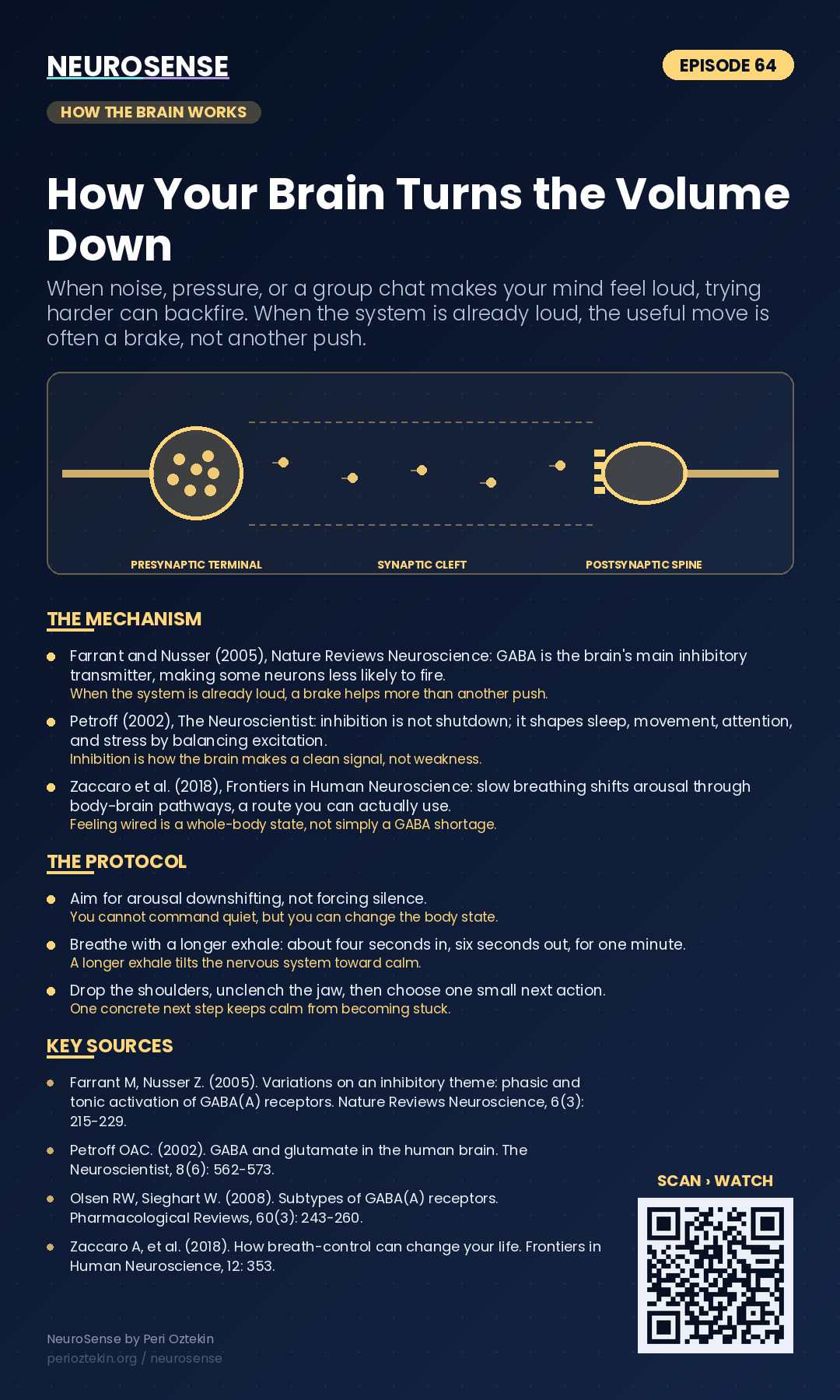
One-page summary
Right-click → Save As to download. Or scan the QR code in the corner to come back here from print.
The science beat (5-sec loop)
Sources
- Farrant M, Nusser Z. (2005). Variations on an inhibitory theme: phasic and tonic activation of GABA(A) receptors. Nature Reviews Neuroscience, 6(3): 215-229.
- Petroff OAC. (2002). GABA and glutamate in the human brain. The Neuroscientist, 8(6): 562-573.
- Olsen RW, Sieghart W. (2008). Subtypes of GABA(A) receptors. Pharmacological Reviews, 60(3): 243-260.
- Zaccaro A, et al. (2018). How breath-control can change your life. Frontiers in Human Neuroscience, 12: 353.
Educational content only. Not medical advice.
Also on Instagram: @neurosensebrain
← Back to all episodes