← All episodes
Episode 62 · Sleep, Recovery & the Body
Why Caffeine Can Make You Crash Later
Caffeine can make a morning feel fixed, then leave you flat when the day asks for effort. That does not mean caffeine creates energy.
The Science
- Porkka-Heiskanen et al. (1997), Science: adenosine builds up the longer you stay awake and creates the brain's sleep pressure.
- Fredholm et al. (1999), Pharmacological Reviews: caffeine works by blocking adenosine receptors, so it masks tiredness rather than creating energy.
- Drake et al. (2013), Journal of Clinical Sleep Medicine: caffeine taken even six hours before bed measurably disrupts sleep, which deepens the pressure underneath.
- Your brain is tracking time online, not just mood.
The Protocol
- Use caffeine as a timing tool, not a rescue button.
- Delay the first dose: get light, water, and movement first.
- Use the smallest dose you can actually feel, and cut it off early.
- Notice the signal, name the mechanism, and change one input before autopilot.
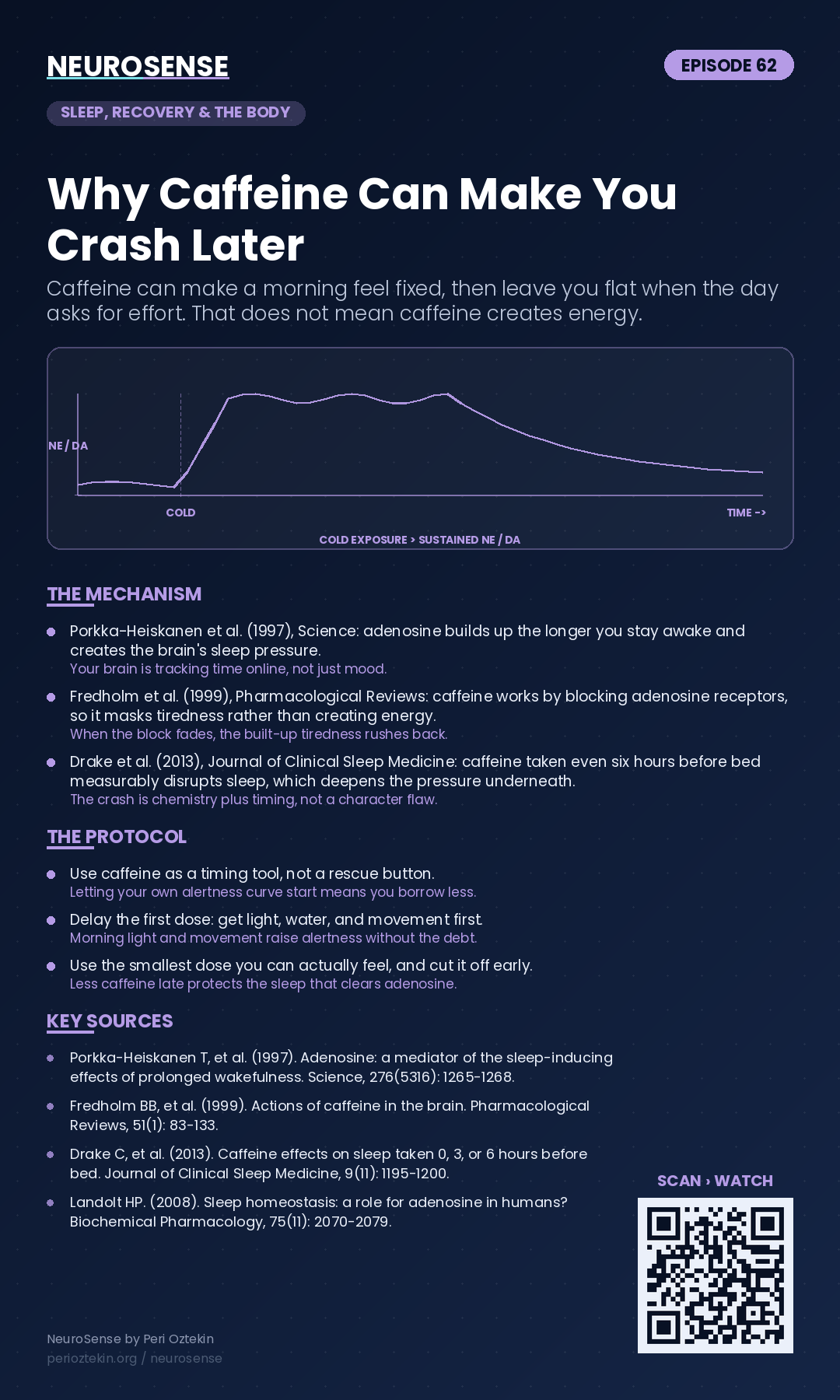
One-page summary
Right-click → Save As to download. Or scan the QR code in the corner to come back here from print.
The science beat (5-sec loop)
Sources
- Porkka-Heiskanen T, et al. (1997). Adenosine: a mediator of the sleep-inducing effects of prolonged wakefulness. Science, 276(5316): 1265-1268.
- Fredholm BB, et al. (1999). Actions of caffeine in the brain. Pharmacological Reviews, 51(1): 83-133.
- Drake C, et al. (2013). Caffeine effects on sleep taken 0, 3, or 6 hours before bed. Journal of Clinical Sleep Medicine, 9(11): 1195-1200.
- Landolt HP. (2008). Sleep homeostasis: a role for adenosine in humans? Biochemical Pharmacology, 75(11): 2070-2079.
Educational content only. Not medical advice.
Also on Instagram: @neurosensebrain
← Back to all episodes