← All episodes
Episode 61 · Stress & Emotion
Why Stress Stays In Your Body
The argument ends, the message stops buzzing, or the test is over, but your body may still be braced. That tight chest is not proof you are failing to calm down.
The Science
- Ulrich-Lai and Herman (2009), Nature Reviews Neuroscience: the stress response runs as a fast nerve branch plus a slower hormone branch, so the body can stay braced after the mind moves on.
- Herman et al. (2016), Comprehensive Physiology: the HPA axis links hypothalamus, pituitary, and adrenal glands, releasing cortisol when demand hits.
- McEwen (1998), New England Journal of Medicine: cortisol mobilizes fuel and attention for real pressure, but turns costly when the alarm keeps running after safety returns.
- The tight chest is a slow chemical tail, not proof you failed to calm down.
The Protocol
- Check the room first: am I actually safe enough right now?
- If yes, label it: this is a leftover alarm in my body.
- Then give the body a slower signal, like an exhale longer than the inhale.
- Notice the signal, name the mechanism, and change one input before autopilot.
One-page summary
Right-click → Save As to download. Or scan the QR code in the corner to come back here from print.
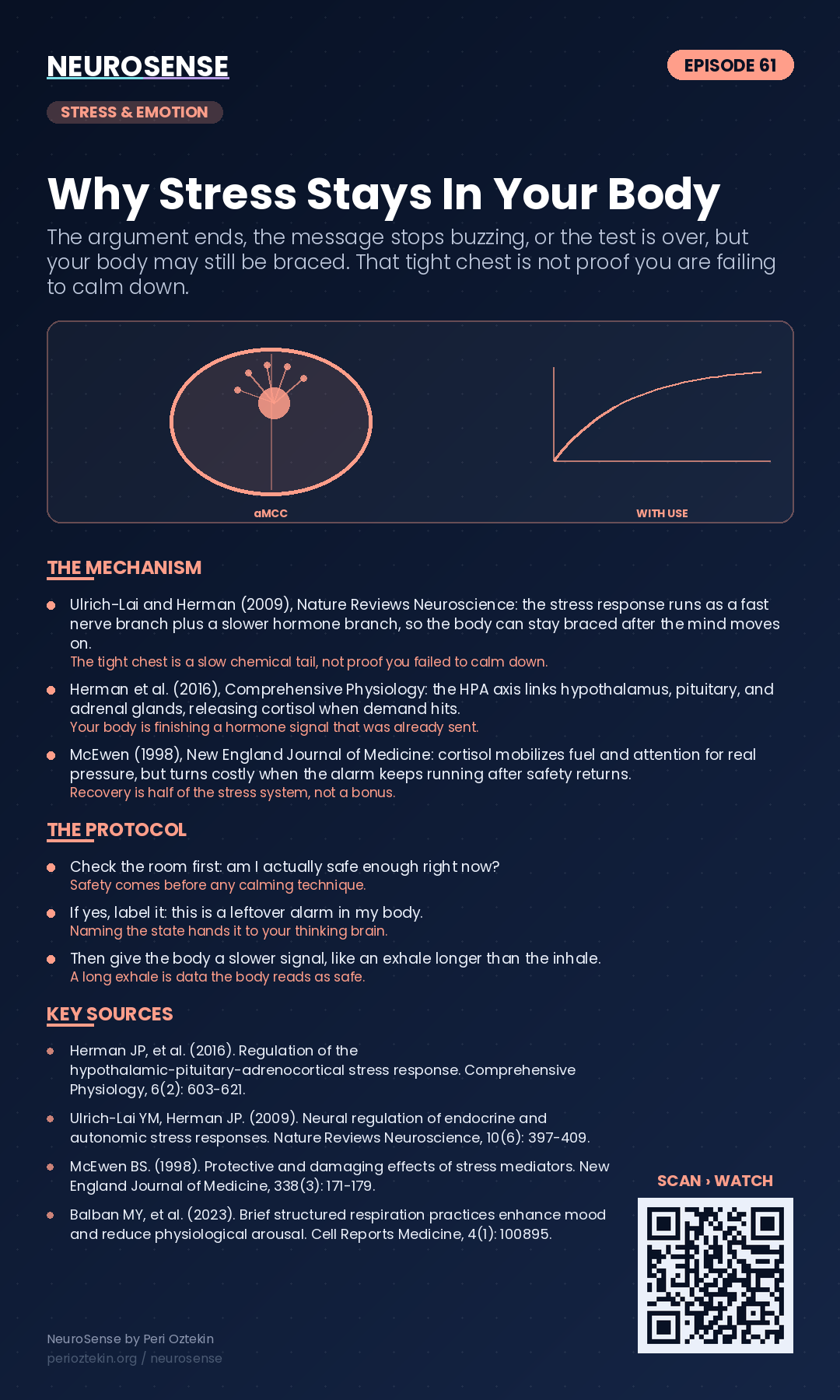
The science beat (5-sec loop)
Sources
- Herman JP, et al. (2016). Regulation of the hypothalamic-pituitary-adrenocortical stress response. Comprehensive Physiology, 6(2): 603-621.
- Ulrich-Lai YM, Herman JP. (2009). Neural regulation of endocrine and autonomic stress responses. Nature Reviews Neuroscience, 10(6): 397-409.
- McEwen BS. (1998). Protective and damaging effects of stress mediators. New England Journal of Medicine, 338(3): 171-179.
- Balban MY, et al. (2023). Brief structured respiration practices enhance mood and reduce physiological arousal. Cell Reports Medicine, 4(1): 100895.
Educational content only. Not medical advice.
Also on Instagram: @neurosensebrain
← Back to all episodes