← All episodes
Episode 60 · The Social Brain
Why a Friend's Embarrassment Hurts You
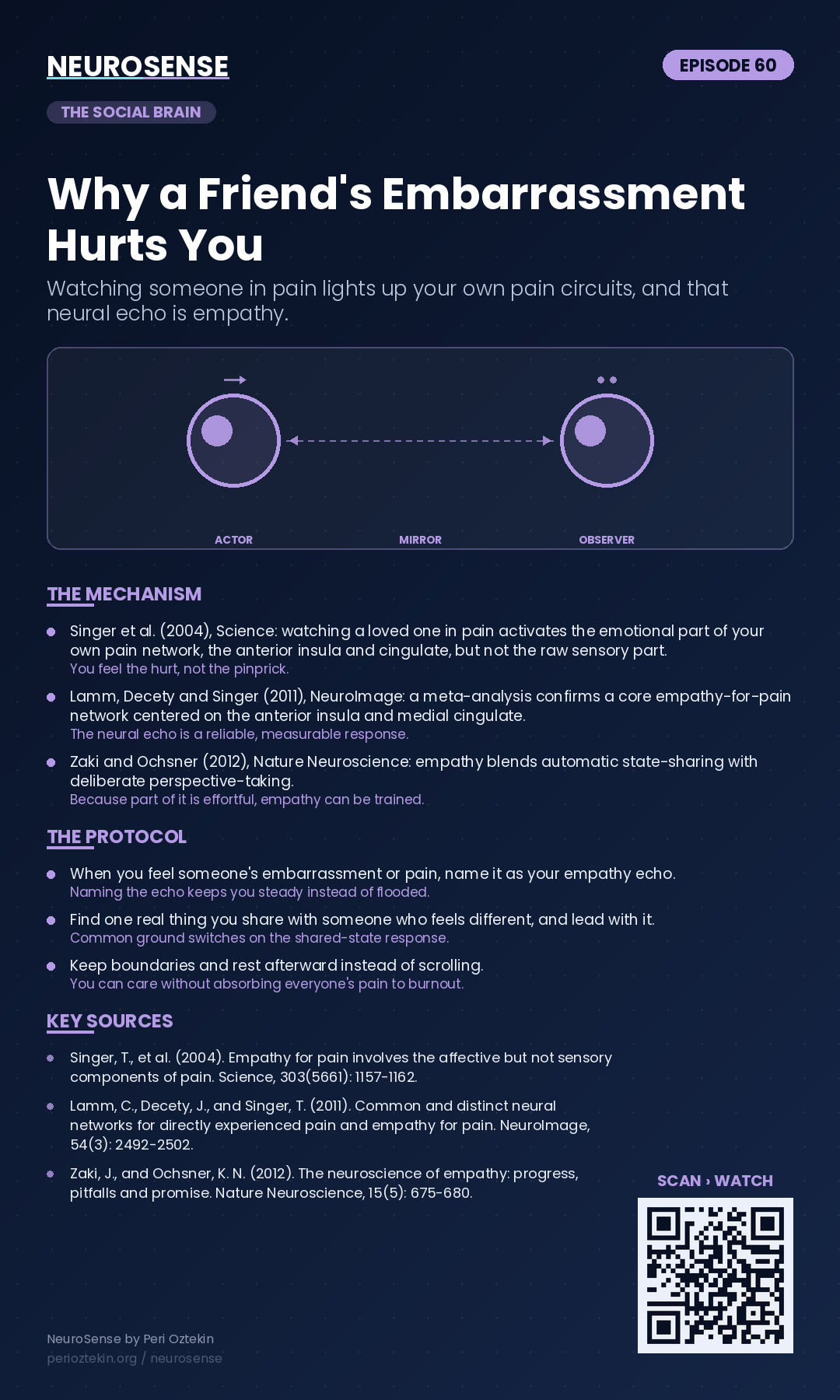
It can actually hurt to watch a friend get embarrassed, because your brain partly blurs the line between them and you. That neural echo is the biological basis of empathy.
The Science
- Singer et al. (2004), Science: watching a loved one feel pain activates the emotional part of your own pain network, the anterior insula and cingulate cortex, but not the raw sensory part.
- Lamm, Decety and Singer (2011), NeuroImage: a meta analysis confirms a core empathy for pain network centered on the bilateral anterior insula and medial cingulate cortex.
- Zaki and Ochsner (2012), Nature Neuroscience: empathy combines automatic state sharing with deliberate perspective taking, so it is partly trainable, not fixed.
- Net effect: your brain runs a partial simulation of others' states, which is why their feelings land in your body, though self and other are not identical.
The Protocol
- Build a human bridge: deliberately find one real thing you share with someone who feels different from you.
- Lead with that commonality in a conversation.
- Notice the signal, name the mechanism, and change one input before autopilot.
- Keep healthy boundaries; you can care without absorbing someone else's pain, and rest after instead of scrolling.
One-page summary
Right-click → Save As to download. Or scan the QR code in the corner to come back here from print.
The science beat (5-sec loop)
Sources
- Singer, T., et al. (2004). Empathy for pain involves the affective but not sensory components of pain. Science, 303(5661): 1157-1162.
- Lamm, C., Decety, J., and Singer, T. (2011). Meta-analytic evidence for common and distinct neural networks associated with directly experienced pain and empathy for pain. NeuroImage, 54(3): 2492-2502.
- Zaki, J., and Ochsner, K. N. (2012). The neuroscience of empathy: progress, pitfalls and promise. Nature Neuroscience, 15(5): 675-680.
Educational content only. Not medical advice.
Also on Instagram: @neurosensebrain
← Back to all episodes