← All episodes
Episode 59 · Stress & Emotion
Your Fear Fires Before Your Logic Loads
You jumped because a pile of laundry looked like an intruder for a split second. That is your brain's fast fear route firing before the slower, smarter one catches up.
The Science
- LeDoux (2000), Annual Review of Neuroscience: a fast route can carry threat signals from the thalamus to the amygdala before the cortex finishes identifying what you saw.
- LeDoux and Pine (2016), American Journal of Psychiatry: defensive circuits and conscious feelings of fear are partly separable systems, not one simple fear center.
- Pessoa and Adolphs (2010), Nature Reviews Neuroscience: the quick low road is a useful teaching idea but real threat processing runs along many roads, not just one.
- Net effect: the fast alarm buys speed at the cost of accuracy, while the slower route adds detail and context a moment later.
The Protocol
- At a flash of panic, when you are safe, wait a few seconds for the slower route to confirm whether the threat is real.
- Lower the alarm first with a slow breath, then decide your next move once the thinking brain is back online.
- Let your logic center have the final word instead of the first reaction.
- Never pause like this during genuine physical danger; this is for false alarms, not real ones.
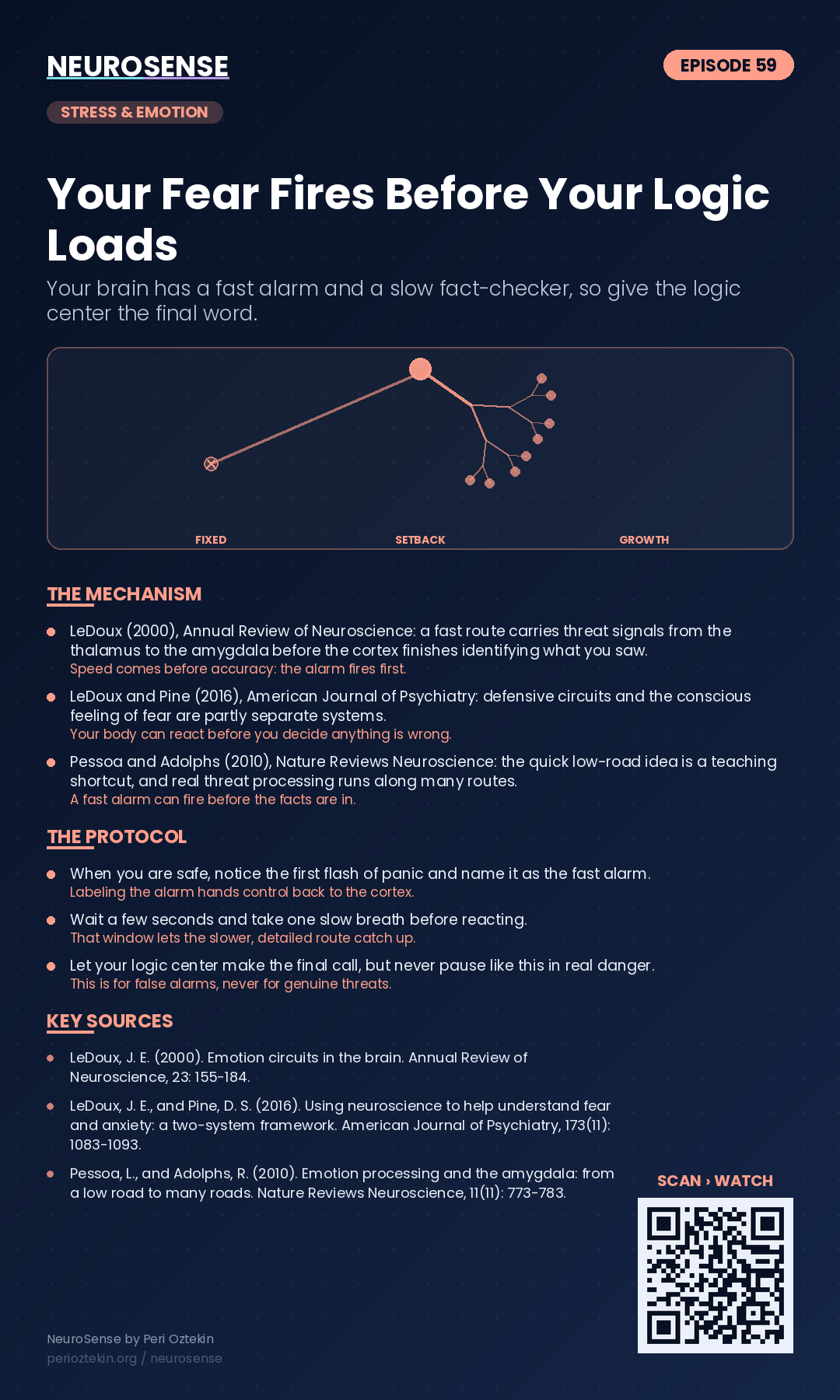
One-page summary
Right-click → Save As to download. Or scan the QR code in the corner to come back here from print.
The science beat (5-sec loop)
Sources
- LeDoux, J. E. (2000). Emotion circuits in the brain. Annual Review of Neuroscience, 23: 155-184.
- LeDoux, J. E., and Pine, D. S. (2016). Using neuroscience to help understand fear and anxiety: a two-system framework. American Journal of Psychiatry, 173(11): 1083-1093.
- Pessoa, L., and Adolphs, R. (2010). Emotion processing and the amygdala: from a low road to many roads of evaluating biological significance. Nature Reviews Neuroscience, 11(11): 773-783.
Educational content only. Not medical advice.
Also on Instagram: @neurosensebrain
← Back to all episodes