← All episodes
Episode 57 · Senses & Perception
The Sixth Sense You Use Every Second
Close your eyes and you still know exactly where your hand is. That is proprioception, a constant internal body map, and your brain can stretch it to include tools you use well.
The Science
- Penfield and Boldrey (1937), Brain: mapping the cortex revealed a body shaped homunculus in the sensory strip, with hands and face taking up outsized space.
- Proske and Gandevia (2012), Physiological Reviews: muscle and joint receptors feed a continuous sense of limb position and movement, the proprioceptive senses.
- Iriki, Tanaka and Iwamura (1996), NeuroReport: after monkeys learned to use a rake, parietal neurons coded the tool as an extension of the hand, evidence the body map can absorb tools.
- Net effect: skilled tools, a racket, a controller, a car, can feel like part of you because the brain literally incorporates them into the map.
The Protocol
- Balance drill: stand on one leg while brushing your teeth to recalibrate the body map and sharpen focus.
- Start eyes open, then try eyes closed once you are steady, switching legs halfway.
- Pick one skill, a sport, instrument, or game, and practice it daily so the tool gets absorbed.
- Notice the signal, name the mechanism, and change one input before autopilot takes over.
One-page summary
Right-click → Save As to download. Or scan the QR code in the corner to come back here from print.
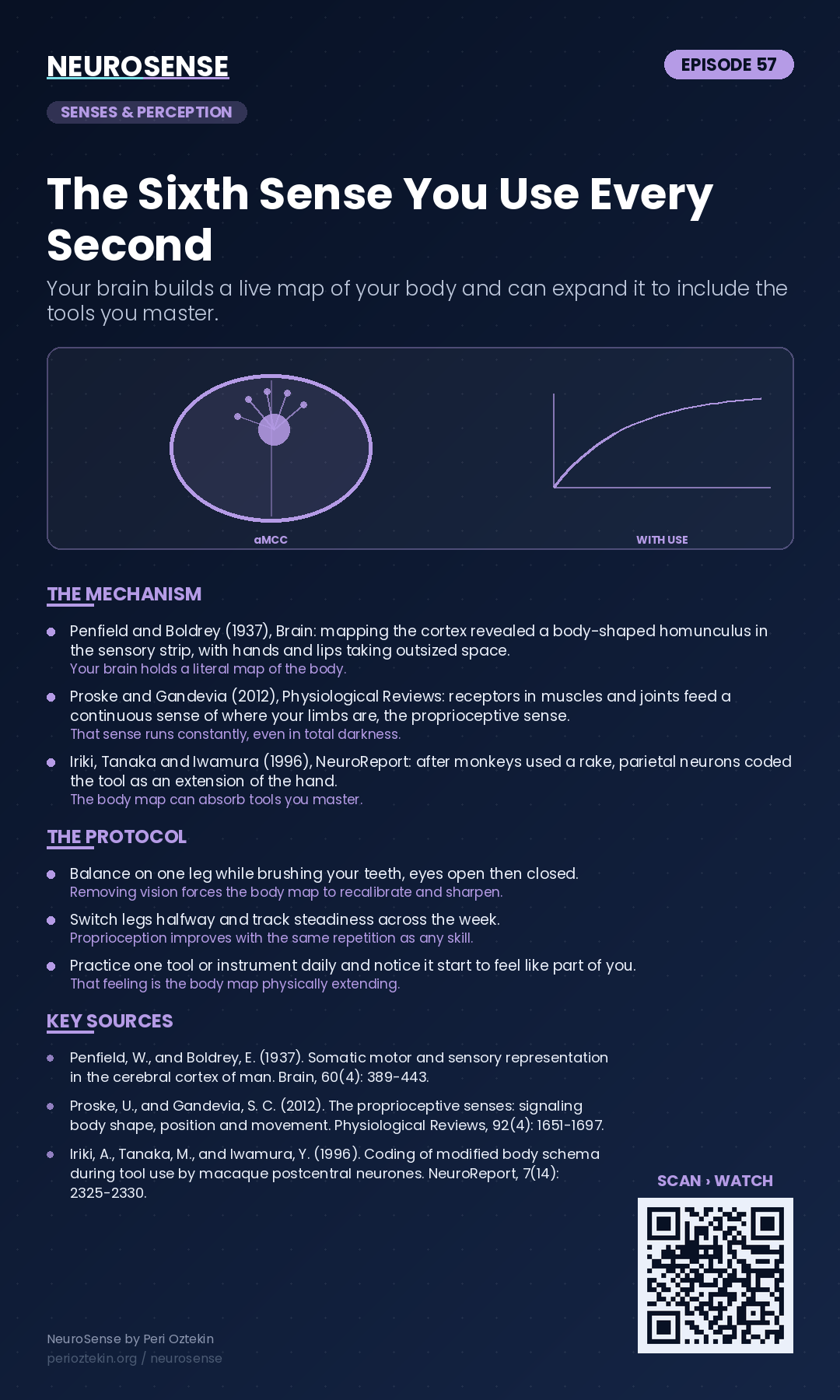
The science beat (5-sec loop)
Sources
- Penfield, W., and Boldrey, E. (1937). Somatic motor and sensory representation in the cerebral cortex of man as studied by electrical stimulation. Brain, 60(4): 389-443.
- Proske, U., and Gandevia, S. C. (2012). The proprioceptive senses: their roles in signaling body shape, body position and movement, and muscle force. Physiological Reviews, 92(4): 1651-1697.
- Iriki, A., Tanaka, M., and Iwamura, Y. (1996). Coding of modified body schema during tool use by macaque postcentral neurones. NeuroReport, 7(14): 2325-2330.
Educational content only. Not medical advice.
Also on Instagram: @neurosensebrain
← Back to all episodes