← All episodes
Episode 55 · Motivation & Habits
Why a Cliffhanger Is Physically Hard to Ignore
You cannot stop watching the mystery box reveal because an open question feels almost like an empty stomach. Curiosity is your brain detecting a gap and pushing you to close it.
The Science
- Loewenstein (1994), Psychological Bulletin: the information gap theory frames curiosity as the felt distance between what you know and what you want to know.
- Kang et al. (2009), Psychological Science: high curiosity activates reward related regions including the caudate, treating information itself like a reward.
- Gruber, Gelman and Ranganath (2014), Neuron: curiosity ramps up a dopaminergic circuit and the hippocampus, improving memory for the answer and even unrelated nearby information.
- Net effect: a gap your brain believes it can close is motivating, and the seeking it triggers makes the answer stick.
The Protocol
- Before reading, turn each heading into a mystery question so your brain wants the answer.
- Write the question down so the gap feels real, then predict the answer before you look.
- Read to close the loop, not just to consume.
- Make distraction one step harder while you are hunting, then quiz yourself later.
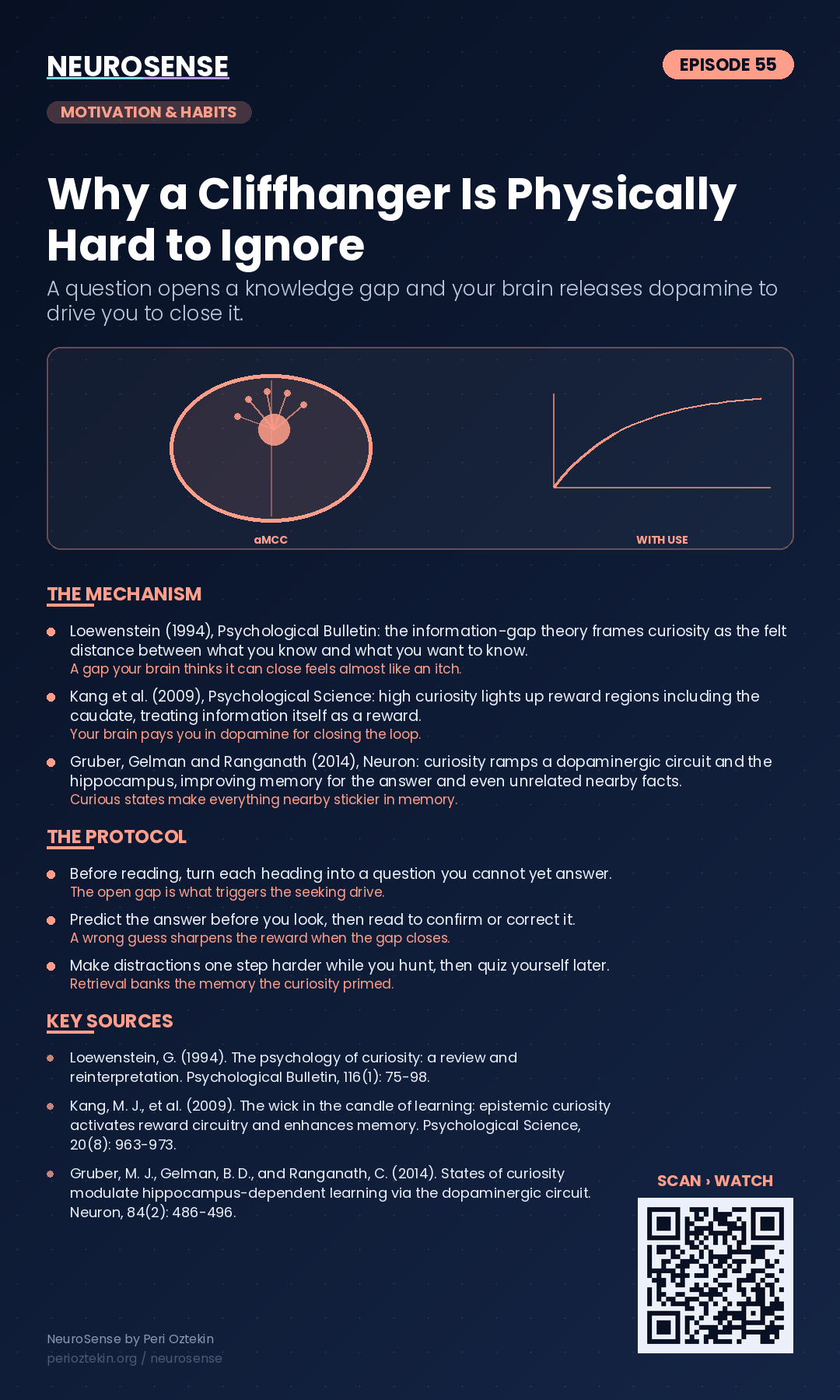
One-page summary
Right-click → Save As to download. Or scan the QR code in the corner to come back here from print.
The science beat (5-sec loop)
Sources
- Loewenstein, G. (1994). The psychology of curiosity: a review and reinterpretation. Psychological Bulletin, 116(1): 75-98.
- Kang, M. J., et al. (2009). The wick in the candle of learning: epistemic curiosity activates reward circuitry and enhances memory. Psychological Science, 20(8): 963-973.
- Gruber, M. J., Gelman, B. D., and Ranganath, C. (2014). States of curiosity modulate hippocampus-dependent learning via the dopaminergic circuit. Neuron, 84(2): 486-496.
Educational content only. Not medical advice.
Also on Instagram: @neurosensebrain
← Back to all episodes