← All episodes
Episode 54 · Motivation & Habits
The Gas and Brake System Behind Every Action
When you cannot start a task, or cannot stop reaching for your phone, you are watching two circuits argue. Your brain runs a Go and a No-Go pathway, and dopamine decides which one wins.
The Science
- DeLong and Wichmann (2007), Archives of Neurology: the basal ganglia run parallel direct (Go) and indirect (No-Go) pathways that initiate or suppress actions.
- Frank (2005), Journal of Cognitive Neuroscience: dopamine tips the balance, boosting the Go pathway and easing off the brake so an action can launch.
- Aron, Robbins and Poldrack (2014), Trends in Cognitive Sciences: a frontal stopping system, including the right inferior frontal cortex, can slam the brakes on an action already in motion.
- Net effect: feeling stuck is often action selection friction, not a character flaw. A tiny completed action works like a key in the ignition.
The Protocol
- Shrink the first step until it is almost laughably easy, then do only that. The small Go releases the brake.
- Make the good action one tap easier to start.
- Make the cheap distraction one step harder to reach.
- Reframe stuck as friction in the launch sequence, then let momentum decide whether you continue.
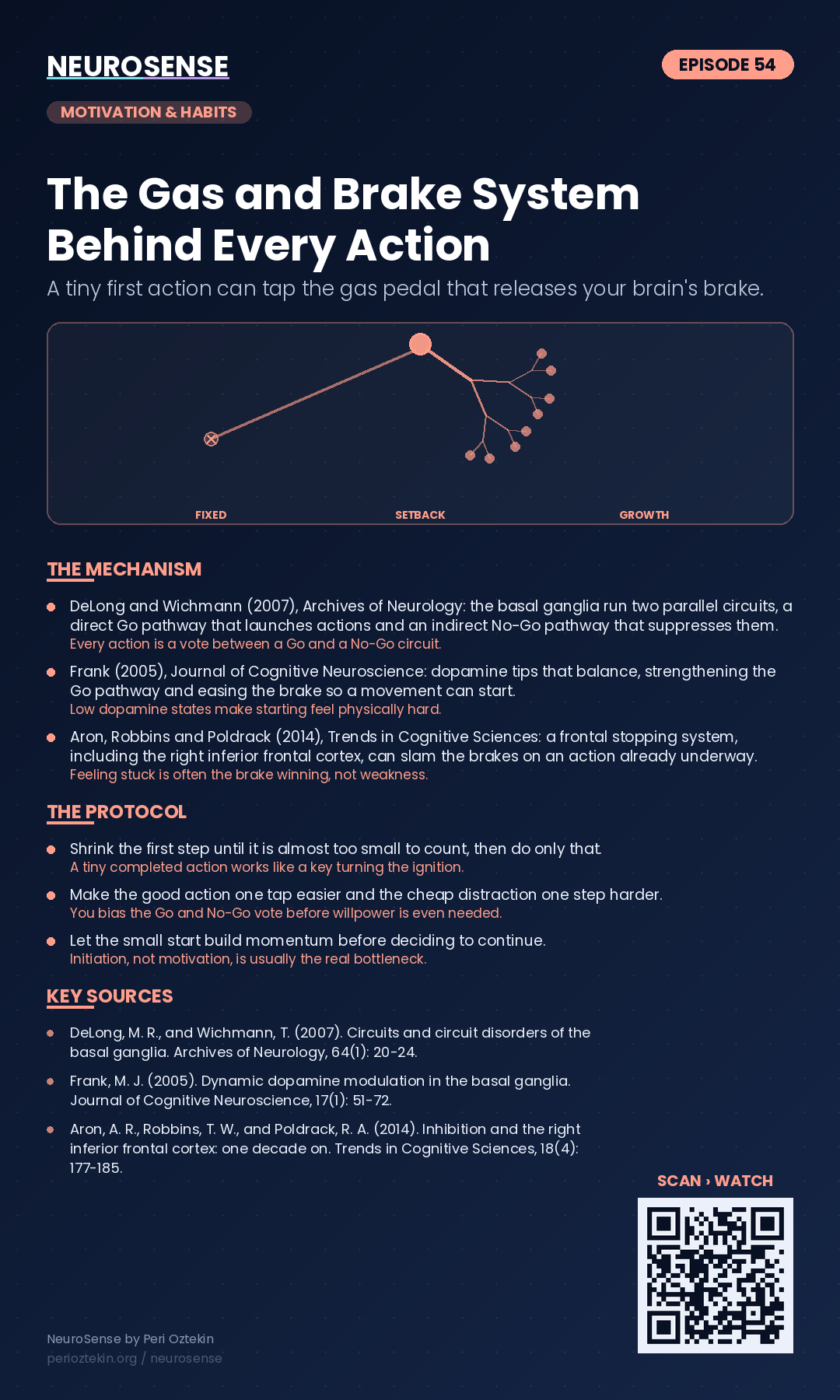
One-page summary
Right-click → Save As to download. Or scan the QR code in the corner to come back here from print.
The science beat (5-sec loop)
Sources
- DeLong, M. R., and Wichmann, T. (2007). Circuits and circuit disorders of the basal ganglia. Archives of Neurology, 64(1): 20-24.
- Frank, M. J. (2005). Dynamic dopamine modulation in the basal ganglia: a neurocomputational account of cognitive deficits in medicated and nonmedicated Parkinsonism. Journal of Cognitive Neuroscience, 17(1): 51-72.
- Aron, A. R., Robbins, T. W., and Poldrack, R. A. (2014). Inhibition and the right inferior frontal cortex: one decade on. Trends in Cognitive Sciences, 18(4): 177-185.
Educational content only. Not medical advice.
Also on Instagram: @neurosensebrain
← Back to all episodes