← All episodes
Episode 52 · Focus & Attention
Your Brain Has a Volume Knob for Reality
Your brain is hit with millions of sensory signals every second, yet you do not glitch out. A brainstem filter called the RAS decides what reaches you and what stays background noise.
The Science
- Moruzzi and Magoun (1949), EEG and Clinical Neurophysiology: stimulating the brainstem reticular formation flips the cortex into an aroused, awake state, the first evidence of an ascending arousal system.
- Saper, Scammell and Lu (2005), Nature: the ascending reticular activating system uses cholinergic and monoaminergic nuclei to set arousal and gate what the cortex processes.
- Desimone and Duncan (1995), Annual Review of Neuroscience: attention works by biased competition, so a current goal raises the priority of matching input and suppresses the rest.
- Net effect: when you name a target, you bias this filter, so matching cues (a specific car, a name, an opportunity) start jumping out at you.
The Protocol
- Each morning, write one specific target for the day. A concrete thing, number, or name, not a vague mood.
- Treat goal setting as programming the filter: you are telling the brain what to raise the volume on.
- Make the invisible signal visible: track the trigger, your body state, and the next action.
- Keep the first step small enough that your nervous system can actually start the rep.
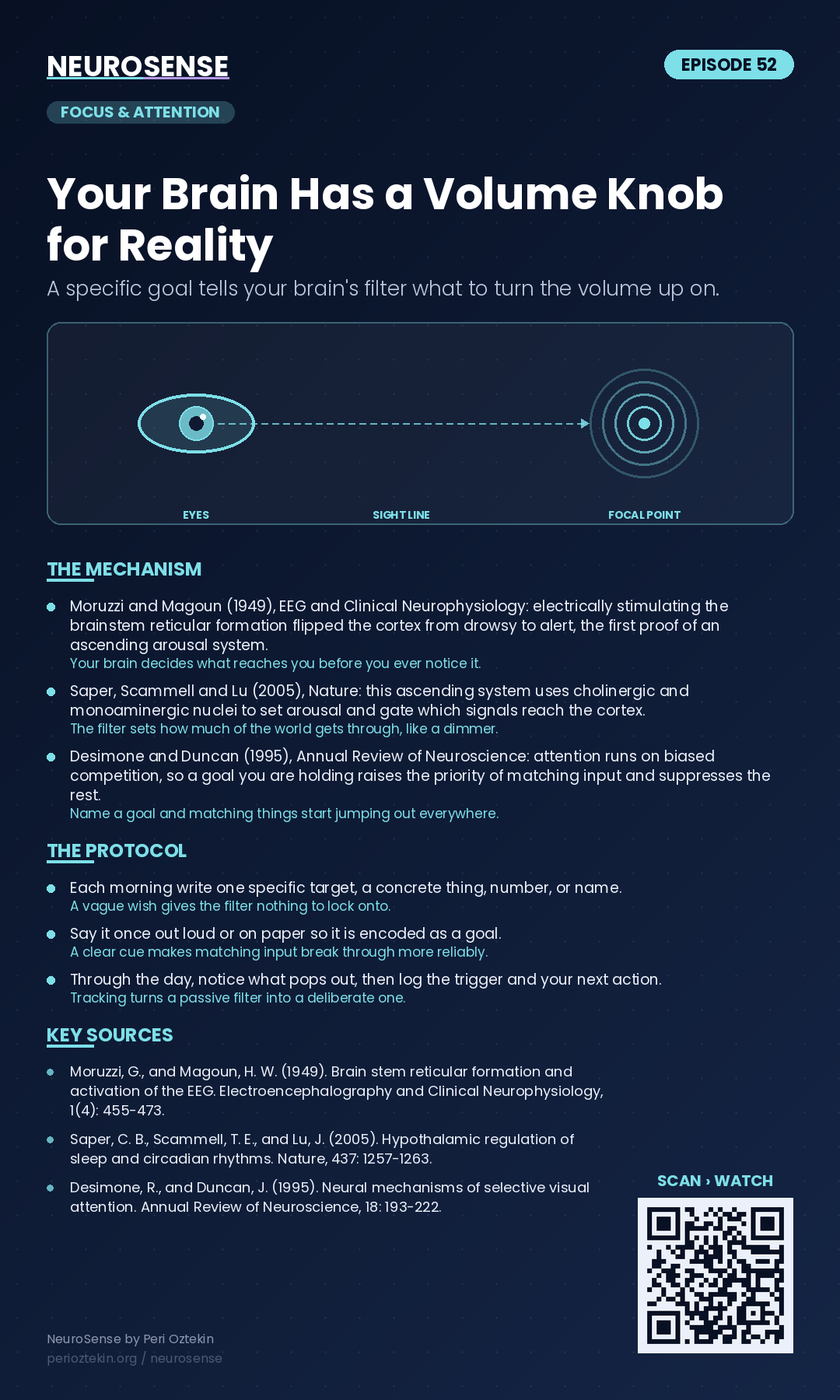
One-page summary
Right-click → Save As to download. Or scan the QR code in the corner to come back here from print.
The science beat (5-sec loop)
Sources
- Moruzzi, G., and Magoun, H. W. (1949). Brain stem reticular formation and activation of the EEG. Electroencephalography and Clinical Neurophysiology, 1(4): 455-473.
- Saper, C. B., Scammell, T. E., and Lu, J. (2005). Hypothalamic regulation of sleep and circadian rhythms. Nature, 437: 1257-1263.
- Desimone, R., and Duncan, J. (1995). Neural mechanisms of selective visual attention. Annual Review of Neuroscience, 18: 193-222.
Educational content only. Not medical advice.
Also on Instagram: @neurosensebrain
← Back to all episodes