← All episodes
Episode 51 · The Social Brain
Loneliness Is A Biological Alarm
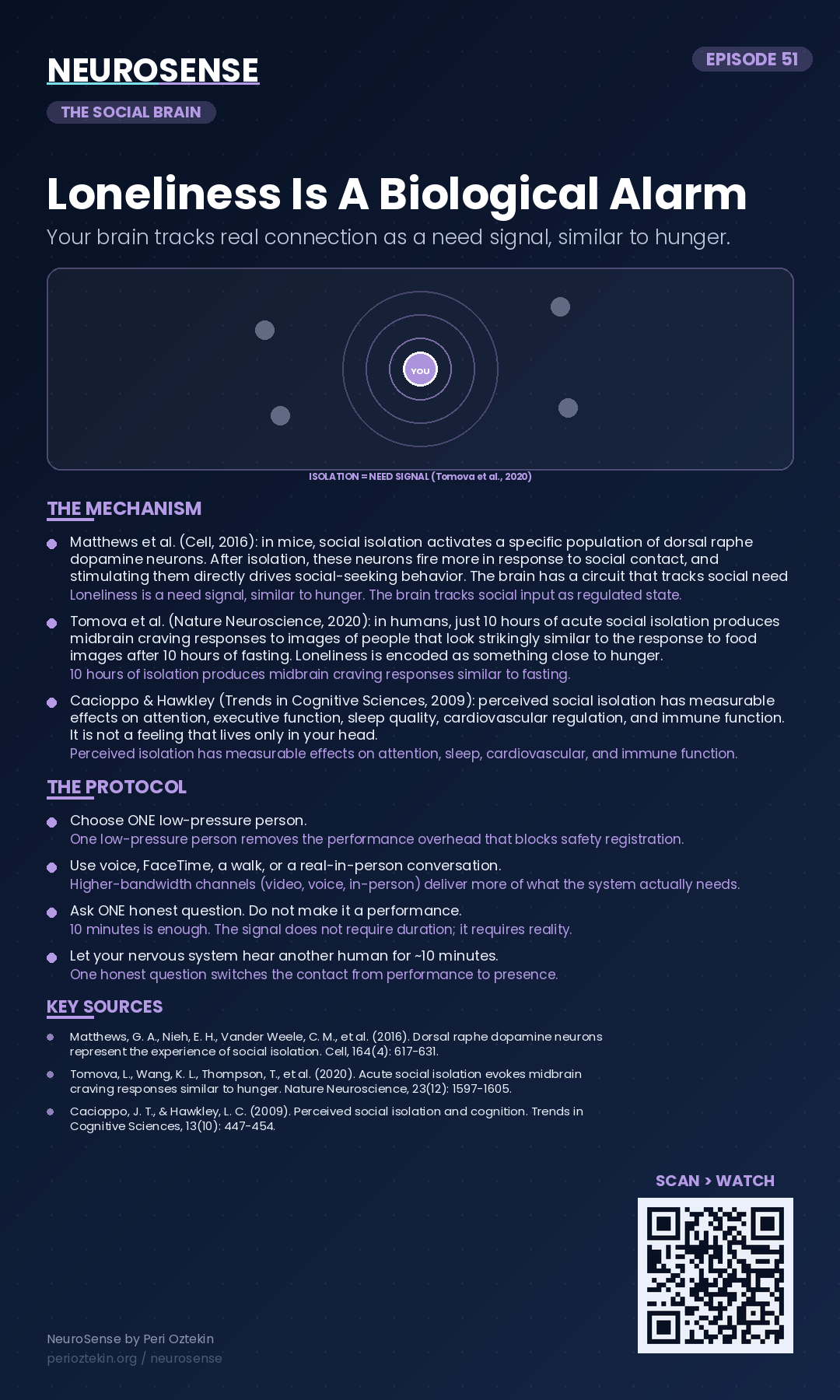
That low-battery lonely feeling is not just a mood. Your brain tracks real connection as a need signal, similar to hunger.
The Science
- Matthews et al. (Cell, 2016): in mice, social isolation activates a specific population of dorsal raphe dopamine neurons. After isolation, these neurons fire more in response to social contact, and stimulating them directly drives social-seeking behavior. The brain has a circuit that tracks social need as a regulated state.
- Tomova et al. (Nature Neuroscience, 2020): in humans, just 10 hours of acute social isolation produces midbrain craving responses to images of people that look strikingly similar to the response to food images after 10 hours of fasting. Loneliness is encoded as something close to hunger.
- Cacioppo & Hawkley (Trends in Cognitive Sciences, 2009): perceived social isolation has measurable effects on attention, executive function, sleep quality, cardiovascular regulation, and immune function. It is not a feeling that lives only in your head.
- Implication: voice, face, movement, and honest conversation feed this system more strongly than silent scrolling. Texting helps; real-channel contact helps more.
The Protocol
- Choose ONE low-pressure person.
- Use voice, FaceTime, a walk, or a real-in-person conversation.
- Ask ONE honest question. Do not make it a performance.
- Let your nervous system hear another human for ~10 minutes.
- Notice the after-effect: does the next task feel slightly less heavy?
One-page summary
Right-click → Save As to download. Or scan the QR code in the corner to come back here from print.
The science beat (5-sec loop)
Sources
- Matthews, G. A., Nieh, E. H., Vander Weele, C. M., et al. (2016). Dorsal raphe dopamine neurons represent the experience of social isolation. Cell, 164(4): 617-631.
- Tomova, L., Wang, K. L., Thompson, T., et al. (2020). Acute social isolation evokes midbrain craving responses similar to hunger. Nature Neuroscience, 23(12): 1597-1605.
- Cacioppo, J. T., & Hawkley, L. C. (2009). Perceived social isolation and cognition. Trends in Cognitive Sciences, 13(10): 447-454.
Educational content only. Not medical advice.
Also on Instagram: @neurosensebrain
← Back to all episodes