← All episodes
Episode 50 · Senses & Perception
Your Body Warns You Before Anxiety Hits
Anxiety rarely appears out of nowhere. Your body usually sends the first warning, and learning to read those signals is a trainable sense.
The Science
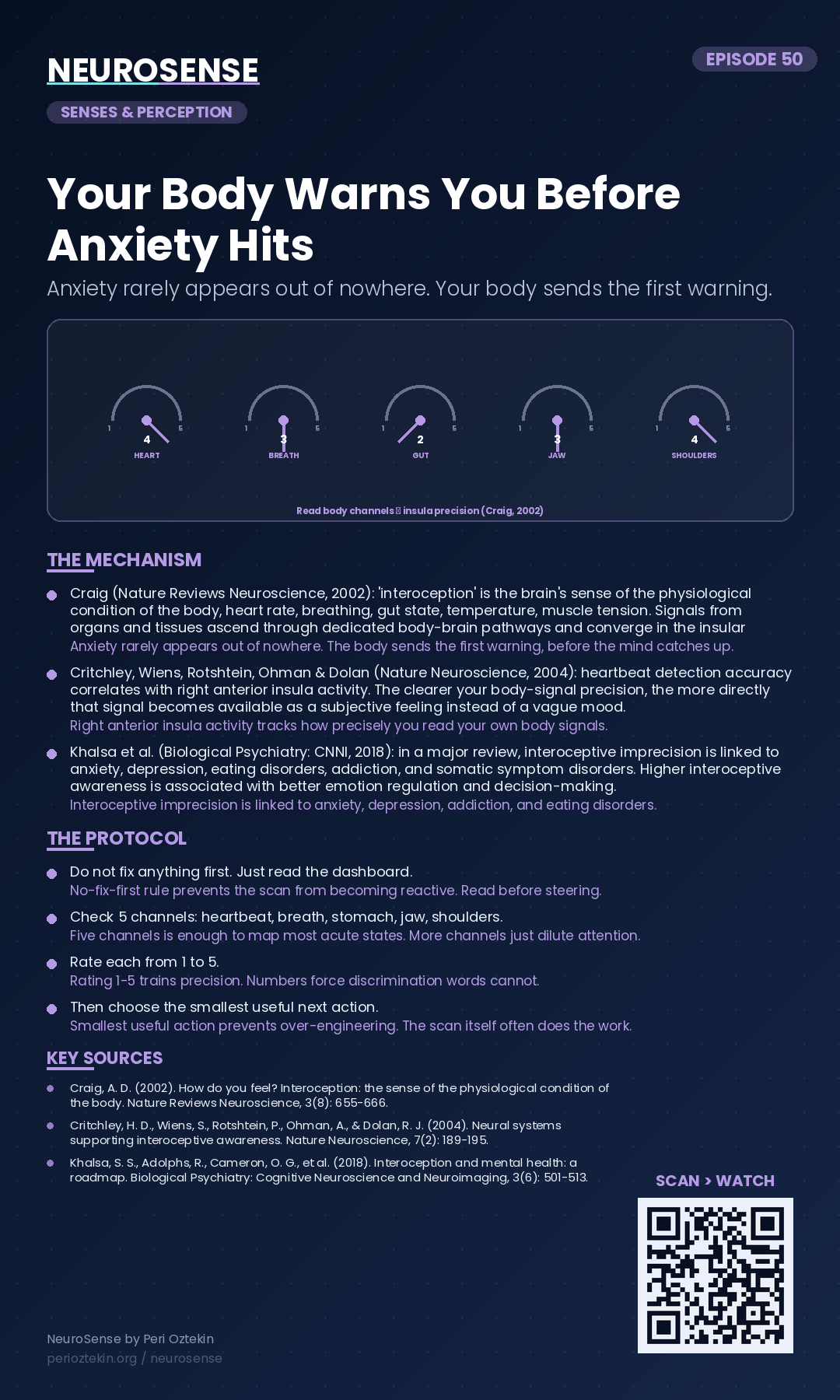
- Craig (Nature Reviews Neuroscience, 2002): 'interoception' is the brain's sense of the physiological condition of the body, heart rate, breathing, gut state, temperature, muscle tension. Signals from organs and tissues ascend through dedicated body-brain pathways and converge in the insular cortex, which builds a living map of your internal state.
- Critchley, Wiens, Rotshtein, Ohman & Dolan (Nature Neuroscience, 2004): heartbeat detection accuracy correlates with right anterior insula activity. The clearer your body-signal precision, the more directly that signal becomes available as a subjective feeling instead of a vague mood.
- Khalsa et al. (Biological Psychiatry: CNNI, 2018): in a major review, interoceptive imprecision is linked to anxiety, depression, eating disorders, addiction, and somatic symptom disorders. Higher interoceptive awareness is associated with better emotion regulation and decision-making.
- Mechanism: the anterior cingulate and salience networks evaluate whether incoming body signals mean danger, effort, anticipation, or a tired nervous system. When the signal is vague, the brain fills in a story. The story can spiral before you noticed the body clue.
The Protocol
- Do not fix anything first. Just read the dashboard.
- Check 5 channels: heartbeat, breath, stomach, jaw, shoulders.
- Rate each from 1 to 5.
- Then choose the smallest useful next action.
- The point is calibration. Precision now means fewer false alarms later.
One-page summary
Right-click → Save As to download. Or scan the QR code in the corner to come back here from print.
The science beat (5-sec loop)
Sources
- Craig, A. D. (2002). How do you feel? Interoception: the sense of the physiological condition of the body. Nature Reviews Neuroscience, 3(8): 655-666.
- Critchley, H. D., Wiens, S., Rotshtein, P., Ohman, A., & Dolan, R. J. (2004). Neural systems supporting interoceptive awareness. Nature Neuroscience, 7(2): 189-195.
- Khalsa, S. S., Adolphs, R., Cameron, O. G., et al. (2018). Interoception and mental health: a roadmap. Biological Psychiatry: Cognitive Neuroscience and Neuroimaging, 3(6): 501-513.
Educational content only. Not medical advice.
Also on Instagram: @neurosensebrain
← Back to all episodes