← All episodes
Episode 49 · Focus & Attention
Why Smart Brains Still Get Stuck
Stuck is not always a lack of intelligence. It often means an old rule is still dominating. Cognitive flexibility is the executive function that helps your brain hold the goal, inhibit the old frame, and test a new angle.
The Science
- Diamond (Annual Review of Psychology, 2013): cognitive flexibility is one of three core executive functions, alongside inhibition and working memory. It is the ability to shift between rules, perspectives, or task demands when conditions change.
- Miyake et al. (Cognitive Psychology, 2000): the foundational 'unity and diversity' framework showed that shifting (rule/set switching) is statistically separable from inhibition and updating. It is a distinct cognitive skill, not just a side effect of general intelligence.
- Dajani & Uddin (Trends in Neurosciences, 2015): cognitive flexibility depends on coordinated activity in the lateral prefrontal cortex, the frontoparietal control network, and the cingulo-opercular network. Generating alternative framings recruits these systems and forces the brain to loosen a single dominant interpretation.
- Important distinction: flexibility is not multitasking. Multitasking splits attention. Flexibility holds one goal and changes the strategy used to reach it.
The Protocol
- Name the stuck problem.
- Set a 2-minute timer.
- Generate THREE intentionally wrong, sideways, or ridiculous approaches.
- Try role prompts: backward thinker, coach, game designer.
- Return to the real problem and choose one useful angle from the search.
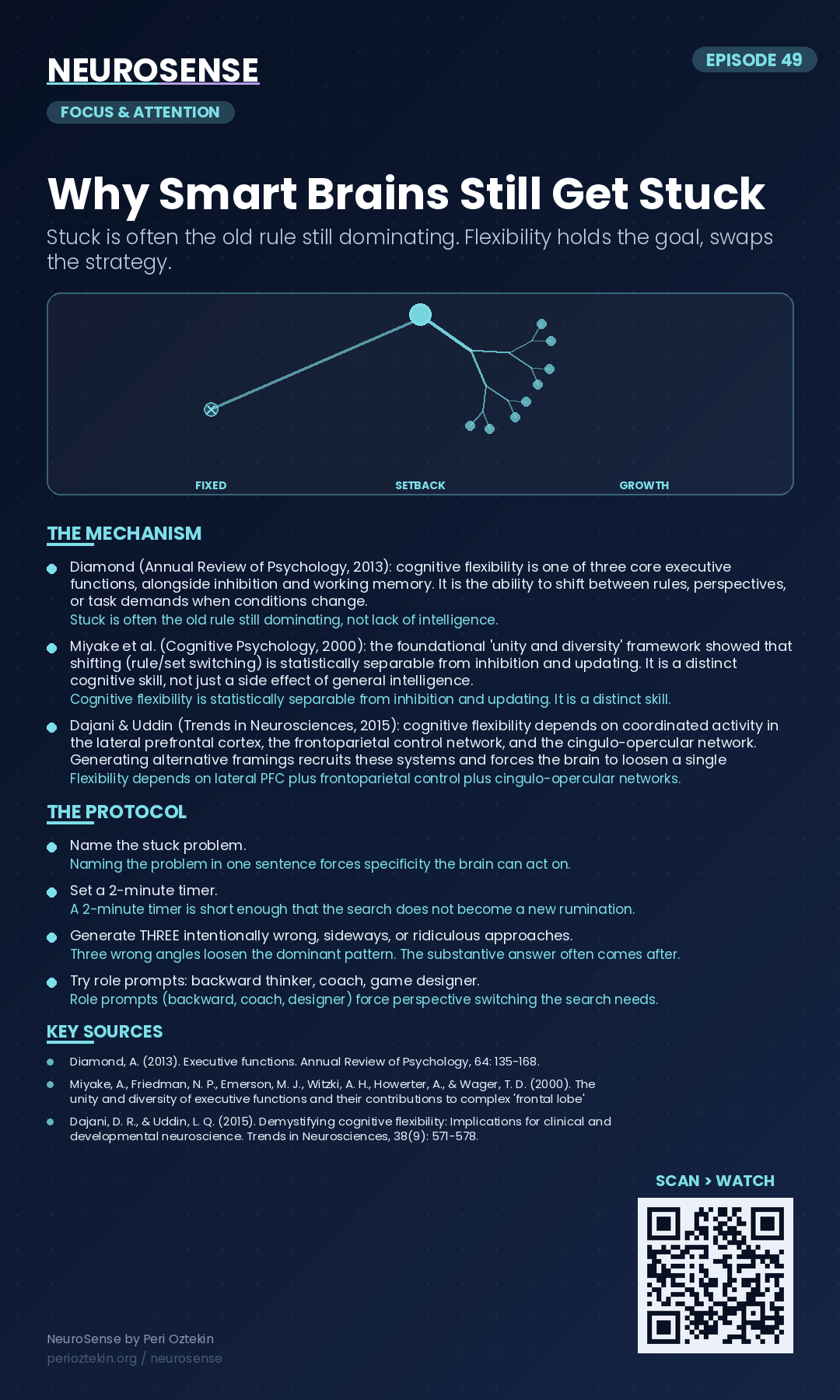
One-page summary
Right-click → Save As to download. Or scan the QR code in the corner to come back here from print.
The science beat (5-sec loop)
Sources
- Diamond, A. (2013). Executive functions. Annual Review of Psychology, 64: 135-168.
- Miyake, A., Friedman, N. P., Emerson, M. J., Witzki, A. H., Howerter, A., & Wager, T. D. (2000). The unity and diversity of executive functions and their contributions to complex 'frontal lobe' tasks: a latent variable analysis. Cognitive Psychology, 41(1): 49-100.
- Dajani, D. R., & Uddin, L. Q. (2015). Demystifying cognitive flexibility: Implications for clinical and developmental neuroscience. Trends in Neurosciences, 38(9): 571-578.
Educational content only. Not medical advice.
Also on Instagram: @neurosensebrain
← Back to all episodes