← All episodes
Episode 48 · Learning & Memory
Why Bad Habits Snap Back
Knowing the better move and still doing the old one is not proof you failed. The old pathway is still easy for your brain to run, and weakening it is a separate process from building the new one.
The Science
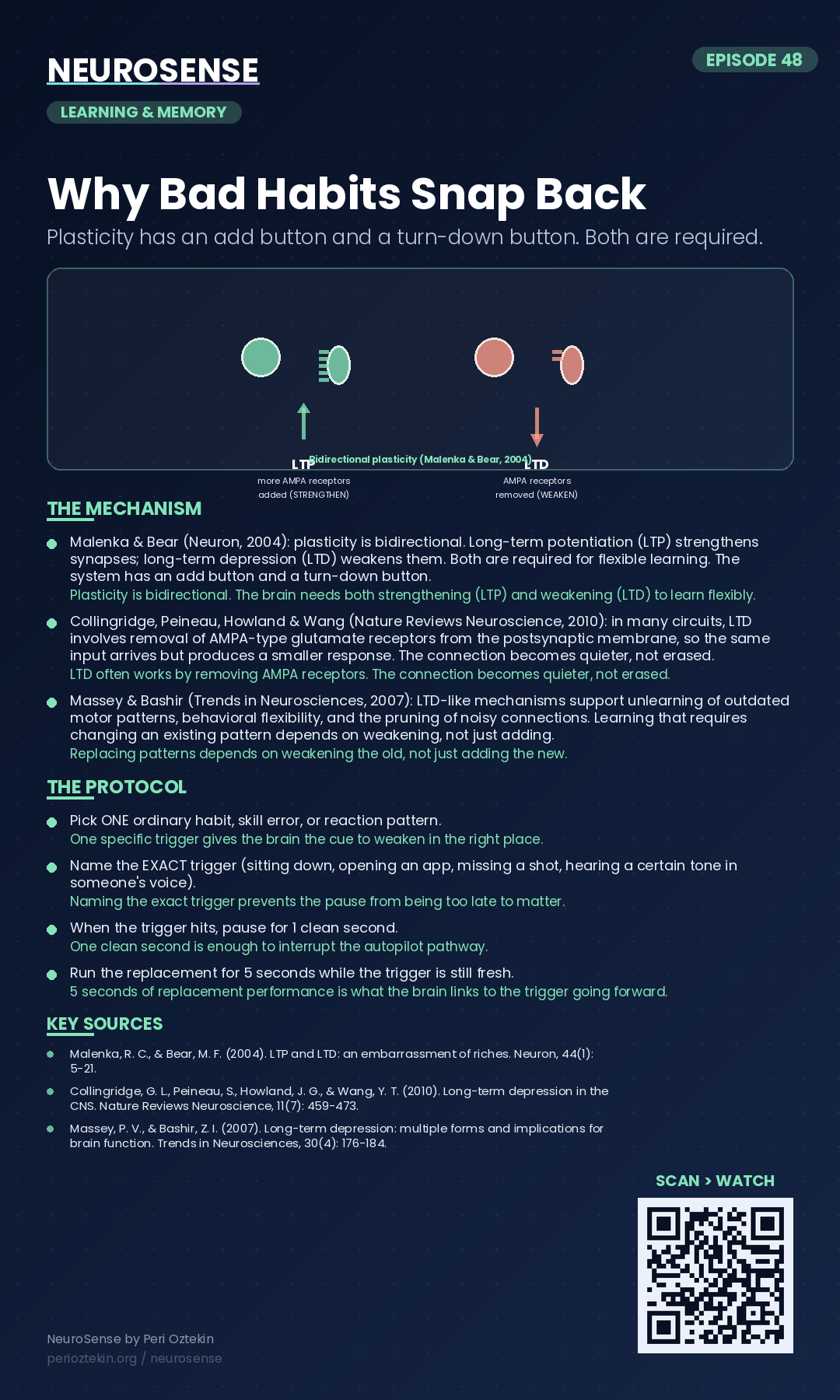
- Malenka & Bear (Neuron, 2004): plasticity is bidirectional. Long-term potentiation (LTP) strengthens synapses; long-term depression (LTD) weakens them. Both are required for flexible learning. The system has an add button and a turn-down button.
- Collingridge, Peineau, Howland & Wang (Nature Reviews Neuroscience, 2010): in many circuits, LTD involves removal of AMPA-type glutamate receptors from the postsynaptic membrane, so the same input arrives but produces a smaller response. The connection becomes quieter, not erased.
- Massey & Bashir (Trends in Neurosciences, 2007): LTD-like mechanisms support unlearning of outdated motor patterns, behavioral flexibility, and the pruning of noisy connections. Learning that requires changing an existing pattern depends on weakening, not just adding.
- Implication: replacement learning works best when the trigger is noticed, the old response is interrupted, and the new response is performed in the same context, repeatedly.
The Protocol
- Pick ONE ordinary habit, skill error, or reaction pattern.
- Name the EXACT trigger (sitting down, opening an app, missing a shot, hearing a certain tone in someone's voice).
- When the trigger hits, pause for 1 clean second.
- Run the replacement for 5 seconds while the trigger is still fresh.
- Repeat in the same context so the old path weakens and the new path strengthens.
One-page summary
Right-click → Save As to download. Or scan the QR code in the corner to come back here from print.
The science beat (5-sec loop)
Sources
- Malenka, R. C., & Bear, M. F. (2004). LTP and LTD: an embarrassment of riches. Neuron, 44(1): 5-21.
- Collingridge, G. L., Peineau, S., Howland, J. G., & Wang, Y. T. (2010). Long-term depression in the CNS. Nature Reviews Neuroscience, 11(7): 459-473.
- Massey, P. V., & Bashir, Z. I. (2007). Long-term depression: multiple forms and implications for brain function. Trends in Neurosciences, 30(4): 176-184.
Educational content only. Not medical advice.
Also on Instagram: @neurosensebrain
← Back to all episodes