← All episodes
Episode 47 · Senses & Perception
The Balance Reset Your Brain Understands
Fog after long sitting is not always weak willpower. Your vestibular system tells your brain where your head, eyes, body, and gravity are, and a small reset can give that system fresh data.
The Science
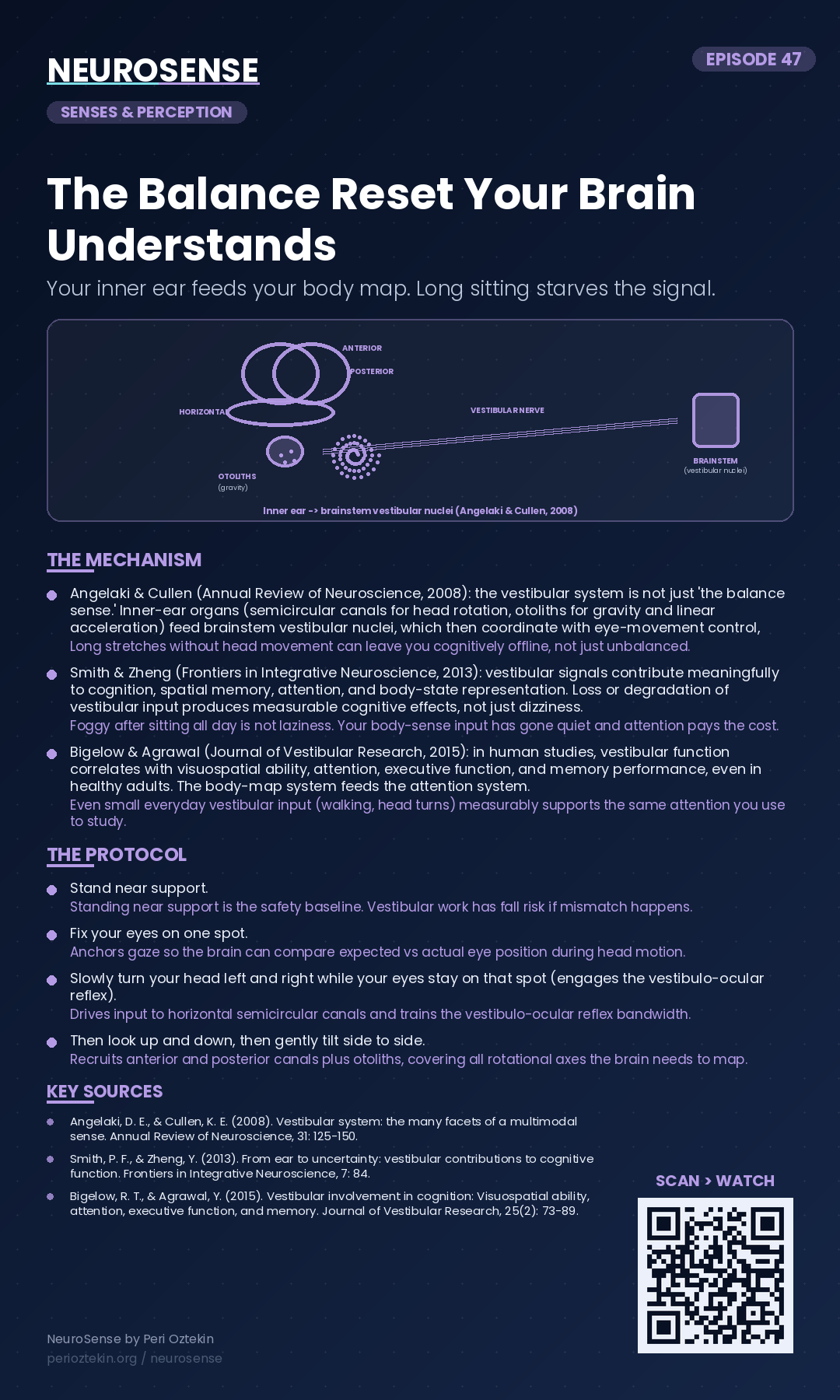
- Angelaki & Cullen (Annual Review of Neuroscience, 2008): the vestibular system is not just 'the balance sense.' Inner-ear organs (semicircular canals for head rotation, otoliths for gravity and linear acceleration) feed brainstem vestibular nuclei, which then coordinate with eye-movement control, posture, the cerebellum, and broader spatial-orientation networks. It is a foundational input to many systems.
- Smith & Zheng (Frontiers in Integrative Neuroscience, 2013): vestibular signals contribute meaningfully to cognition, spatial memory, attention, and body-state representation. Loss or degradation of vestibular input produces measurable cognitive effects, not just dizziness.
- Bigelow & Agrawal (Journal of Vestibular Research, 2015): in human studies, vestibular function correlates with visuospatial ability, attention, executive function, and memory performance, even in healthy adults. The body-map system feeds the attention system.
- Implication: long sitting and screen tunnel starve the vestibular system of fresh input. A controlled reset gives the brain real gravity and motion data again.
The Protocol
- Stand near support.
- Fix your eyes on one spot.
- Slowly turn your head left and right while your eyes stay on that spot (engages the vestibulo-ocular reflex).
- Then look up and down, then gently tilt side to side.
- Add ONE safe balance rep only if your body is ready (single-leg near a wall, slow pivot, light bounce).
- Stop if dizzy. This is calibration, not punishment.
One-page summary
Right-click → Save As to download. Or scan the QR code in the corner to come back here from print.
The science beat (5-sec loop)
Sources
- Angelaki, D. E., & Cullen, K. E. (2008). Vestibular system: the many facets of a multimodal sense. Annual Review of Neuroscience, 31: 125-150.
- Smith, P. F., & Zheng, Y. (2013). From ear to uncertainty: vestibular contributions to cognitive function. Frontiers in Integrative Neuroscience, 7: 84.
- Bigelow, R. T., & Agrawal, Y. (2015). Vestibular involvement in cognition: Visuospatial ability, attention, executive function, and memory. Journal of Vestibular Research, 25(2): 73-89.
Educational content only. Not medical advice.
Also on Instagram: @neurosensebrain
← Back to all episodes