← All episodes
Episode 46 · Stress & Emotion
The Word Swap That Changes Your Stress Response
Your body can feel activated before something hard. The words you choose help your brain decide whether that activation means danger or readiness.
The Science
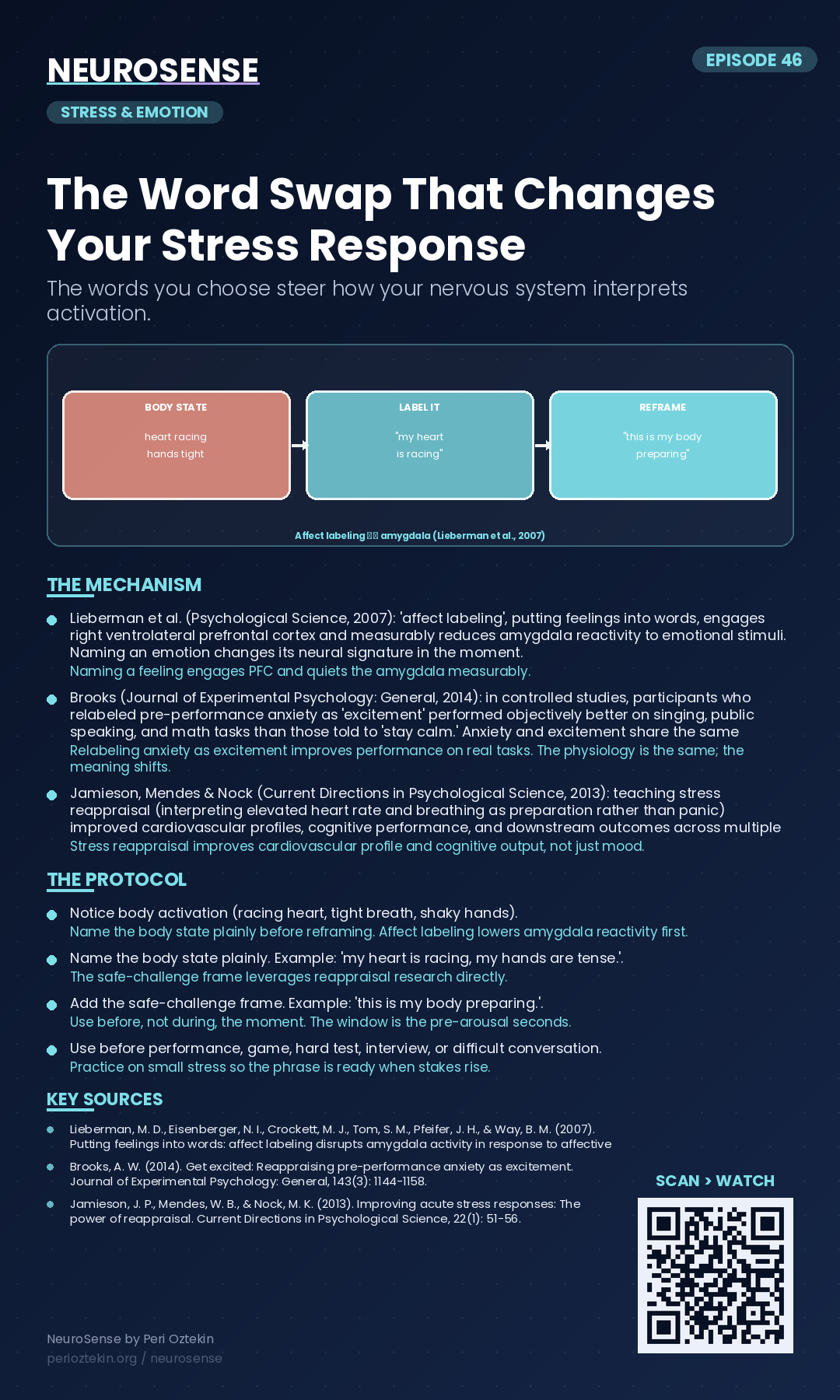
- Lieberman et al. (Psychological Science, 2007): 'affect labeling', putting feelings into words, engages right ventrolateral prefrontal cortex and measurably reduces amygdala reactivity to emotional stimuli. Naming an emotion changes its neural signature in the moment.
- Brooks (Journal of Experimental Psychology: General, 2014): in controlled studies, participants who relabeled pre-performance anxiety as 'excitement' performed objectively better on singing, public speaking, and math tasks than those told to 'stay calm.' Anxiety and excitement share the same arousal physiology; the brain treats them differently based on the label.
- Jamieson, Mendes & Nock (Current Directions in Psychological Science, 2013): teaching stress reappraisal (interpreting elevated heart rate and breathing as preparation rather than panic) improved cardiovascular profiles, cognitive performance, and downstream outcomes across multiple studies.
- Implication: language is not magic over biology, but it does steer the interpretation your nervous system applies to the signal it is already sending.
The Protocol
- Notice body activation (racing heart, tight breath, shaky hands).
- Name the body state plainly. Example: 'my heart is racing, my hands are tense.'
- Add the safe-challenge frame. Example: 'this is my body preparing.'
- Use before performance, game, hard test, interview, or difficult conversation.
- Practice on small stress first so the phrase is ready when stakes rise.
One-page summary
Right-click → Save As to download. Or scan the QR code in the corner to come back here from print.
The science beat (5-sec loop)
Sources
- Lieberman, M. D., Eisenberger, N. I., Crockett, M. J., Tom, S. M., Pfeifer, J. H., & Way, B. M. (2007). Putting feelings into words: affect labeling disrupts amygdala activity in response to affective stimuli. Psychological Science, 18(5): 421-428.
- Brooks, A. W. (2014). Get excited: Reappraising pre-performance anxiety as excitement. Journal of Experimental Psychology: General, 143(3): 1144-1158.
- Jamieson, J. P., Mendes, W. B., & Nock, M. K. (2013). Improving acute stress responses: The power of reappraisal. Current Directions in Psychological Science, 22(1): 51-56.
Educational content only. Not medical advice.
Also on Instagram: @neurosensebrain
← Back to all episodes