← All episodes
Episode 45 · Learning & Memory
How Movement Primes Your Brain To Learn Faster
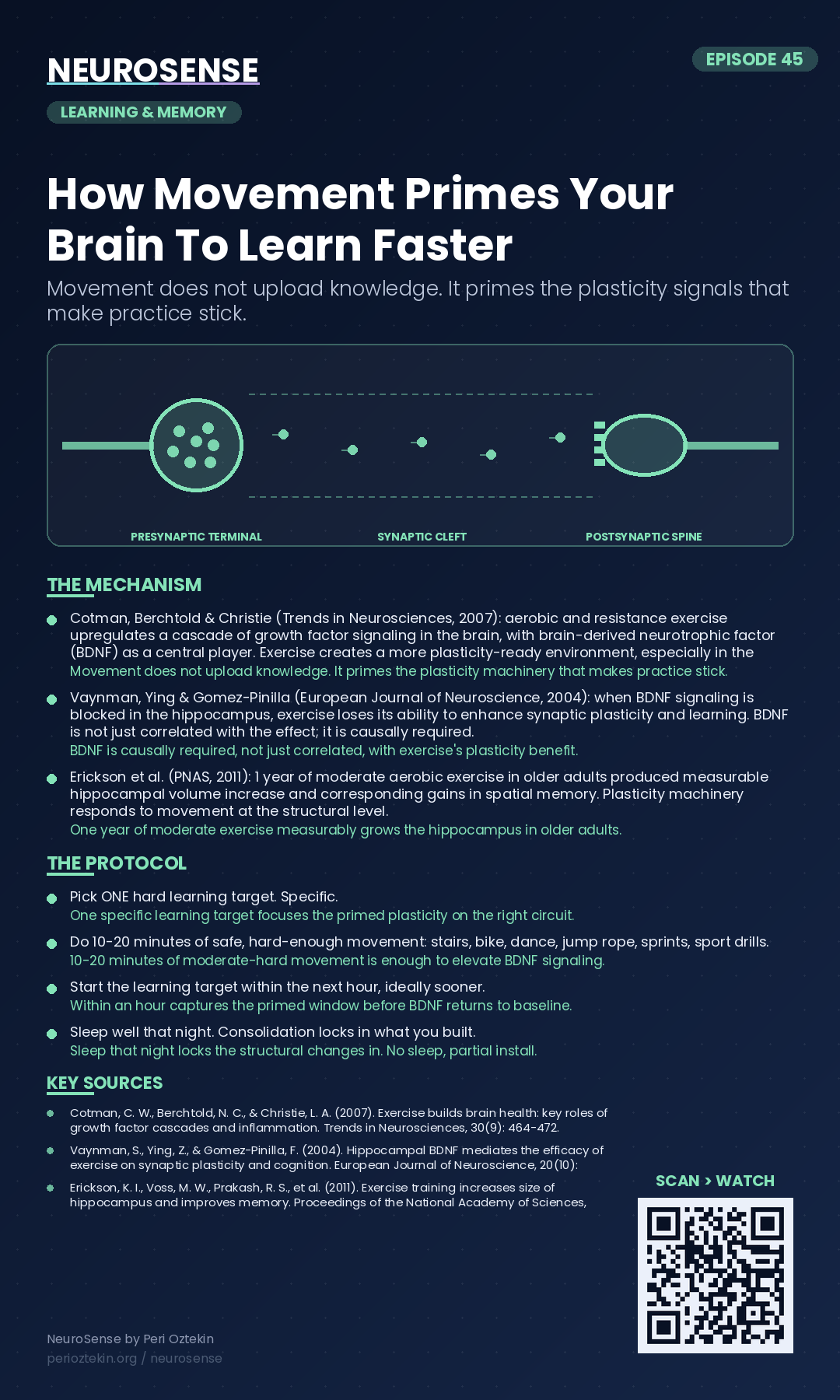
Movement does not upload knowledge into your brain. It primes the plasticity signals that help hard practice stick.
The Science
- Cotman, Berchtold & Christie (Trends in Neurosciences, 2007): aerobic and resistance exercise upregulates a cascade of growth factor signaling in the brain, with brain-derived neurotrophic factor (BDNF) as a central player. Exercise creates a more plasticity-ready environment, especially in the hippocampus.
- Vaynman, Ying & Gomez-Pinilla (European Journal of Neuroscience, 2004): when BDNF signaling is blocked in the hippocampus, exercise loses its ability to enhance synaptic plasticity and learning. BDNF is not just correlated with the effect; it is causally required.
- Erickson et al. (PNAS, 2011): 1 year of moderate aerobic exercise in older adults produced measurable hippocampal volume increase and corresponding gains in spatial memory. Plasticity machinery responds to movement at the structural level.
- Mechanism: late-phase long-term potentiation requires new protein synthesis, including BDNF and structural remodeling at dendritic spines. Practice sends the signal; BDNF helps the change stabilize.
The Protocol
- Pick ONE hard learning target. Specific.
- Do 10-20 minutes of safe, hard-enough movement: stairs, bike, dance, jump rope, sprints, sport drills.
- Start the learning target within the next hour, ideally sooner.
- Sleep well that night. Consolidation locks in what you built.
- Effort level: breathe harder, not punishment.
One-page summary
Right-click → Save As to download. Or scan the QR code in the corner to come back here from print.
The science beat (5-sec loop)
Sources
- Cotman, C. W., Berchtold, N. C., & Christie, L. A. (2007). Exercise builds brain health: key roles of growth factor cascades and inflammation. Trends in Neurosciences, 30(9): 464-472.
- Vaynman, S., Ying, Z., & Gomez-Pinilla, F. (2004). Hippocampal BDNF mediates the efficacy of exercise on synaptic plasticity and cognition. European Journal of Neuroscience, 20(10): 2580-2590.
- Erickson, K. I., Voss, M. W., Prakash, R. S., et al. (2011). Exercise training increases size of hippocampus and improves memory. Proceedings of the National Academy of Sciences, 108(7): 3017-3022.
Educational content only. Not medical advice.
Also on Instagram: @neurosensebrain
← Back to all episodes