← All episodes
Episode 44 · How the Brain Works
The Brain Gate That Decides What You Notice
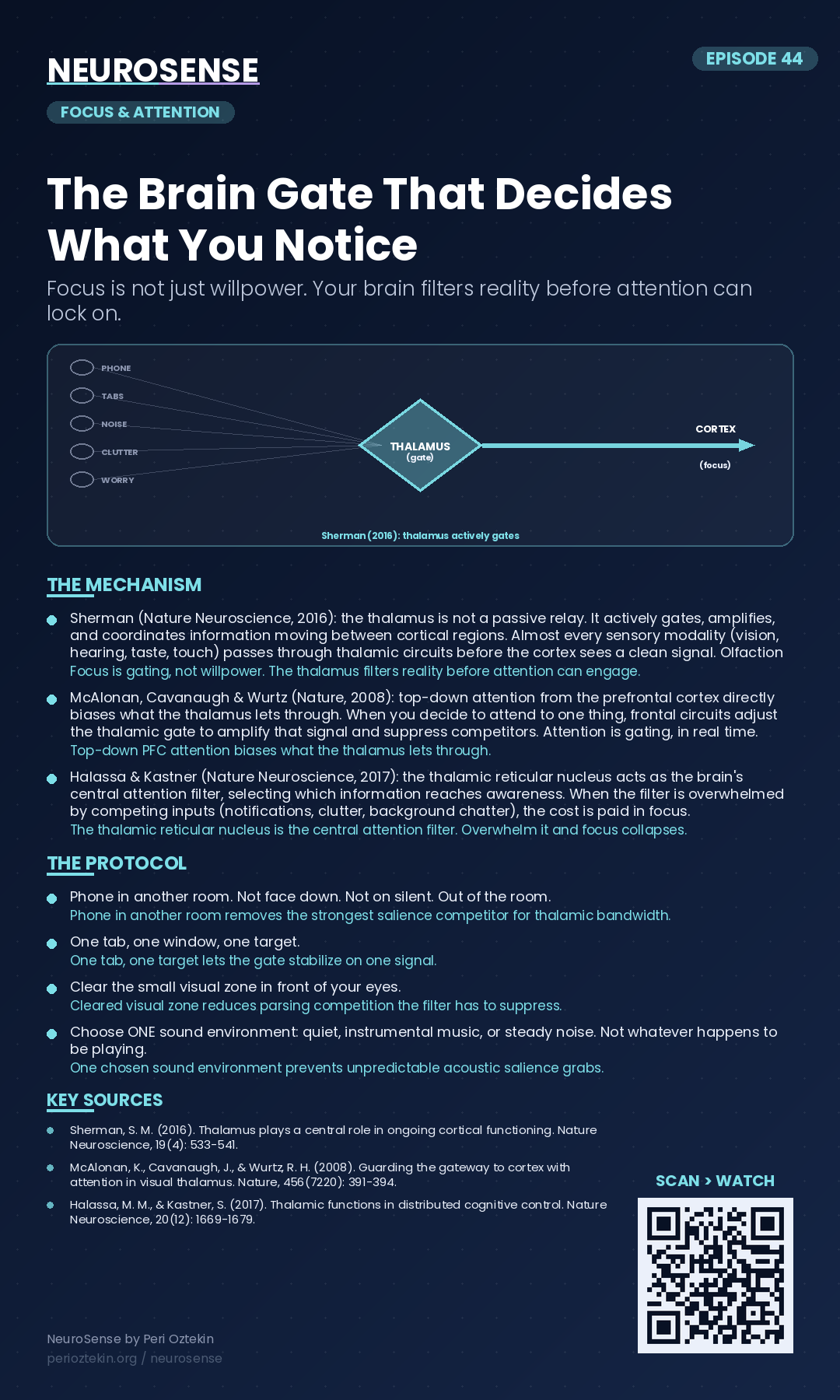
Focus is not just willpower. Your brain has to filter reality before attention can lock onto anything, and one structure does most of the filtering.
The Science
- Sherman (Nature Neuroscience, 2016): the thalamus is not a passive relay. It actively gates, amplifies, and coordinates information moving between cortical regions. Almost every sensory modality (vision, hearing, taste, touch) passes through thalamic circuits before the cortex sees a clean signal. Olfaction is the famous partial exception, which is why smells can yank up memories so fast.
- McAlonan, Cavanaugh & Wurtz (Nature, 2008): top-down attention from the prefrontal cortex directly biases what the thalamus lets through. When you decide to attend to one thing, frontal circuits adjust the thalamic gate to amplify that signal and suppress competitors. Attention is gating, in real time.
- Halassa & Kastner (Nature Neuroscience, 2017): the thalamic reticular nucleus acts as the brain's central attention filter, selecting which information reaches awareness. When the filter is overwhelmed by competing inputs (notifications, clutter, background chatter), the cost is paid in focus.
The Protocol
- Phone in another room. Not face down. Not on silent. Out of the room.
- One tab, one window, one target.
- Clear the small visual zone in front of your eyes.
- Choose ONE sound environment: quiet, instrumental music, or steady noise. Not whatever happens to be playing.
- Then start for 5 minutes and let the gate lock onto the target signal.
One-page summary
Right-click → Save As to download. Or scan the QR code in the corner to come back here from print.
The science beat (5-sec loop)
Sources
- Sherman, S. M. (2016). Thalamus plays a central role in ongoing cortical functioning. Nature Neuroscience, 19(4): 533-541.
- McAlonan, K., Cavanaugh, J., & Wurtz, R. H. (2008). Guarding the gateway to cortex with attention in visual thalamus. Nature, 456(7220): 391-394.
- Halassa, M. M., & Kastner, S. (2017). Thalamic functions in distributed cognitive control. Nature Neuroscience, 20(12): 1669-1679.
Educational content only. Not medical advice.
Also on Instagram: @neurosensebrain
← Back to all episodes