← All episodes
Episode 43 · The Social Brain
Why Real Friends Hit Different Than Group Chats
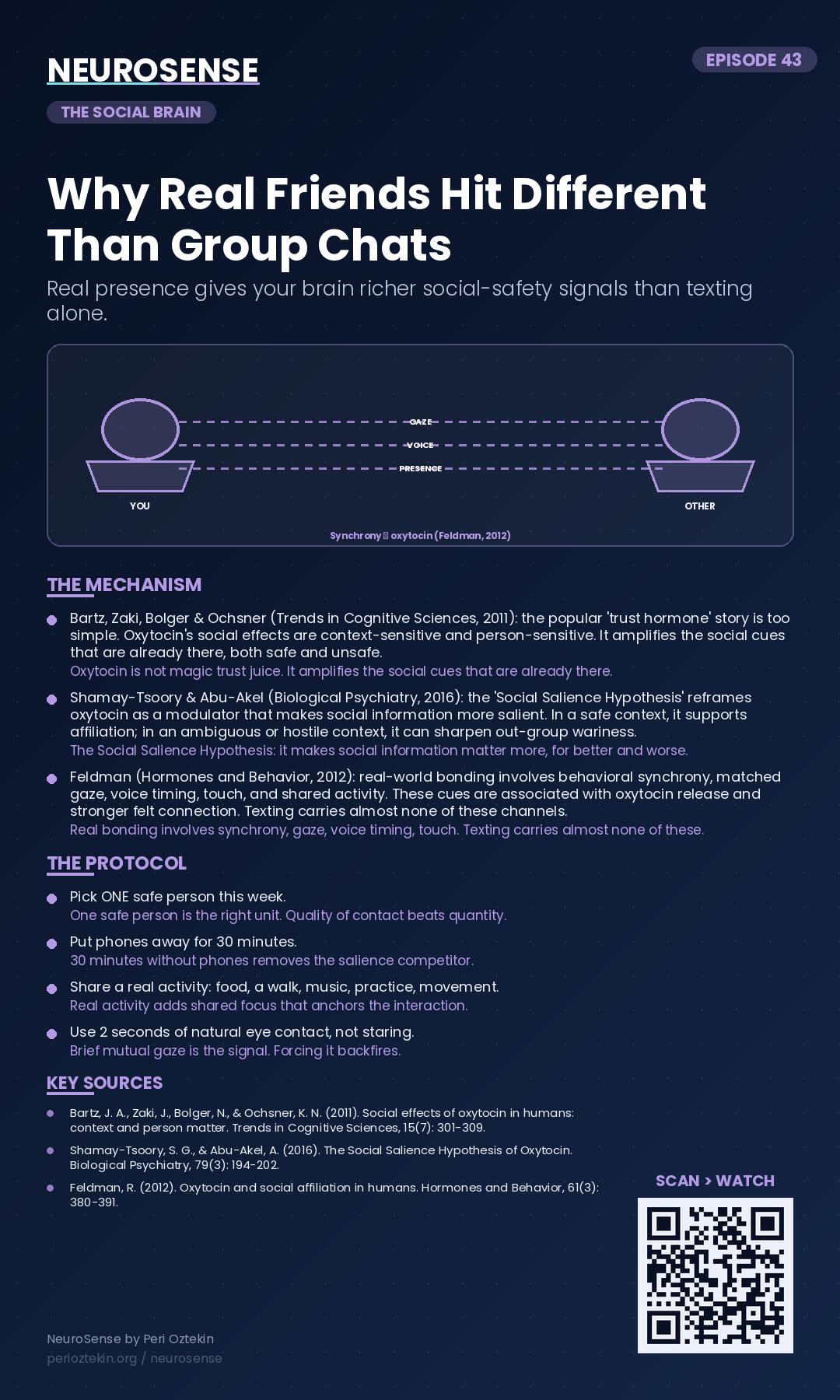
A group chat can keep you connected. Real presence gives your brain richer social-safety signals, and the difference is measurable.
The Science
- Bartz, Zaki, Bolger & Ochsner (Trends in Cognitive Sciences, 2011): the popular 'trust hormone' story is too simple. Oxytocin's social effects are context-sensitive and person-sensitive. It amplifies the social cues that are already there, both safe and unsafe.
- Shamay-Tsoory & Abu-Akel (Biological Psychiatry, 2016): the 'Social Salience Hypothesis' reframes oxytocin as a modulator that makes social information more salient. In a safe context, it supports affiliation; in an ambiguous or hostile context, it can sharpen out-group wariness.
- Feldman (Hormones and Behavior, 2012): real-world bonding involves behavioral synchrony, matched gaze, voice timing, touch, and shared activity. These cues are associated with oxytocin release and stronger felt connection. Texting carries almost none of these channels.
- Implication: in-person time with one safe person gives the social brain inputs that a screen literally cannot reproduce.
The Protocol
- Pick ONE safe person this week.
- Put phones away for 30 minutes.
- Share a real activity: food, a walk, music, practice, movement.
- Use 2 seconds of natural eye contact, not staring.
- Use touch only if it feels welcome and natural (a fist bump, handshake, hug at greeting).
- The point is not forced closeness; it is giving your social brain repeated safe cues over time.
One-page summary
Right-click → Save As to download. Or scan the QR code in the corner to come back here from print.
The science beat (5-sec loop)
Sources
- Bartz, J. A., Zaki, J., Bolger, N., & Ochsner, K. N. (2011). Social effects of oxytocin in humans: context and person matter. Trends in Cognitive Sciences, 15(7): 301-309.
- Shamay-Tsoory, S. G., & Abu-Akel, A. (2016). The Social Salience Hypothesis of Oxytocin. Biological Psychiatry, 79(3): 194-202.
- Feldman, R. (2012). Oxytocin and social affiliation in humans. Hormones and Behavior, 61(3): 380-391.
Educational content only. Not medical advice.
Also on Instagram: @neurosensebrain
← Back to all episodes