← All episodes
Episode 42 · Motivation & Habits
Mood Repair, Not Laziness
You are not lazy when a task feels hard to start. Your brain may be escaping discomfort before your future plan can take over.
The Science
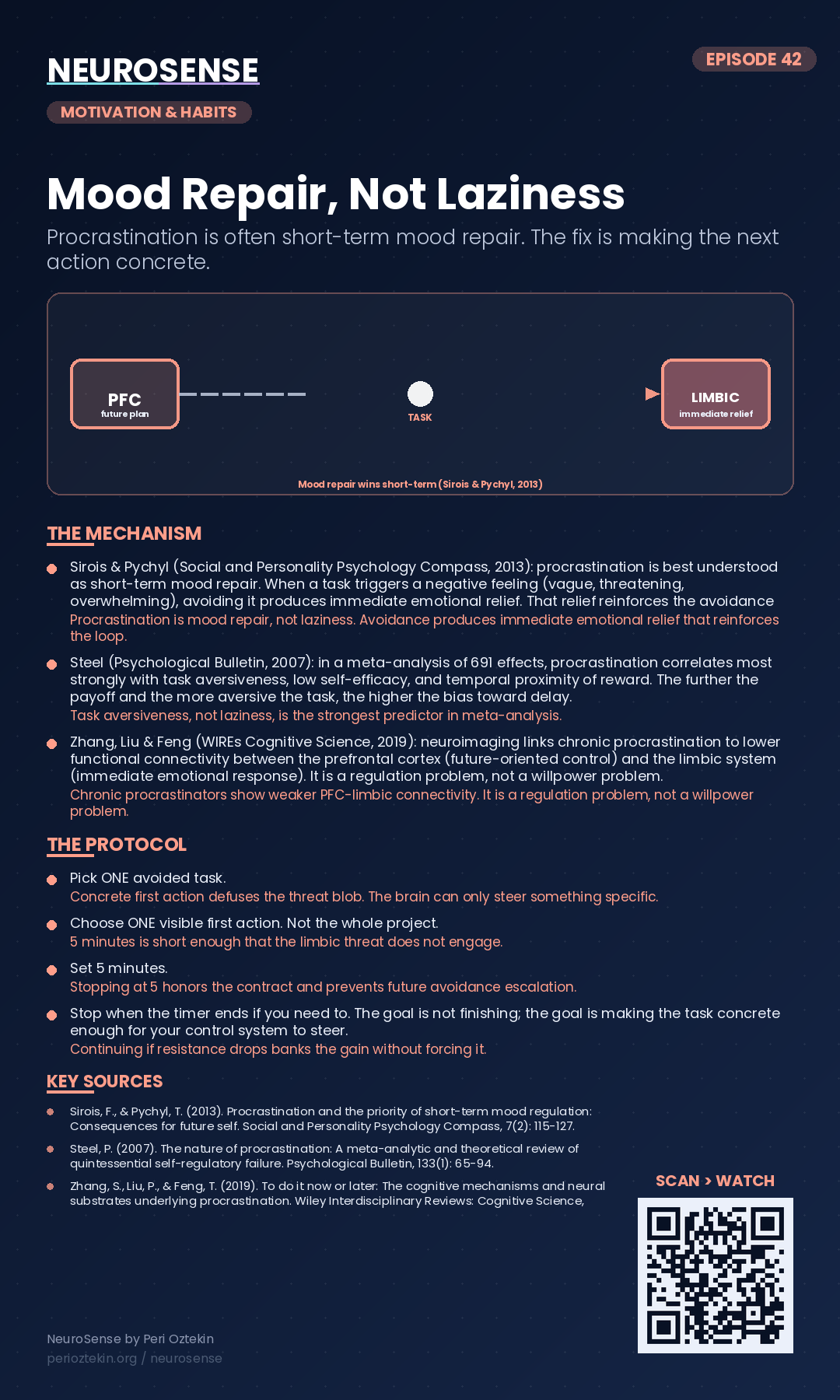
- Sirois & Pychyl (Social and Personality Psychology Compass, 2013): procrastination is best understood as short-term mood repair. When a task triggers a negative feeling (vague, threatening, overwhelming), avoiding it produces immediate emotional relief. That relief reinforces the avoidance loop, even when it costs you long-term.
- Steel (Psychological Bulletin, 2007): in a meta-analysis of 691 effects, procrastination correlates most strongly with task aversiveness, low self-efficacy, and temporal proximity of reward. The further the payoff and the more aversive the task, the higher the bias toward delay.
- Zhang, Liu & Feng (WIREs Cognitive Science, 2019): neuroimaging links chronic procrastination to lower functional connectivity between the prefrontal cortex (future-oriented control) and the limbic system (immediate emotional response). It is a regulation problem, not a willpower problem.
The Protocol
- Pick ONE avoided task.
- Choose ONE visible first action. Not the whole project.
- Set 5 minutes.
- Stop when the timer ends if you need to. The goal is not finishing; the goal is making the task concrete enough for your control system to steer.
- If resistance drops, keep going.
One-page summary
Right-click → Save As to download. Or scan the QR code in the corner to come back here from print.
The science beat (5-sec loop)
Sources
- Sirois, F., & Pychyl, T. (2013). Procrastination and the priority of short-term mood regulation: Consequences for future self. Social and Personality Psychology Compass, 7(2): 115-127.
- Steel, P. (2007). The nature of procrastination: A meta-analytic and theoretical review of quintessential self-regulatory failure. Psychological Bulletin, 133(1): 65-94.
- Zhang, S., Liu, P., & Feng, T. (2019). To do it now or later: The cognitive mechanisms and neural substrates underlying procrastination. Wiley Interdisciplinary Reviews: Cognitive Science, 10(4): e1492.
Educational content only. Not medical advice.
Also on Instagram: @neurosensebrain
← Back to all episodes