← All episodes
Episode 41 · Senses & Perception
The One-Zone Reset Your Brain Can Feel
Aesthetics are not just taste. Your brain reacts to how expensive a scene is to process, and that changes your state before you start the task.
The Science
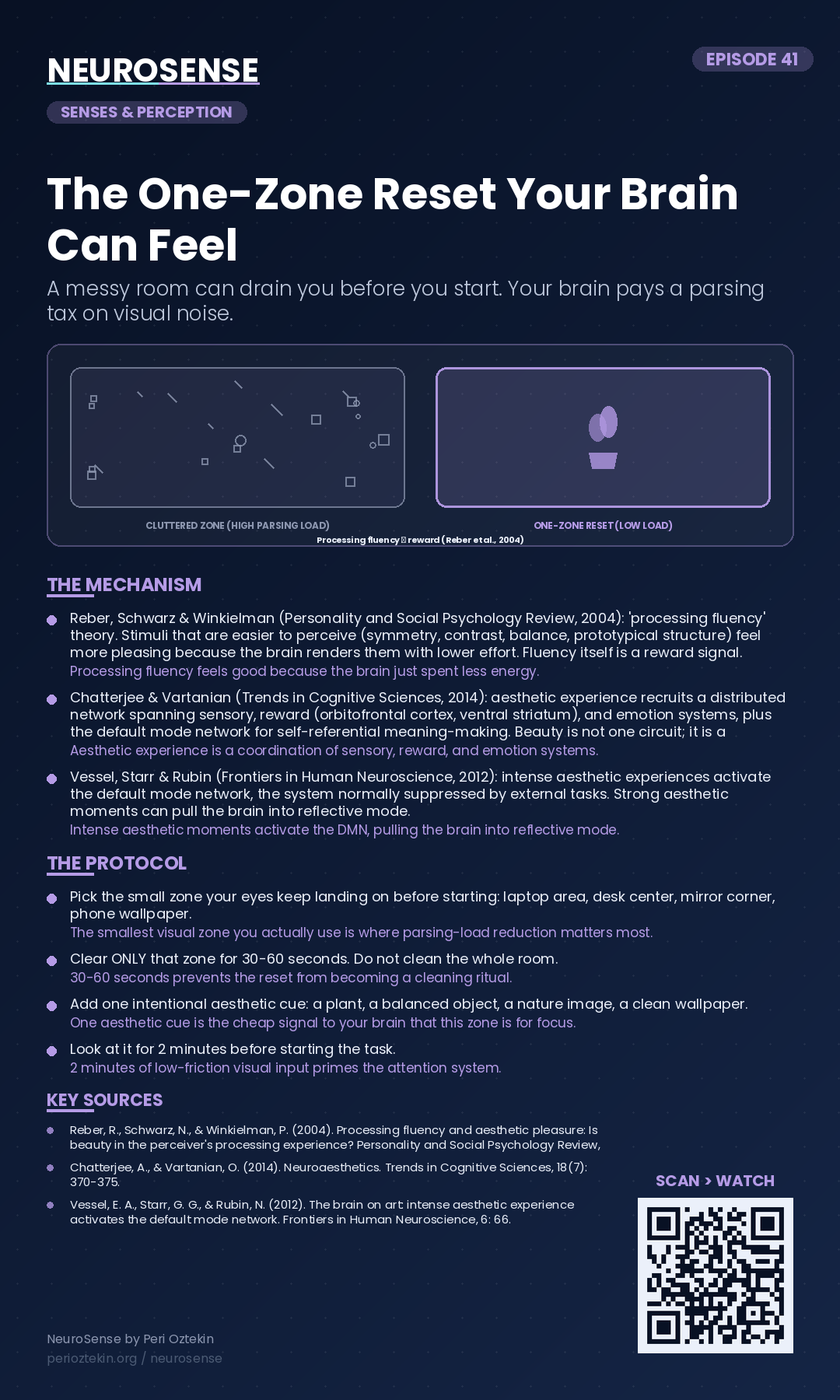
- Reber, Schwarz & Winkielman (Personality and Social Psychology Review, 2004): 'processing fluency' theory. Stimuli that are easier to perceive (symmetry, contrast, balance, prototypical structure) feel more pleasing because the brain renders them with lower effort. Fluency itself is a reward signal.
- Chatterjee & Vartanian (Trends in Cognitive Sciences, 2014): aesthetic experience recruits a distributed network spanning sensory, reward (orbitofrontal cortex, ventral striatum), and emotion systems, plus the default mode network for self-referential meaning-making. Beauty is not one circuit; it is a coordination.
- Vessel, Starr & Rubin (Frontiers in Human Neuroscience, 2012): intense aesthetic experiences activate the default mode network, the system normally suppressed by external tasks. Strong aesthetic moments can pull the brain into reflective mode.
- Visual clutter increases perceptual competition and parsing demand, raising cognitive load before the task itself has started.
The Protocol
- Pick the small zone your eyes keep landing on before starting: laptop area, desk center, mirror corner, phone wallpaper.
- Clear ONLY that zone for 30-60 seconds. Do not clean the whole room.
- Add one intentional aesthetic cue: a plant, a balanced object, a nature image, a clean wallpaper.
- Look at it for 2 minutes before starting the task.
- The point is lower visual parsing load, not perfection.
One-page summary
Right-click → Save As to download. Or scan the QR code in the corner to come back here from print.
The science beat (5-sec loop)
Sources
- Reber, R., Schwarz, N., & Winkielman, P. (2004). Processing fluency and aesthetic pleasure: Is beauty in the perceiver's processing experience? Personality and Social Psychology Review, 8(4): 364-382.
- Chatterjee, A., & Vartanian, O. (2014). Neuroaesthetics. Trends in Cognitive Sciences, 18(7): 370-375.
- Vessel, E. A., Starr, G. G., & Rubin, N. (2012). The brain on art: intense aesthetic experience activates the default mode network. Frontiers in Human Neuroscience, 6: 66.
Educational content only. Not medical advice.
Also on Instagram: @neurosensebrain
← Back to all episodes