← All episodes
Episode 40 · Learning & Memory
Why Play Wires Your Brain Faster
Play is not a break from learning. It is a brain state that gives your nervous system more error signals to train on.
The Science
- Pellis & Pellis (Learning & Behavior, 2017): play fighting in animals increases behavioral flexibility and supports prefrontal cortex development. Play deprivation produces measurable deficits in adaptive social and motor responding.
- Vanderschuren, Achterberg & Trezza (Neuroscience & Biobehavioral Reviews, 2016): social play strongly activates the prefrontal cortex, dopamine reward circuitry, and opioid systems, while modulating the stress response. The neurobiological signature is high arousal plus low threat.
- Bjork & Bjork (2011, Desirable Difficulties): durable learning requires generating attempts, making errors, and encoding corrections. Conditions that maximize attempts without overwhelming the learner produce stronger long-term retention than rote drilling.
- Implication: low-threat exploration produces more attempts and richer error signals, which is the raw material plasticity needs.
The Protocol
- Pick ONE specific skill that usually makes you tense.
- Set 10 minutes. Score attempts only, not correctness.
- Add a silly or weird variation. Bonus points for ridiculous strategies.
- Do it with a friend if you can. Social context further lowers the threat signal.
- Then return to serious practice. The nervous system enters that next session looser and more exploratory.
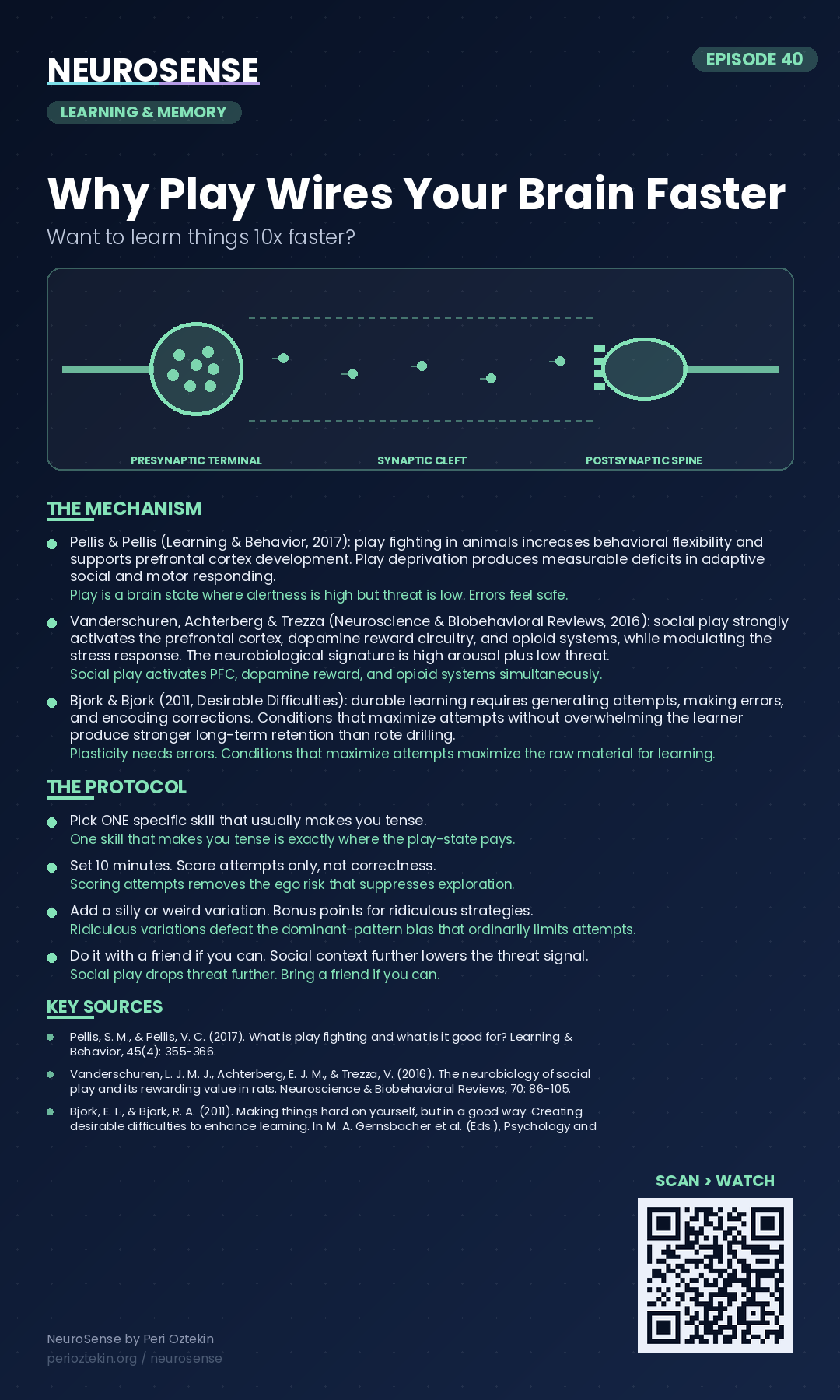
One-page summary
Right-click → Save As to download. Or scan the QR code in the corner to come back here from print.
The science beat (5-sec loop)
Sources
- Pellis, S. M., & Pellis, V. C. (2017). What is play fighting and what is it good for? Learning & Behavior, 45(4): 355-366.
- Vanderschuren, L. J. M. J., Achterberg, E. J. M., & Trezza, V. (2016). The neurobiology of social play and its rewarding value in rats. Neuroscience & Biobehavioral Reviews, 70: 86-105.
- Bjork, E. L., & Bjork, R. A. (2011). Making things hard on yourself, but in a good way: Creating desirable difficulties to enhance learning. In M. A. Gernsbacher et al. (Eds.), Psychology and the real world (pp. 56-64).
Educational content only. Not medical advice.
Also on Instagram: @neurosensebrain
← Back to all episodes