← All episodes
Episode 38 · Sleep, Recovery & the Body
Why Eating Boring Food Might Be Making You Anxious
The link between your gut microbes and your anxiety is direct, measurable, and largely controlled by what you put on your plate.
The Science
- Cryan & Dinan (Nature Reviews Neuroscience, 2012): the gut microbiota communicates with the brain via the vagus nerve, immune signaling, and microbial metabolites. The pathway is bidirectional and modulates mood, anxiety, and cognition.
- Foster & McVey Neufeld (Trends in Neurosciences, 2013): low microbiome diversity is associated with elevated anxiety and depressive symptoms in human studies, and germ-free animal models show clear behavioral and HPA-axis alterations.
- Yatsunenko et al. (Nature, 2012): microbiome composition is shaped substantially by diet, narrow diets produce narrow strain populations; diverse plant intake produces diverse, resilient microbial ecosystems.
The Protocol
- Aim for 30 different plant foods per week. Each distinct plant counts ONCE.
- Examples that count: apple, almonds, paprika, oats, kale, blueberries, parsley, chickpeas, sunflower seeds, all separate items.
- Add 1 serving of fermented food per day: kimchi, sauerkraut, plain yogurt, kefir, miso.
- Reduce ultra-processed food, it feeds less helpful bacteria.
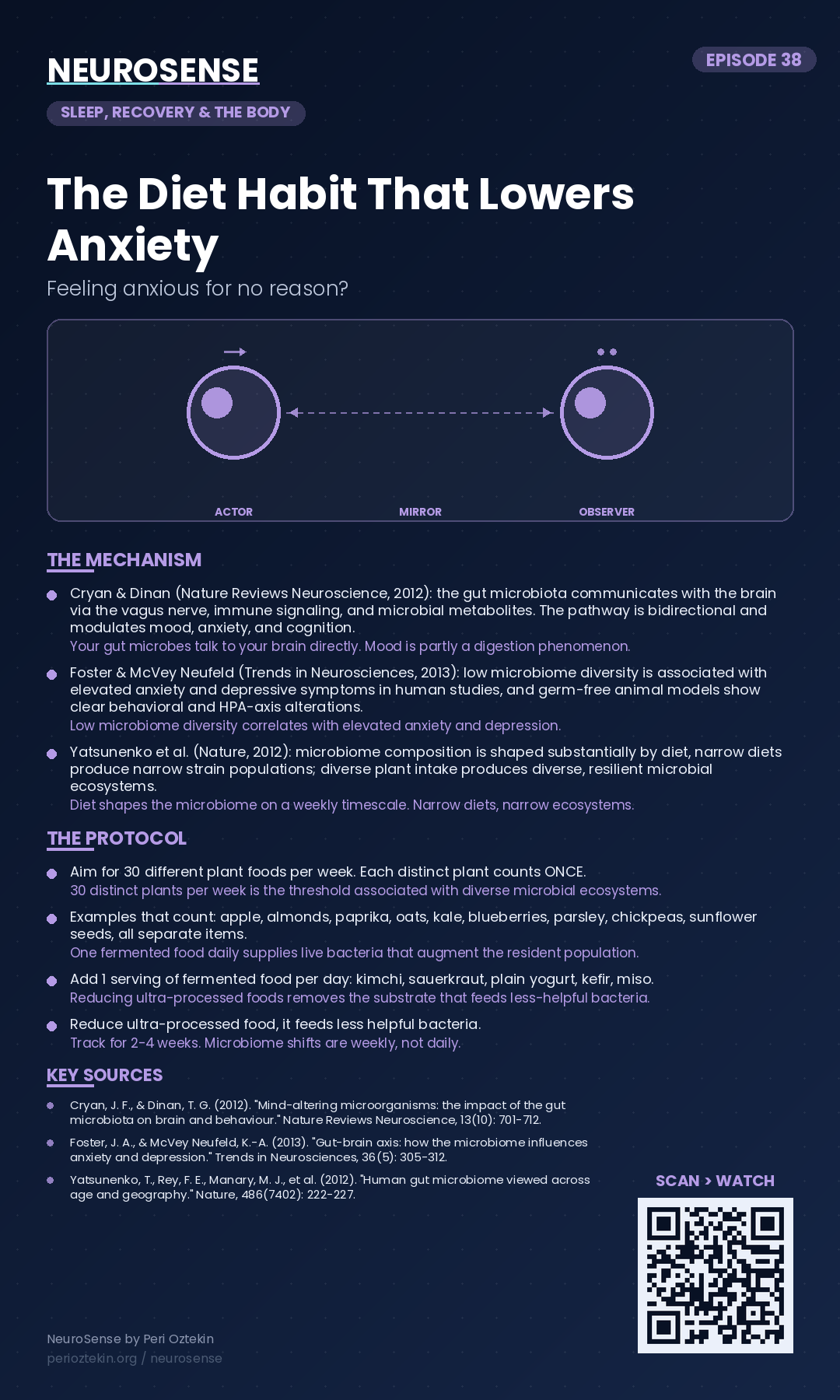
One-page summary
Right-click → Save As to download. Or scan the QR code in the corner to come back here from print.
The science beat (5-sec loop)
Sources
- Cryan, J. F., & Dinan, T. G. (2012). "Mind-altering microorganisms: the impact of the gut microbiota on brain and behaviour." Nature Reviews Neuroscience, 13(10): 701-712.
- Foster, J. A., & McVey Neufeld, K.-A. (2013). "Gut-brain axis: how the microbiome influences anxiety and depression." Trends in Neurosciences, 36(5): 305-312.
- Yatsunenko, T., Rey, F. E., Manary, M. J., et al. (2012). "Human gut microbiome viewed across age and geography." Nature, 486(7402): 222-227.
Educational content only. Not medical advice.
Also on Instagram: @neurosensebrain
← Back to all episodes