← All episodes
Episode 37 · Stress & Emotion
Why Gratitude Journals Don't Actually Work (And What Does)
Most gratitude advice is missing the active ingredient. The mechanism is connection, not journaling.
The Science
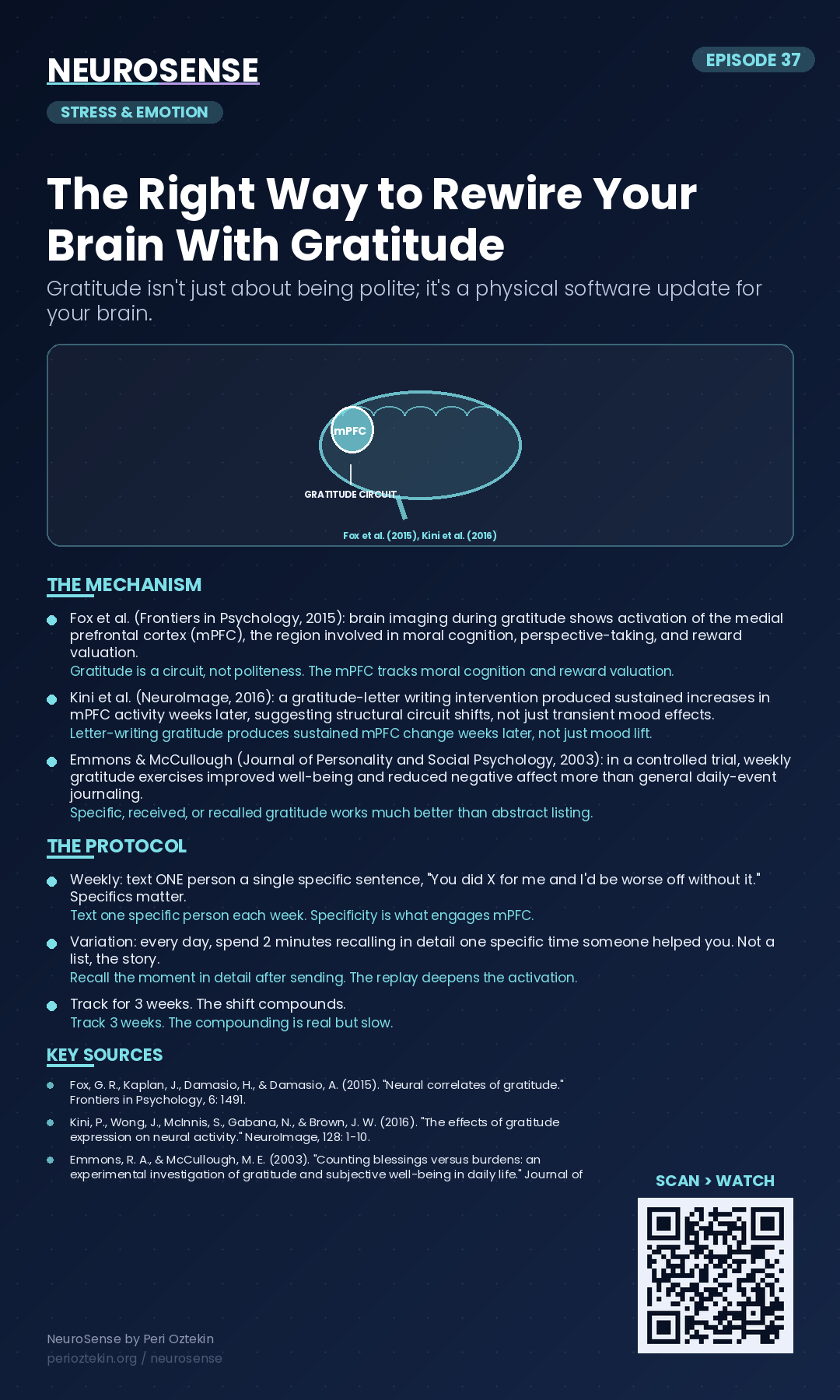
- Fox et al. (Frontiers in Psychology, 2015): brain imaging during gratitude shows activation of the medial prefrontal cortex (mPFC), the region involved in moral cognition, perspective-taking, and reward valuation.
- Kini et al. (NeuroImage, 2016): a gratitude-letter writing intervention produced sustained increases in mPFC activity weeks later, suggesting structural circuit shifts, not just transient mood effects.
- Emmons & McCullough (Journal of Personality and Social Psychology, 2003): in a controlled trial, weekly gratitude exercises improved well-being and reduced negative affect more than general daily-event journaling.
- Critical: effects are stronger for SPECIFIC, RECEIVED, or RECALLED-IN-NARRATIVE gratitude, much weaker for abstract listing.
The Protocol
- Weekly: text ONE person a single specific sentence, "You did X for me and I'd be worse off without it." Specifics matter.
- Variation: every day, spend 2 minutes recalling in detail one specific time someone helped you. Not a list, the story.
- Track for 3 weeks. The shift compounds.
One-page summary
Right-click → Save As to download. Or scan the QR code in the corner to come back here from print.
The science beat (5-sec loop)
Sources
- Fox, G. R., Kaplan, J., Damasio, H., & Damasio, A. (2015). "Neural correlates of gratitude." Frontiers in Psychology, 6: 1491.
- Kini, P., Wong, J., McInnis, S., Gabana, N., & Brown, J. W. (2016). "The effects of gratitude expression on neural activity." NeuroImage, 128: 1-10.
- Emmons, R. A., & McCullough, M. E. (2003). "Counting blessings versus burdens: an experimental investigation of gratitude and subjective well-being in daily life." Journal of Personality and Social Psychology, 84(2): 377-389.
Educational content only. Not medical advice.
Also on Instagram: @neurosensebrain
← Back to all episodes