← All episodes
Episode 36 · Learning & Memory
Why Practice Is About Thinking LESS, Not More
Mastery isn't being smarter while you do the skill. It's offloading the skill to a different brain region entirely.
The Science
- Ito (Nature Reviews Neuroscience, 2008): the cerebellum builds and refines "internal models" of skilled action, comparing intended movement to actual movement and adjusting in milliseconds. This is the substrate of skill automation.
- Schmahmann (Neuroscience Letters, 2019): the cerebellum holds ~50% of the brain's neurons despite occupying ~10% of brain volume, and contributes to cognitive as well as motor automation.
- Bengtsson et al. (Nature Neuroscience, 2005): extensive piano practicing produces region-specific white matter changes in tracts connecting cerebellum to cortex, measurable structural evidence of skill transfer.
- Implication: pros look "effortless" because their cerebellum is doing the work, freeing the prefrontal cortex for higher-level strategy.
The Protocol
- Practice ONE specific move or sequence until it feels boring. Boredom = the signal that automation is happening.
- Then increase difficulty by ~5%, faster, harder variation, or longer combo.
- Resist the urge to switch drills constantly. Variety feels productive but slows the transfer.
- Sleep matters: cerebellar consolidation accelerates during deep sleep.
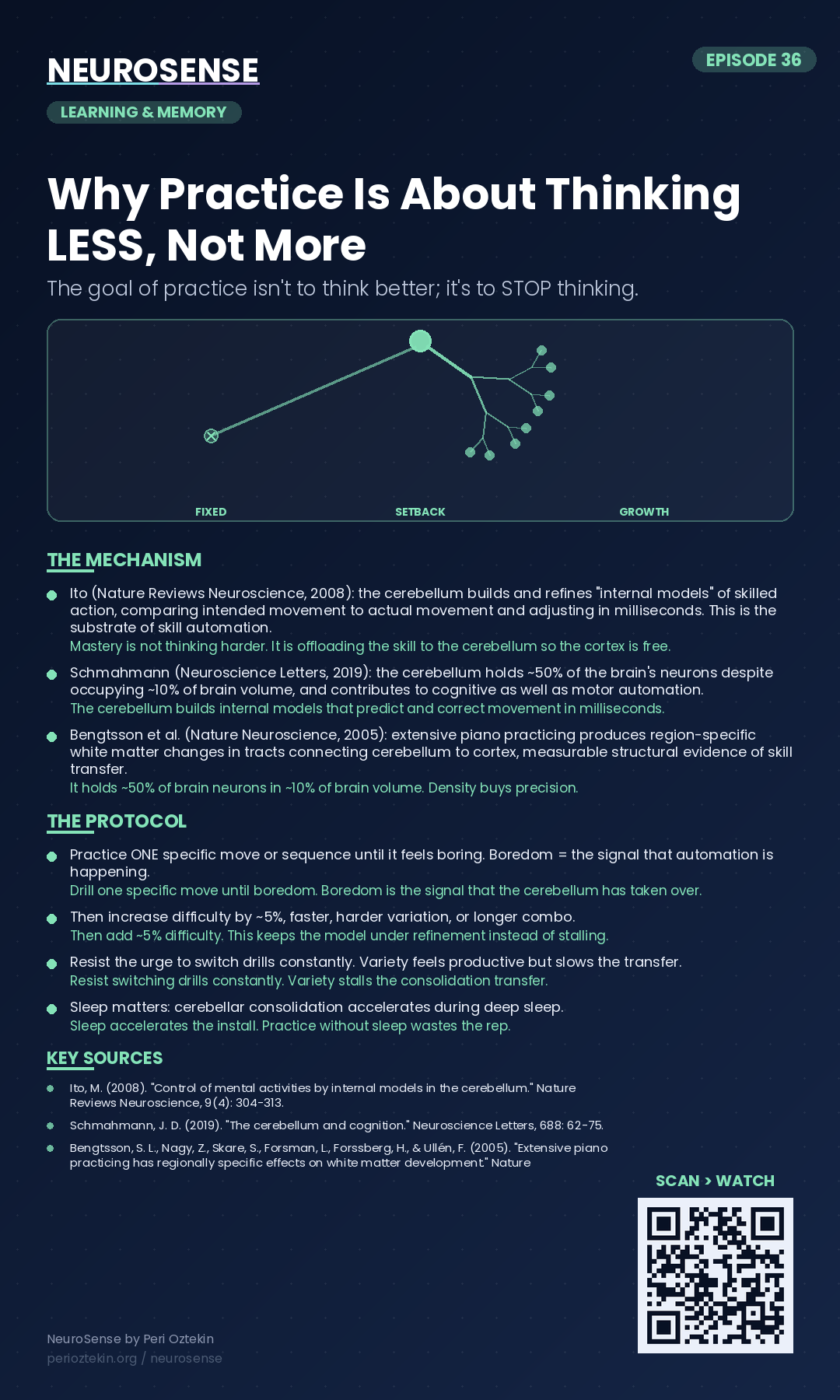
One-page summary
Right-click → Save As to download. Or scan the QR code in the corner to come back here from print.
The science beat (5-sec loop)
Sources
- Ito, M. (2008). "Control of mental activities by internal models in the cerebellum." Nature Reviews Neuroscience, 9(4): 304-313.
- Schmahmann, J. D. (2019). "The cerebellum and cognition." Neuroscience Letters, 688: 62-75.
- Bengtsson, S. L., Nagy, Z., Skare, S., Forsman, L., Forssberg, H., & Ullén, F. (2005). "Extensive piano practicing has regionally specific effects on white matter development." Nature Neuroscience, 8(9): 1148-1150.
Educational content only. Not medical advice.
Also on Instagram: @neurosensebrain
← Back to all episodes