← All episodes
Episode 33 · The Social Brain
Why You Feel Different Around Different Friend Groups
Your confidence shifts wildly between groups because your brain runs a chemical status tracker, and the chemical it uses is serotonin.
The Science
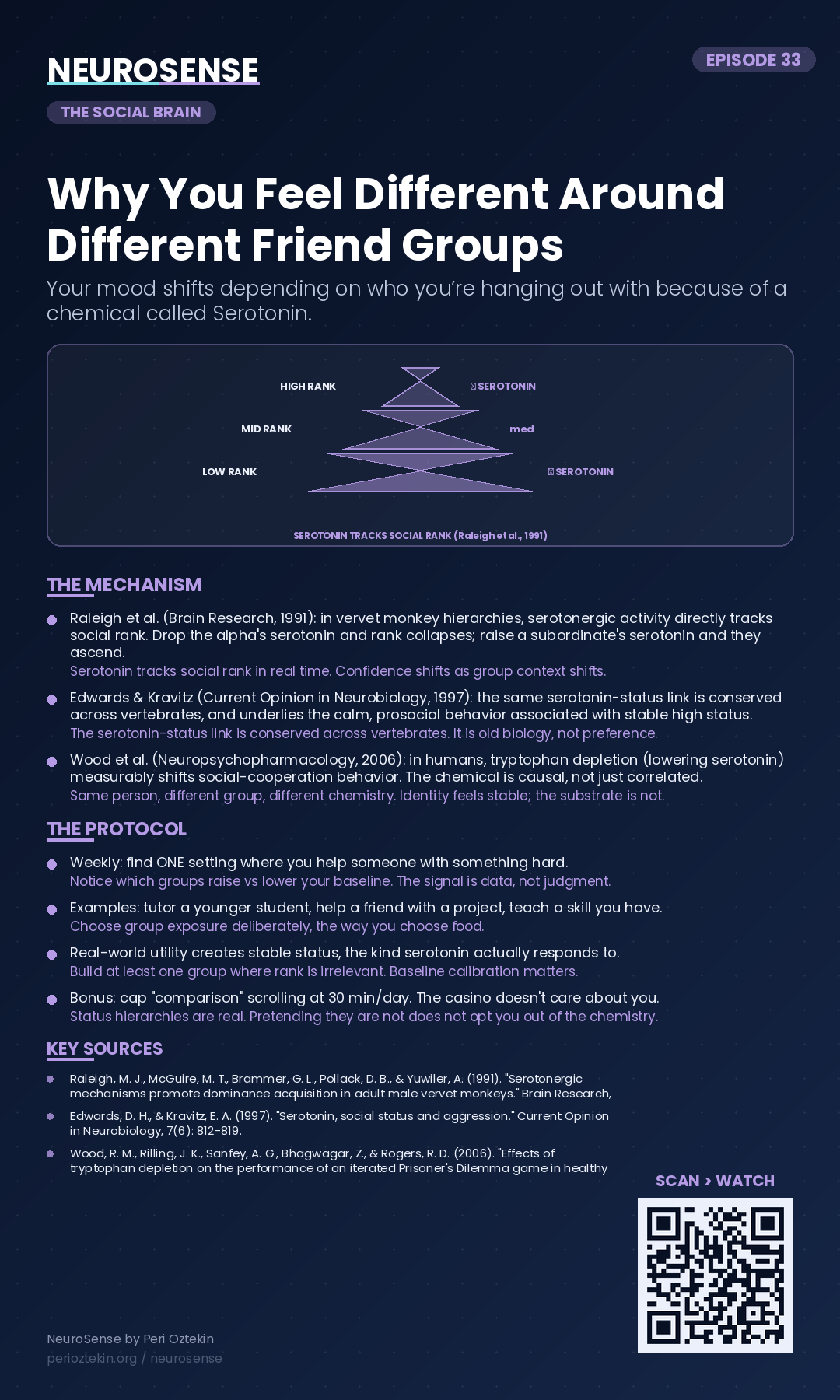
- Raleigh et al. (Brain Research, 1991): in vervet monkey hierarchies, serotonergic activity directly tracks social rank. Drop the alpha's serotonin and rank collapses; raise a subordinate's serotonin and they ascend.
- Edwards & Kravitz (Current Opinion in Neurobiology, 1997): the same serotonin-status link is conserved across vertebrates, and underlies the calm, prosocial behavior associated with stable high status.
- Wood et al. (Neuropsychopharmacology, 2006): in humans, tryptophan depletion (lowering serotonin) measurably shifts social-cooperation behavior. The chemical is causal, not just correlated.
- Implication: social media activates this tracker constantly, every scroll is a comparison/rank update. The brain doesn't separate online status from IRL status.
The Protocol
- Weekly: find ONE setting where you help someone with something hard.
- Examples: tutor a younger student, help a friend with a project, teach a skill you have.
- Real-world utility creates stable status, the kind serotonin actually responds to.
- Bonus: cap "comparison" scrolling at 30 min/day. The casino doesn't care about you.
One-page summary
Right-click → Save As to download. Or scan the QR code in the corner to come back here from print.
The science beat (5-sec loop)
Sources
- Raleigh, M. J., McGuire, M. T., Brammer, G. L., Pollack, D. B., & Yuwiler, A. (1991). "Serotonergic mechanisms promote dominance acquisition in adult male vervet monkeys." Brain Research, 559(2): 181-190.
- Edwards, D. H., & Kravitz, E. A. (1997). "Serotonin, social status and aggression." Current Opinion in Neurobiology, 7(6): 812-819.
- Wood, R. M., Rilling, J. K., Sanfey, A. G., Bhagwagar, Z., & Rogers, R. D. (2006). "Effects of tryptophan depletion on the performance of an iterated Prisoner's Dilemma game in healthy adults." Neuropsychopharmacology, 31(5): 1075-1084.
Educational content only. Not medical advice.
Also on Instagram: @neurosensebrain
← Back to all episodes