← All episodes
Episode 30 · How the Brain Works
They're Reading Thoughts in Real-Time. What That Means for You.
Brain-machine interfaces decode neural spikes directly into digital actions. The technology is real and accelerating. The takeaway for you might surprise you.
The Science
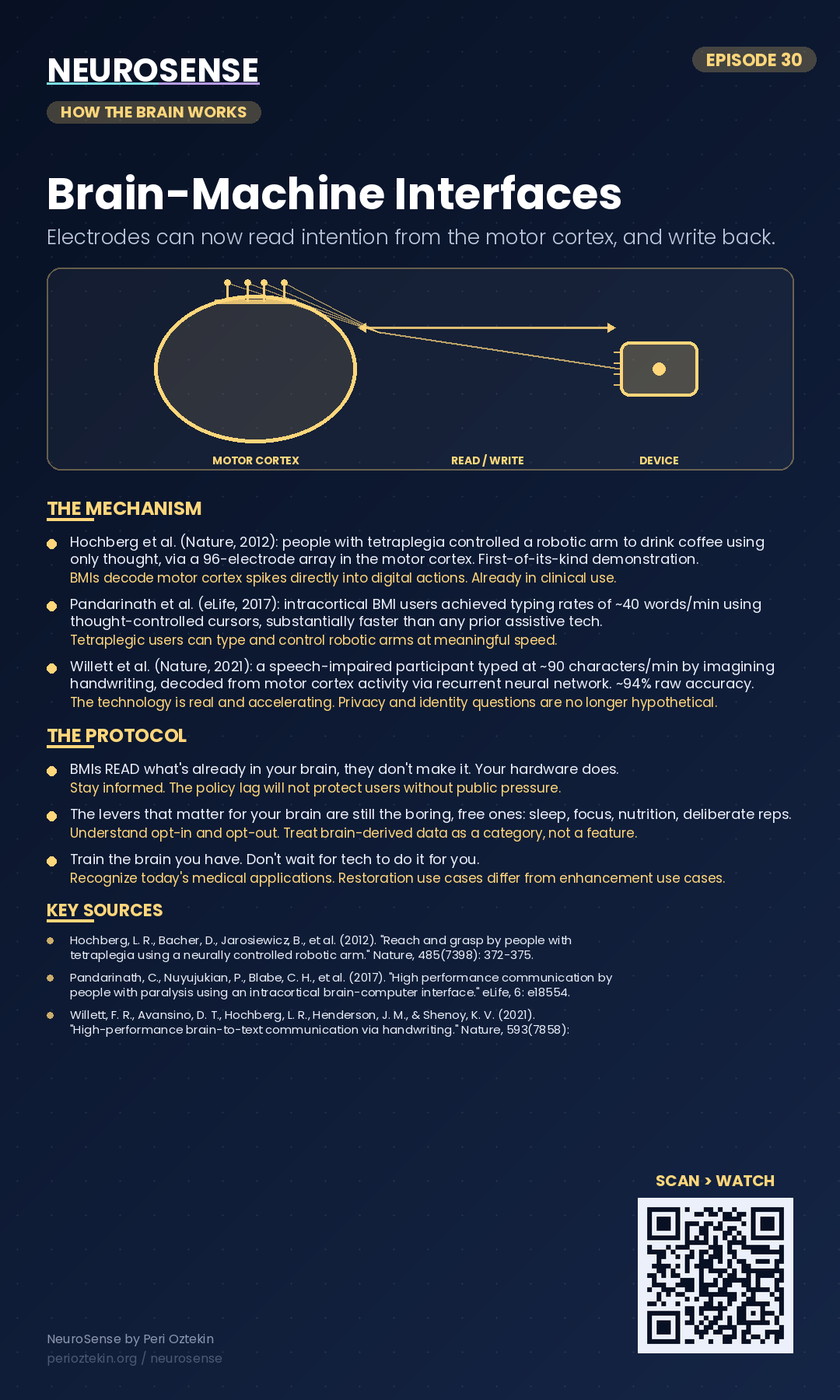
- Hochberg et al. (Nature, 2012): people with tetraplegia controlled a robotic arm to drink coffee using only thought, via a 96-electrode array in the motor cortex. First-of-its-kind demonstration.
- Pandarinath et al. (eLife, 2017): intracortical BMI users achieved typing rates of ~40 words/min using thought-controlled cursors, substantially faster than any prior assistive tech.
- Willett et al. (Nature, 2021): a speech-impaired participant typed at ~90 characters/min by imagining handwriting, decoded from motor cortex activity via recurrent neural network. ~94% raw accuracy.
- Longer-term: bidirectional brain-AI bandwidth, read AND write. Highly contested, both scientifically and ethically.
The Takeaway
- BMIs READ what's already in your brain, they don't make it. Your hardware does.
- The levers that matter for your brain are still the boring, free ones: sleep, focus, nutrition, deliberate reps.
- Train the brain you have. Don't wait for tech to do it for you.
One-page summary
Right-click → Save As to download. Or scan the QR code in the corner to come back here from print.
The science beat (5-sec loop)
Sources
- Hochberg, L. R., Bacher, D., Jarosiewicz, B., et al. (2012). "Reach and grasp by people with tetraplegia using a neurally controlled robotic arm." Nature, 485(7398): 372-375.
- Pandarinath, C., Nuyujukian, P., Blabe, C. H., et al. (2017). "High performance communication by people with paralysis using an intracortical brain-computer interface." eLife, 6: e18554.
- Willett, F. R., Avansino, D. T., Hochberg, L. R., Henderson, J. M., & Shenoy, K. V. (2021). "High-performance brain-to-text communication via handwriting." Nature, 593(7858): 249-254.
Educational content only. Not medical advice.
Also on Instagram: @neurosensebrain
← Back to all episodes