← All episodes
Episode 28 · Focus & Attention
Why Your Best Ideas Hit You in the Shower
Insight doesn't come from working harder. It comes from letting a different network take over.
The Science
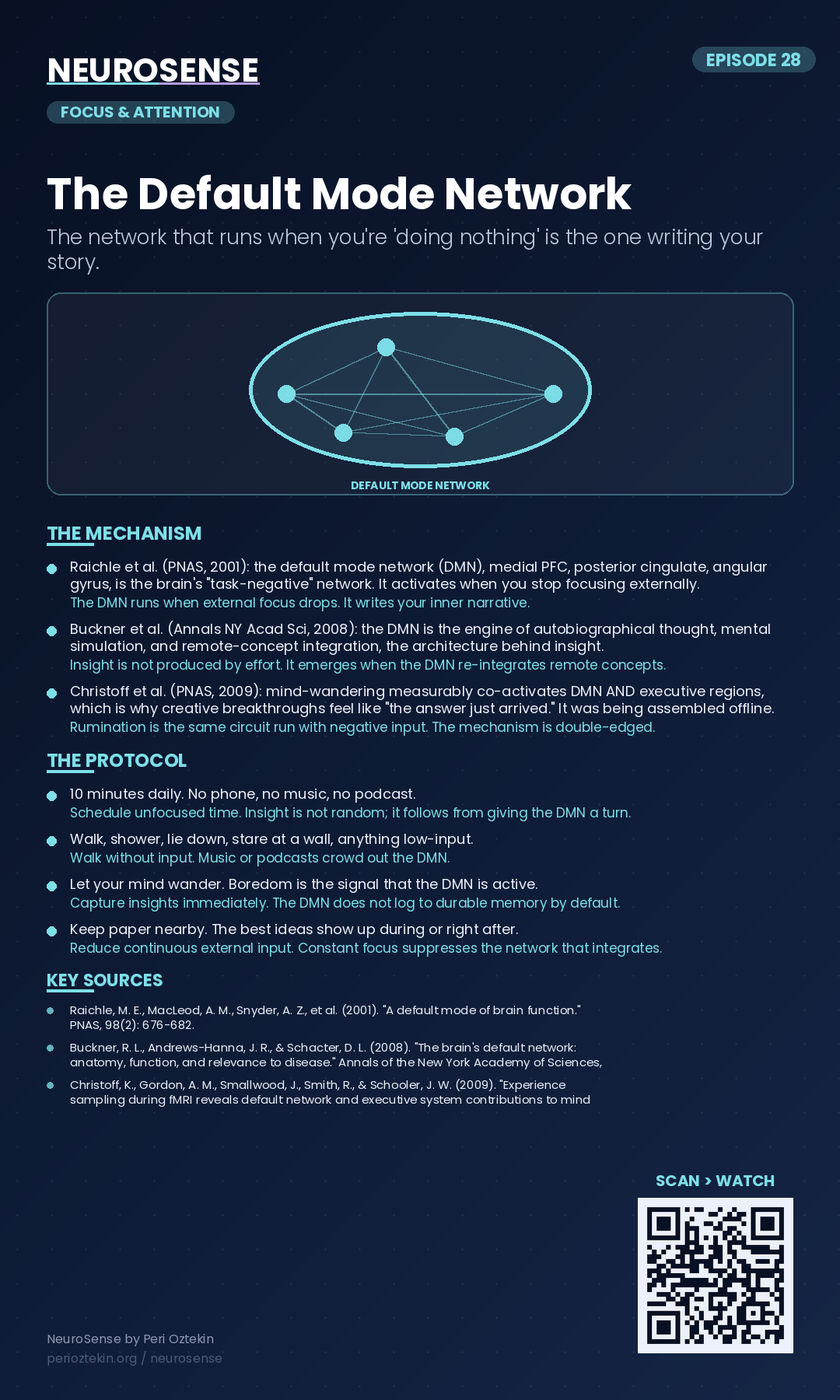
- Raichle et al. (PNAS, 2001): the default mode network (DMN), medial PFC, posterior cingulate, angular gyrus, is the brain's "task-negative" network. It activates when you stop focusing externally.
- Buckner et al. (Annals NY Acad Sci, 2008): the DMN is the engine of autobiographical thought, mental simulation, and remote-concept integration, the architecture behind insight.
- Christoff et al. (PNAS, 2009): mind-wandering measurably co-activates DMN AND executive regions, which is why creative breakthroughs feel like "the answer just arrived." It was being assembled offline.
- Ward et al. (J. Assoc. Consumer Research, 2017): the mere presence of a smartphone, even silent, even face-down, measurably reduces available cognitive capacity. Phones starve the DMN of floor time.
The Protocol
- 10 minutes daily. No phone, no music, no podcast.
- Walk, shower, lie down, stare at a wall, anything low-input.
- Let your mind wander. Boredom is the signal that the DMN is active.
- Keep paper nearby. The best ideas show up during or right after.
One-page summary
Right-click → Save As to download. Or scan the QR code in the corner to come back here from print.
The science beat (5-sec loop)
Sources
- Raichle, M. E., MacLeod, A. M., Snyder, A. Z., et al. (2001). "A default mode of brain function." PNAS, 98(2): 676-682.
- Buckner, R. L., Andrews-Hanna, J. R., & Schacter, D. L. (2008). "The brain's default network: anatomy, function, and relevance to disease." Annals of the New York Academy of Sciences, 1124: 1-38.
- Christoff, K., Gordon, A. M., Smallwood, J., Smith, R., & Schooler, J. W. (2009). "Experience sampling during fMRI reveals default network and executive system contributions to mind wandering." PNAS, 106(21): 8719-8724.
- Ward, A. F., Duke, K., Gneezy, A., & Bos, M. W. (2017). "Brain drain: the mere presence of one's own smartphone reduces available cognitive capacity." Journal of the Association for Consumer Research, 2(2): 140-154.
Educational content only. Not medical advice.
Also on Instagram: @neurosensebrain
← Back to all episodes