← All episodes
Episode 27 · Sleep, Recovery & the Body
What You Eat Literally Builds Your Brain
Foggy brain isn't always about sleep or sugar. Sometimes it's the fat you're not eating.
The Science
- Bazinet & Layé (Nature Reviews Neuroscience, 2014): the human brain is ~60% fat by dry weight, with long-chain omega-3 polyunsaturated fatty acids (EPA and DHA) forming critical components of neural cell membranes and myelin.
- Bourre (J. Nutrition, Health & Aging, 2004): omega-3 deficiency reduces myelin integrity, slowing axonal signal conduction. The result is detectable cognitive slowing.
- Su et al. (JAMA Network Open, 2018): meta-analysis of 19 RCTs (n=2,240) found EPA-predominant supplementation significantly reduced anxiety symptoms, the effect size scaled with dose.
The Protocol
- Target 1–3 g of EPA per day.
- Best sources: fatty fish (salmon, sardines, mackerel), aim for 2+ servings/week.
- Alternative: high-quality fish oil supplement (check the EPA dose on the label, not just "fish oil mg").
- Walnuts, chia, flax give you the precursor (ALA), useful but you need more grams.
- Be patient: incorporation into neural membranes takes ~2–3 weeks of consistency.
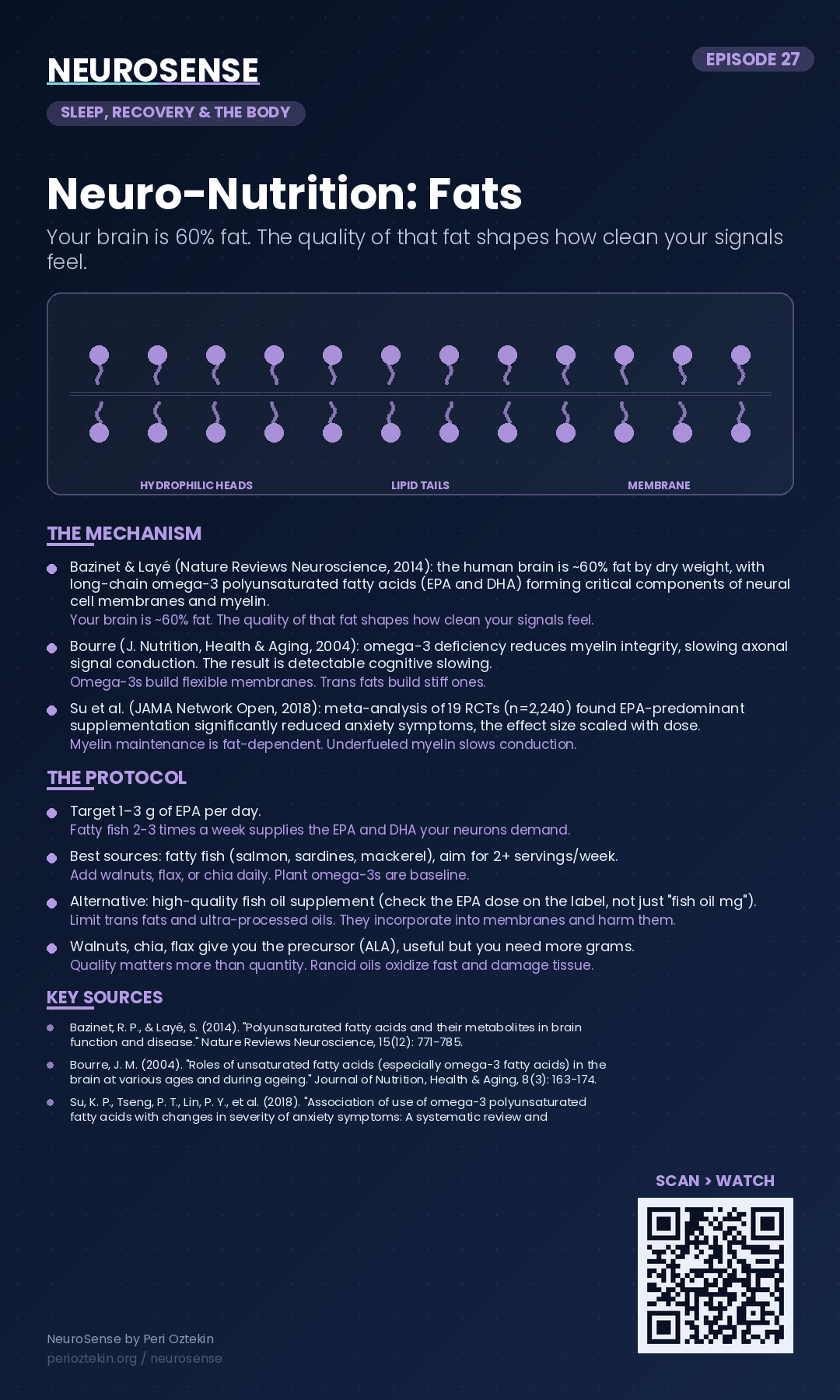
One-page summary
Right-click → Save As to download. Or scan the QR code in the corner to come back here from print.
The science beat (5-sec loop)
Sources
- Bazinet, R. P., & Layé, S. (2014). "Polyunsaturated fatty acids and their metabolites in brain function and disease." Nature Reviews Neuroscience, 15(12): 771-785.
- Bourre, J. M. (2004). "Roles of unsaturated fatty acids (especially omega-3 fatty acids) in the brain at various ages and during ageing." Journal of Nutrition, Health & Aging, 8(3): 163-174.
- Su, K. P., Tseng, P. T., Lin, P. Y., et al. (2018). "Association of use of omega-3 polyunsaturated fatty acids with changes in severity of anxiety symptoms: A systematic review and meta-analysis." JAMA Network Open, 1(5): e182327.
Educational content only. Not medical advice.
Also on Instagram: @neurosensebrain
← Back to all episodes