← All episodes
Episode 24 · Focus & Attention
How to Force Your Brain to Lock In (in 60 Seconds)
When rereading does not work, the problem may be the visual path, not your character.
The Science
- Rayner (Psychological Bulletin, 1998): your eyes don't move smoothly across a page. They jump in small movements called saccades and pause in fixations. Each jump is a chance for attention to shift to a competing target.
- Buschman & Miller (Science, 2007): top-down attention (driven by the prefrontal cortex) competes with bottom-up attention (driven by salient visual targets). Visual clutter biases the system toward bottom-up, which feels like distraction.
- Sara (Nature Reviews Neuroscience, 2009): when the visual field is narrowed to a single target, the locus coeruleus releases noradrenaline, sharpening attention and suppressing competing signals.
The Protocol
- Put a blank card under the line you are reading. The card hides the rest of the page from the visual field.
- Use a pen tip to guide your eyes across the sentence, eliminates saccade-drift.
- After each paragraph, stop and say the main idea in one plain sentence out loud. Forces comprehension before continuing.
- Use it for one page first. Track whether rereading drops.
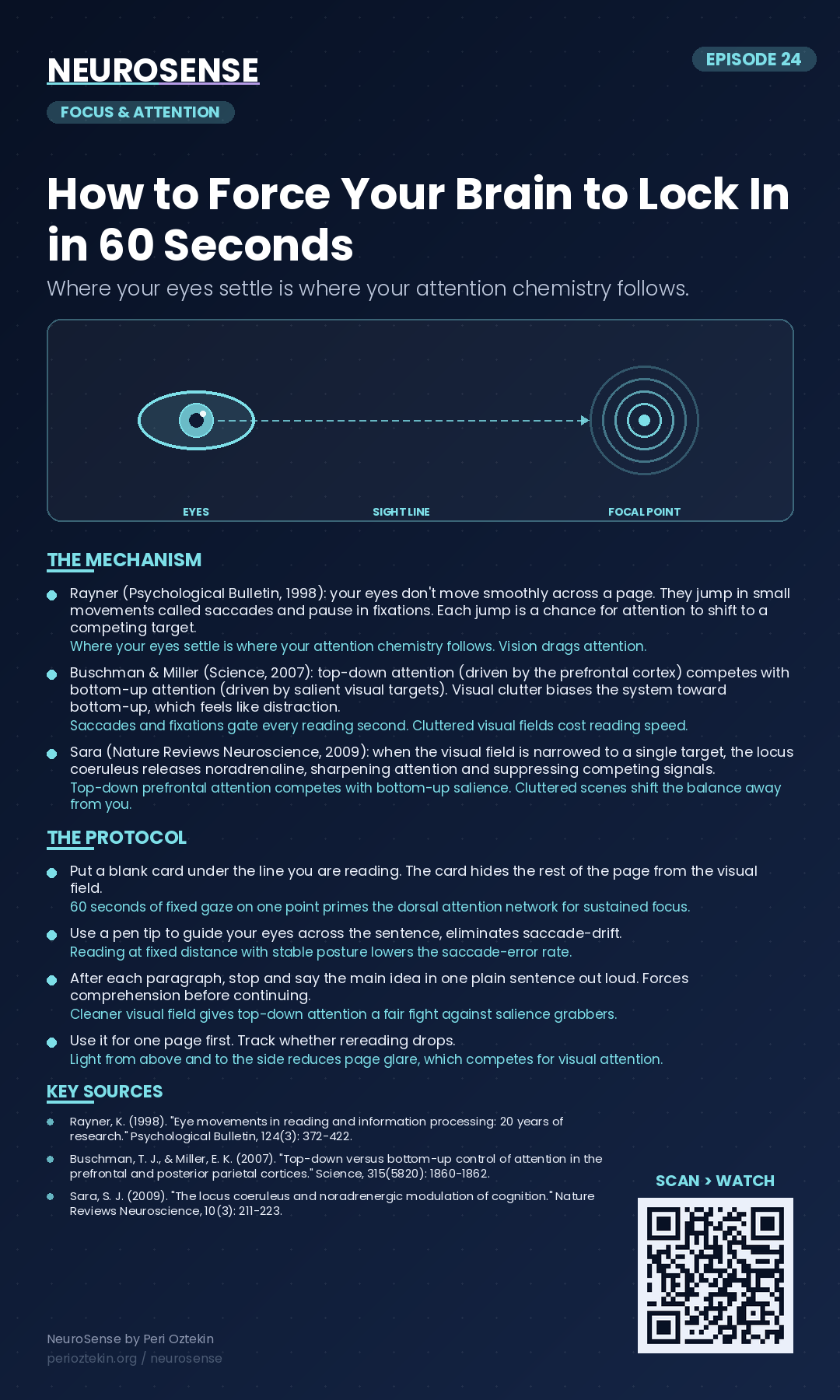
One-page summary
Right-click → Save As to download. Or scan the QR code in the corner to come back here from print.
The science beat (5-sec loop)
Sources
- Rayner, K. (1998). "Eye movements in reading and information processing: 20 years of research." Psychological Bulletin, 124(3): 372-422.
- Buschman, T. J., & Miller, E. K. (2007). "Top-down versus bottom-up control of attention in the prefrontal and posterior parietal cortices." Science, 315(5820): 1860-1862.
- Sara, S. J. (2009). "The locus coeruleus and noradrenergic modulation of cognition." Nature Reviews Neuroscience, 10(3): 211-223.
Educational content only. Not medical advice.
Also on Instagram: @neurosensebrain
← Back to all episodes