← All episodes
Episode 23 · Learning & Memory
The Move That Separates A-Students From Everyone Else
After a low score, the brain often turns someone else's success into a trait story. NeuroSense turns it into a process map.
The Science
- Dweck (Mindset, 2006): the difference between fixed and growth mindset is not about how you feel, it's about whether your brain searches for strategy after failure or shuts the search down to protect self-esteem.
- Mangels et al. (Social Cognitive and Affective Neuroscience, 2006): EEG evidence shows growth-mindset individuals have stronger neural responses to error feedback and stronger subsequent learning. The error-correction circuits literally allocate more energy.
- Yeager et al. (Psychological Science, 2022): targeted growth-mindset interventions improve grades most when the student then has access to better strategy, the mindset opens the door; strategy walks through it.
The Protocol
- After the next quiz, find one person who improved or scored higher.
- Ask: What did you do first? What did you do when you got stuck? What did you change from last time?
- Test one specific answer on one assignment this week.
- Track whether the change moved your score, that's the evidence the mindset feeds on.
One-page summary
Right-click → Save As to download. Or scan the QR code in the corner to come back here from print.
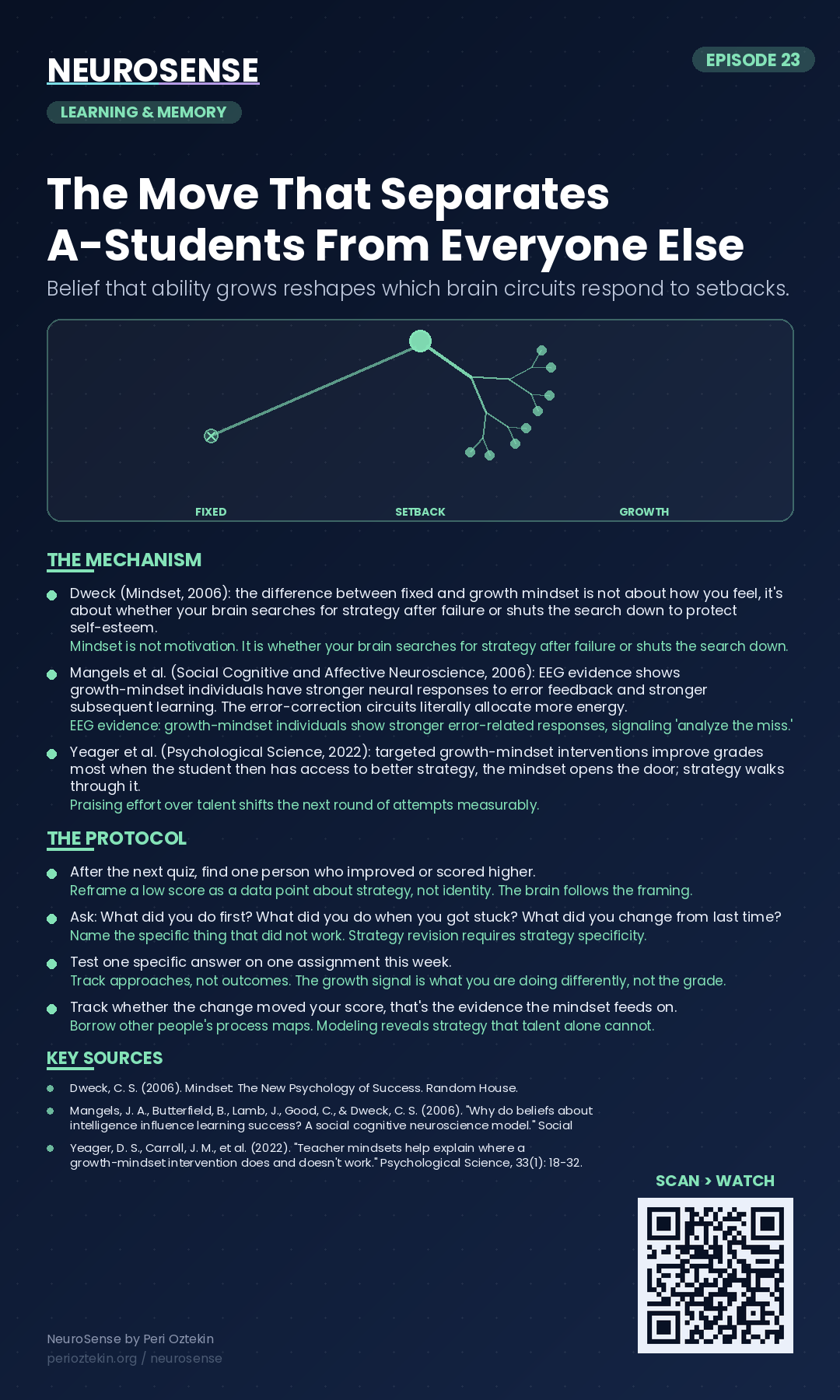
The science beat (5-sec loop)
Sources
- Dweck, C. S. (2006). Mindset: The New Psychology of Success. Random House.
- Mangels, J. A., Butterfield, B., Lamb, J., Good, C., & Dweck, C. S. (2006). "Why do beliefs about intelligence influence learning success? A social cognitive neuroscience model." Social Cognitive and Affective Neuroscience, 1(2): 75-86.
- Yeager, D. S., Carroll, J. M., et al. (2022). "Teacher mindsets help explain where a growth-mindset intervention does and doesn't work." Psychological Science, 33(1): 18-32.
Educational content only. Not medical advice.
Also on Instagram: @neurosensebrain
← Back to all episodes