← All episodes
Episode 22 · Sleep, Recovery & the Body
Why Brain Fog Is Actually Your Brain Being Dirty
Pull an all-nighter and you're not just tired, your brain has yesterday's trash still sitting in it.
The Science
- Xie et al. (Science, 2013): during sleep, the interstitial space between brain cells expands by ~60%, allowing cerebrospinal fluid (CSF) to flush metabolic waste, including β-amyloid, the protein implicated in Alzheimer's.
- Iliff et al. (Science Translational Medicine, 2012): this clearance system, the "glymphatic system", runs primarily during deep sleep. It does not catch up the next day.
- Lee et al. (J. Neuroscience, 2015): glymphatic clearance is significantly more efficient when sleeping in the lateral (side) position vs. prone or supine.
The Protocol
- Sleep on your side. Lateral position is the most efficient for glymphatic flow.
- Cool the bedroom to ~65°F / 18°C. Core body temp must drop 2–3° to enter deep sleep.
- Cut caffeine 8 hours before bed. Caffeine half-life is ~5 hours.
- 8 hours minimum. Adolescent brains specifically need 8–10 (per AAP).
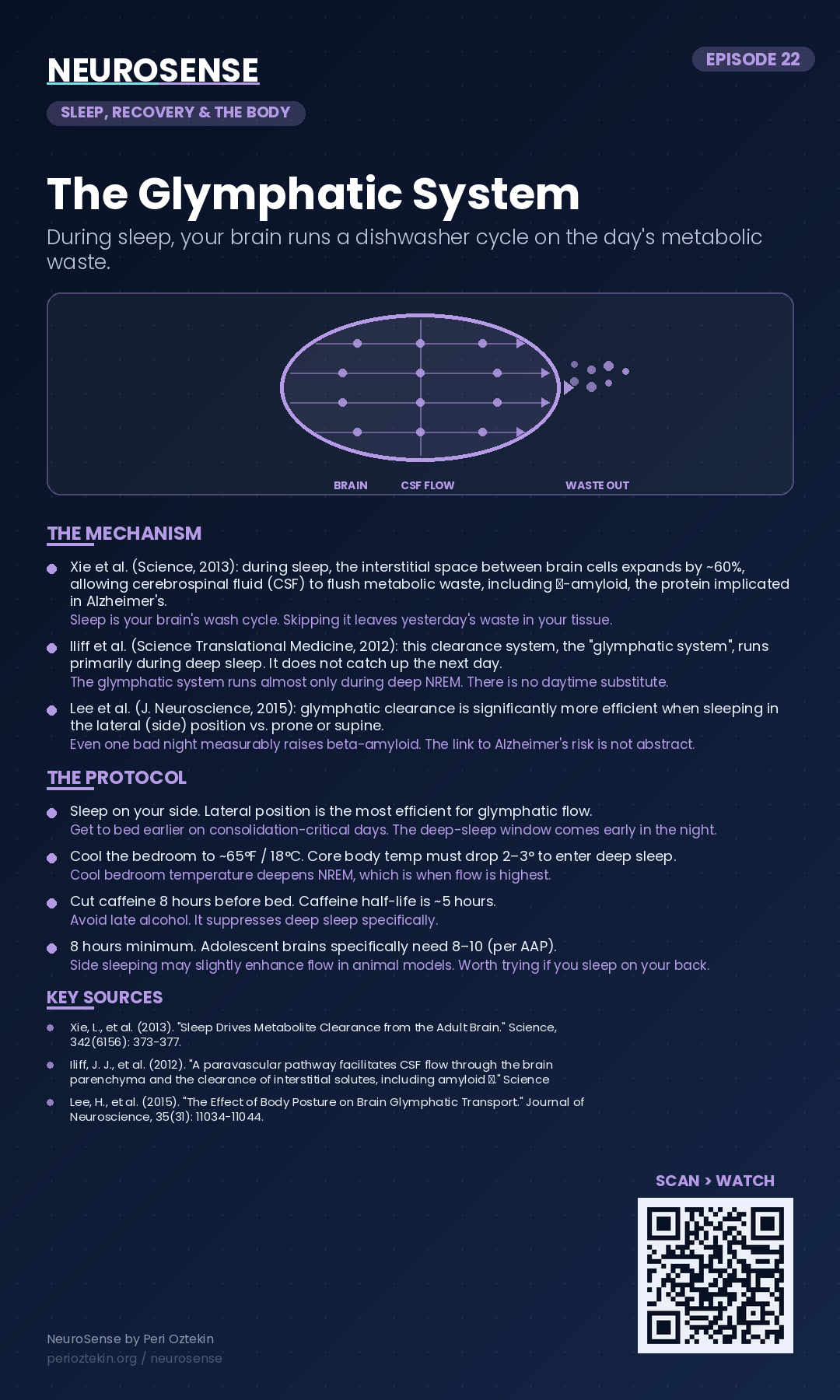
One-page summary
Right-click → Save As to download. Or scan the QR code in the corner to come back here from print.
The science beat (5-sec loop)
Sources
- Xie, L., et al. (2013). "Sleep Drives Metabolite Clearance from the Adult Brain." Science, 342(6156): 373-377.
- Iliff, J. J., et al. (2012). "A paravascular pathway facilitates CSF flow through the brain parenchyma and the clearance of interstitial solutes, including amyloid β." Science Translational Medicine, 4(147): 147ra111.
- Lee, H., et al. (2015). "The Effect of Body Posture on Brain Glymphatic Transport." Journal of Neuroscience, 35(31): 11034-11044.
- Walker, M. (2017). Why We Sleep. Penguin Random House.
Educational content only. Not medical advice.
Also on Instagram: @neurosensebrain
← Back to all episodes