← All episodes
Episode 21 · Learning & Memory
Why Your Brain NEEDS You to Fail
You're not bad at it. Your brain is rewiring, and the failure is the rewire.
The Science
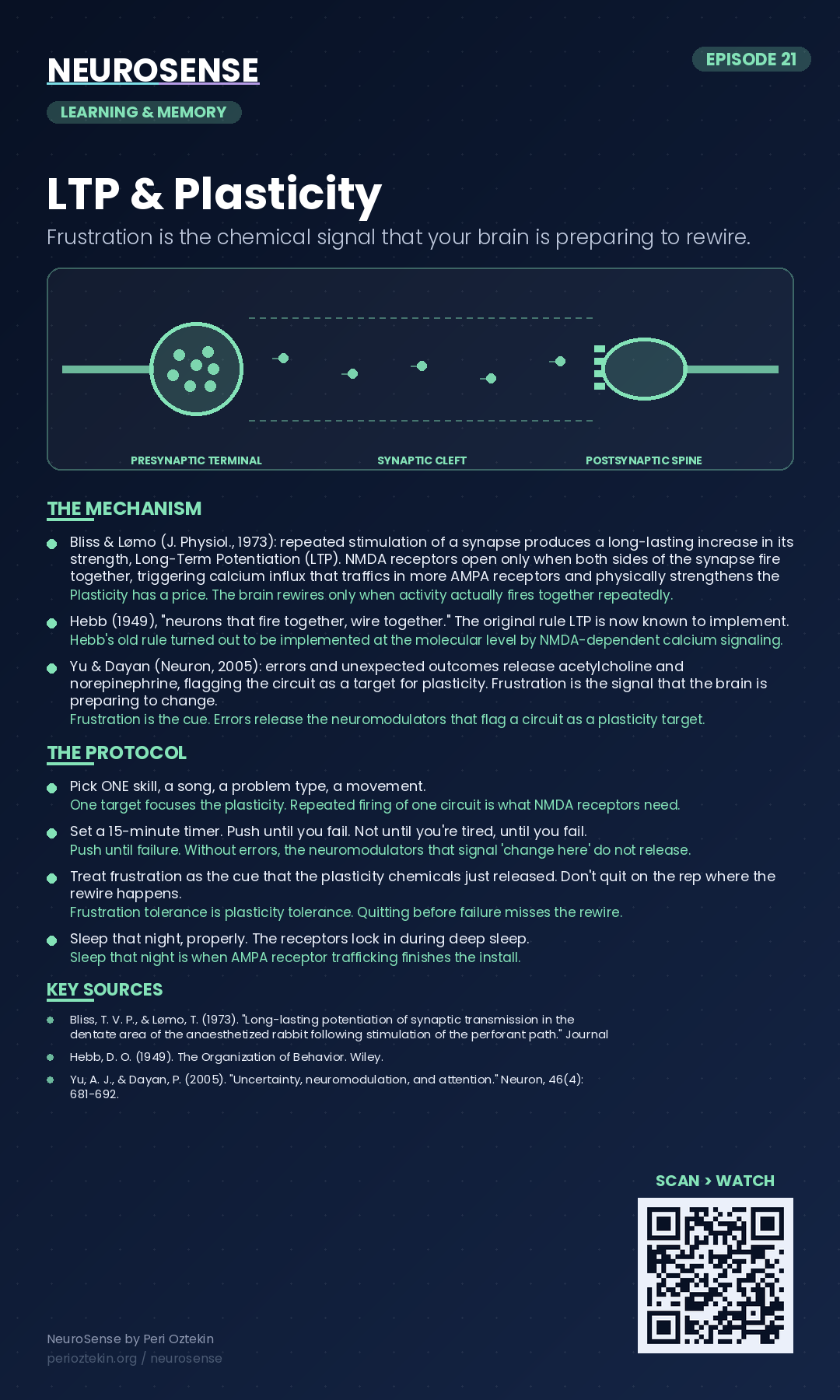
- Bliss & Lømo (J. Physiol., 1973): repeated stimulation of a synapse produces a long-lasting increase in its strength. This is Long-Term Potentiation (LTP). NMDA receptors open only when both sides of the synapse fire together, triggering calcium influx that traffics in more AMPA receptors and physically strengthens the connection.
- Hebb (1949): "neurons that fire together, wire together." The original rule LTP is now known to implement.
- Yu & Dayan (Neuron, 2005): errors and unexpected outcomes release acetylcholine and norepinephrine, flagging the circuit as a target for plasticity. Frustration is the signal that the brain is preparing to change.
- Consolidation is sleep-dependent: the receptor insertion that locks LTP in peaks during deep sleep. No sleep, no install.
The Protocol
- Pick ONE skill: a song, a problem type, a movement.
- Set a 15-minute timer. Push until you fail. Not until you're tired. Until you fail.
- Treat frustration as the cue that the plasticity chemicals just released. Don't quit on the rep where the rewire happens.
- Sleep that night, properly. The receptors lock in during deep sleep.
One-page summary
Right-click → Save As to download. Or scan the QR code in the corner to come back here from print.
Sources
- Bliss, T. V. P., & Lømo, T. (1973). J Physiol, 232(2): 331–356.
- Hebb, D. O. (1949). The Organization of Behavior. Wiley.
- Yu, A. J., & Dayan, P. (2005). Neuron, 46(4): 681–692.
- Harvard MCB80.2x, Lesson on LTP. Cox, D.
Educational content only. Not medical advice.
Also on Instagram: @neurosensebrain
← Back to all episodes