← All episodes
Episode 20 · How the Brain Works
The Math Behind Your Mind.
The Nernst potential is the exact voltage where electrical and chemical forces on a single ion cancel out. Your neurons live perpetually just shy of that balance.
The Science
- Nernst (Zeitschrift für Physikalische Chemie, 1889): the Nernst equation predicts the equilibrium potential for any single ion species across a semi-permeable membrane. At that voltage, the electrical driving force on the ion exactly cancels the chemical (concentration) driving force, and net flow stops.
- For typical neuronal concentrations, the Nernst potential is approximately +60 mV for Na+, -90 mV for K+, and -65 mV for Cl-. The resting membrane potential of a neuron sits between these values, weighted by the relative permeabilities of each ion species.
- Goldman (J Gen Physiol, 1943): the Goldman-Hodgkin-Katz equation generalizes the Nernst equation to multiple ions, predicting actual resting potential as a permeability-weighted average. This formalism is the quantitative bridge between ion biophysics and cellular electrophysiology.
- Three closely related terms: NERNST potential is the equation's output for a single ion; EQUILIBRIUM potential is the same concept used in measurements; REVERSAL potential is the experimentally measured voltage at which a current through a channel reverses direction.
The Protocol
- Identify one daily imbalance (sleep, diet, stress) and align it with your biology.
- Audit your default state, if it's stress, your neurons live closer to the firing threshold than they should.
- Consistency over intensity. Your 'equilibrium potential' is built from steady habits, not heroics.
One-page summary
Right-click → Save As to download. Or scan the QR code in the corner to come back here from print.
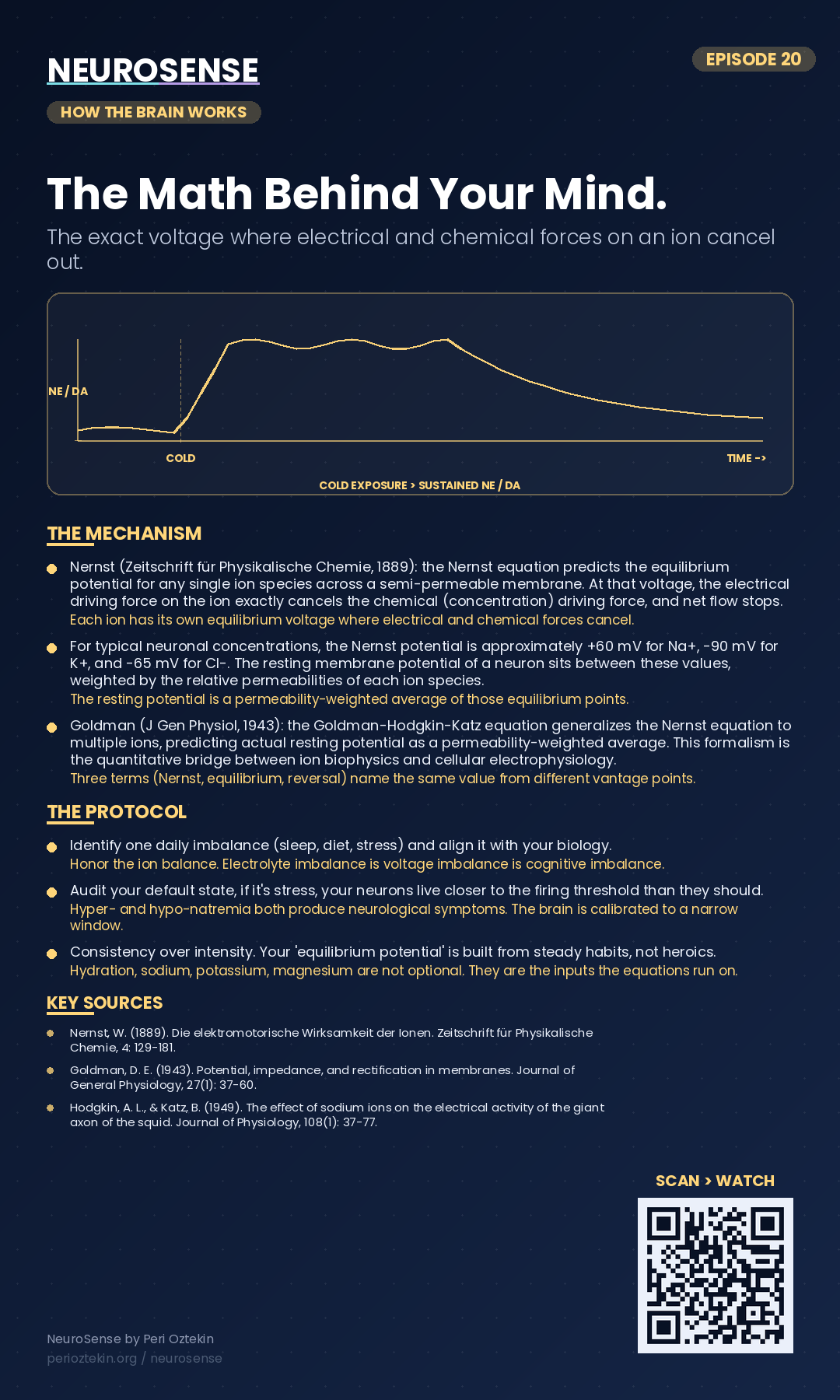
The science beat (5-sec loop)
Sources
- Nernst, W. (1889). Die elektromotorische Wirksamkeit der Ionen. Zeitschrift für Physikalische Chemie, 4: 129-181.
- Goldman, D. E. (1943). Potential, impedance, and rectification in membranes. Journal of General Physiology, 27(1): 37-60.
- Hodgkin, A. L., & Katz, B. (1949). The effect of sodium ions on the electrical activity of the giant axon of the squid. Journal of Physiology, 108(1): 37-77.
Educational content only. Not medical advice.
Also on Instagram: @neurosensebrain
← Back to all episodes