← All episodes
Episode 19 · How the Brain Works
Caffeine Doesn't Give You Energy. It Steals Your Off Switch
No drug invents new feelings. Each hijacks an existing neuromodulator system by mimicking, blocking, or extending what the brain already does.
The Science
- Hyman, Malenka & Nestler (Annual Review of Neuroscience, 2006): all major psychoactive drugs act on conserved neuromodulator systems (dopamine, serotonin, acetylcholine, norepinephrine, opioid). They do not create new signaling pathways; they bias existing ones by mimicking ligands (agonists), blocking receptors (antagonists), or preventing reuptake.
- Most neuromodulators act through G-protein-coupled receptors (GPCRs), which shift synaptic strength and excitability rather than directly opening ion channels. Effects are slower (seconds to minutes) but more pervasive than ionotropic transmission.
- Fredholm et al. (Pharmacological Reviews, 1999): caffeine works as a competitive antagonist at adenosine A1 and A2A receptors. It does not provide energy; it blocks the sleep-promoting adenosine that has accumulated during wakefulness, removing the 'off' signal.
- Volkow et al. (J Clinical Investigation, 2003): repeated drug use that drives supraphysiological neuromodulator release downregulates the corresponding receptors. Tolerance and withdrawal are predictable consequences of pharmacology, not failures of character.
The Protocol
- Caffeine timing: wait 90-120 min after waking. Let your natural cortisol cycle do the work first.
- Audit substances: which receptor? Agonist, antagonist, or reuptake? What's the tolerance curve?
- Sleep restores receptor sensitivity. Sleep-deprived → everything less effective.
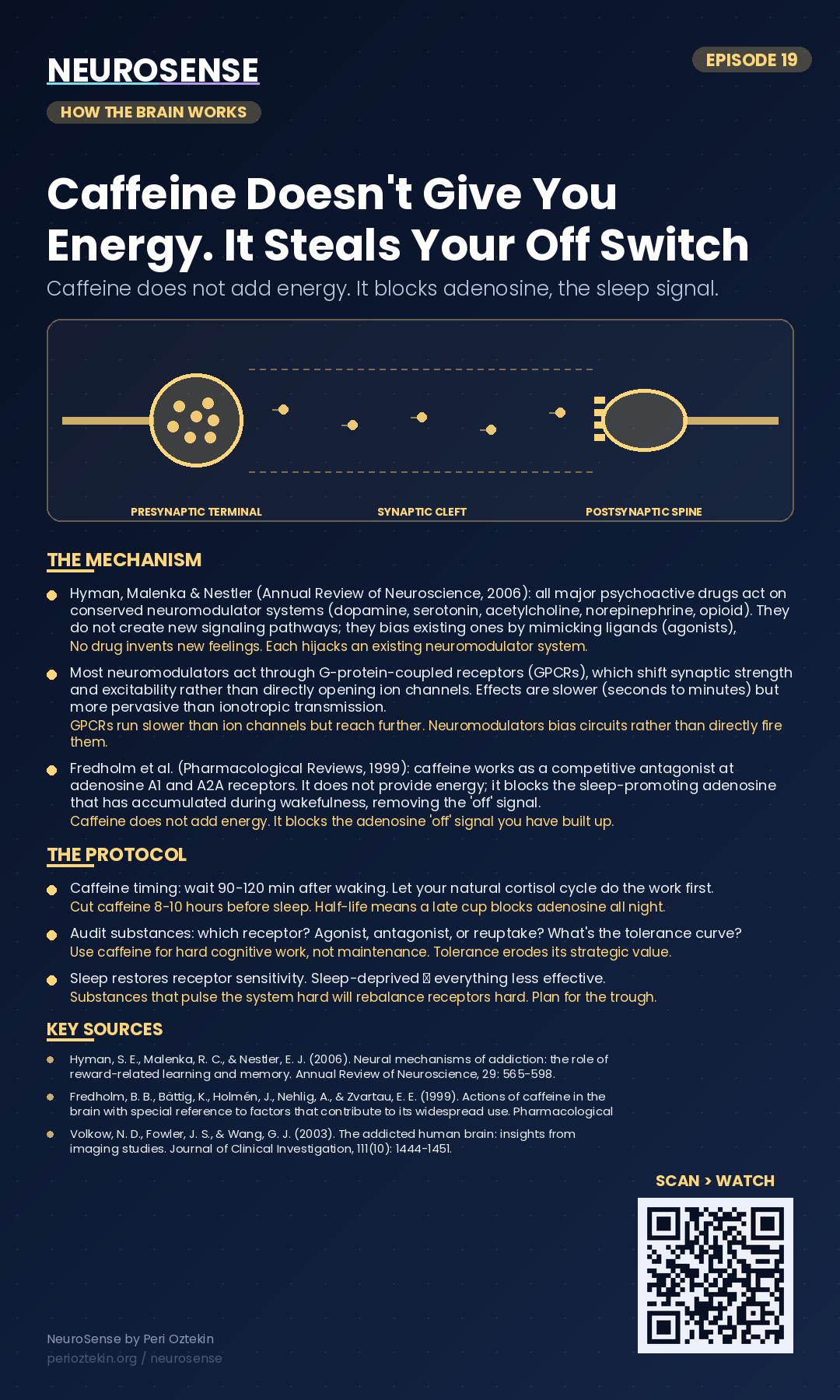
One-page summary
Right-click → Save As to download. Or scan the QR code in the corner to come back here from print.
The science beat (5-sec loop)
Sources
- Hyman, S. E., Malenka, R. C., & Nestler, E. J. (2006). Neural mechanisms of addiction: the role of reward-related learning and memory. Annual Review of Neuroscience, 29: 565-598.
- Fredholm, B. B., Bättig, K., Holmén, J., Nehlig, A., & Zvartau, E. E. (1999). Actions of caffeine in the brain with special reference to factors that contribute to its widespread use. Pharmacological Reviews, 51(1): 83-133.
- Volkow, N. D., Fowler, J. S., & Wang, G. J. (2003). The addicted human brain: insights from imaging studies. Journal of Clinical Investigation, 111(10): 1444-1451.
Educational content only. Not medical advice.
Also on Instagram: @neurosensebrain
← Back to all episodes