← All episodes
Episode 18 · Learning & Memory
Memories Are Made While You Sit Still
The hippocampus converts short-term experience into long-term memory. Remove it, and you can never form a new declarative memory again.
The Science
- Scoville & Milner (J Neurology, Neurosurgery & Psychiatry, 1957): the case of patient H.M. (Henry Molaison) established the hippocampus as essential for declarative memory formation. After bilateral medial-temporal-lobe resection for epilepsy, H.M. could no longer form new memories of facts or events, though his intelligence and procedural learning were intact.
- Squire & Wixted (Annual Review of Neuroscience, 2011): the hippocampus binds the components of an experience (what, where, when) and acts as an index pointing to distributed cortical sites. Over weeks to months, these traces become independent of the hippocampus through systems consolidation.
- Tambini, Ketz & Davachi (Neuron, 2010): in awake humans, hippocampal-cortical correlations during rest immediately after learning predict later memory for the studied material. The 'replay' that solidifies a memory begins within minutes of encoding.
- Sleep, especially NREM slow-wave sleep, then re-runs that replay at compressed speed for further consolidation. Encoding alone is not enough; the post-encoding window matters as much as the encoding itself.
The Protocol
- 5 minutes of silence after every study block. Phone AWAY, not just face-down.
- Don't switch immediately to a high-input task. Give the replay window time.
- Deep sleep amplifies consolidation. All-nighters cost you twice.
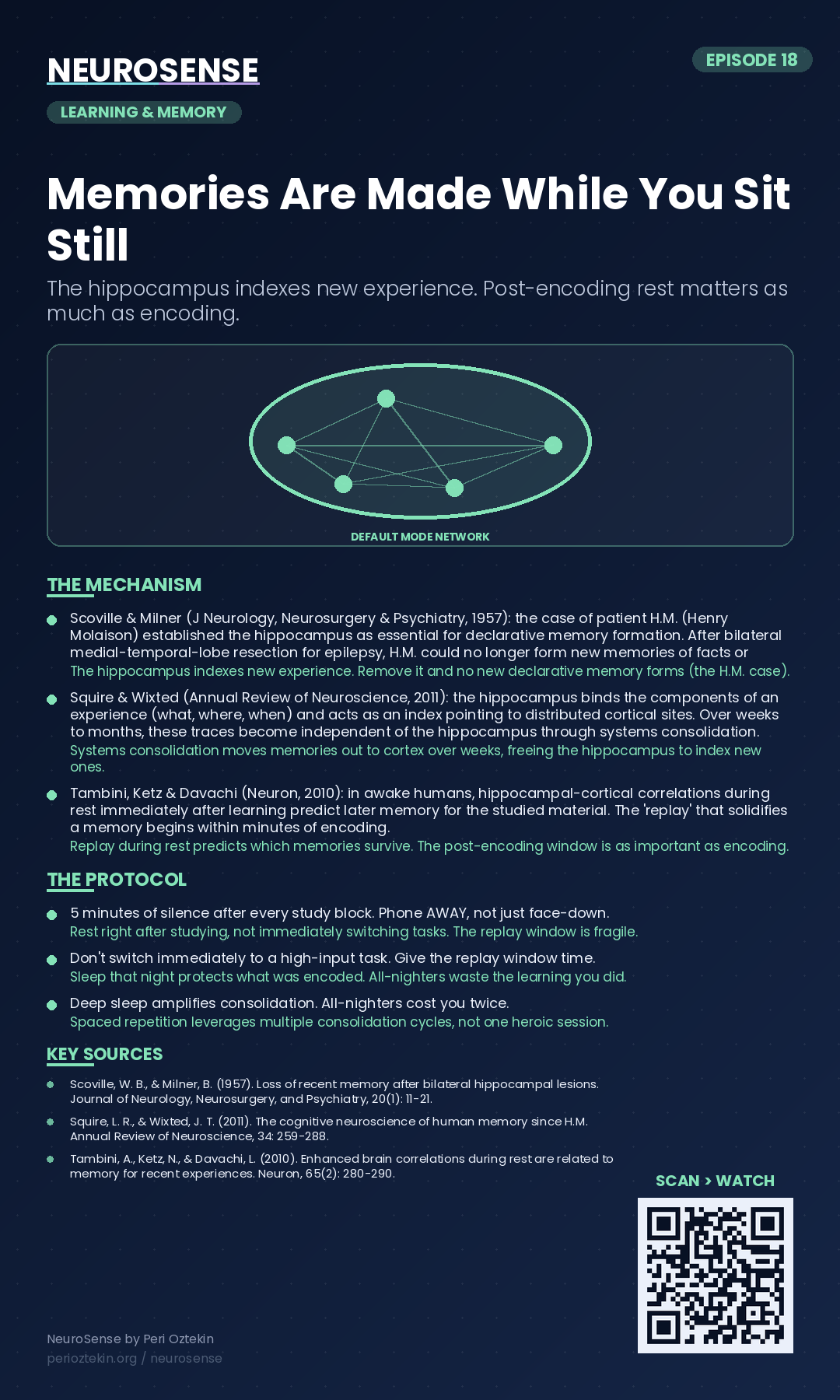
One-page summary
Right-click → Save As to download. Or scan the QR code in the corner to come back here from print.
The science beat (5-sec loop)
Sources
- Scoville, W. B., & Milner, B. (1957). Loss of recent memory after bilateral hippocampal lesions. Journal of Neurology, Neurosurgery, and Psychiatry, 20(1): 11-21.
- Squire, L. R., & Wixted, J. T. (2011). The cognitive neuroscience of human memory since H.M. Annual Review of Neuroscience, 34: 259-288.
- Tambini, A., Ketz, N., & Davachi, L. (2010). Enhanced brain correlations during rest are related to memory for recent experiences. Neuron, 65(2): 280-290.
Educational content only. Not medical advice.
Also on Instagram: @neurosensebrain
← Back to all episodes