← All episodes
Episode 17 · Sleep, Recovery & the Body
Recharge Without Sleeping.
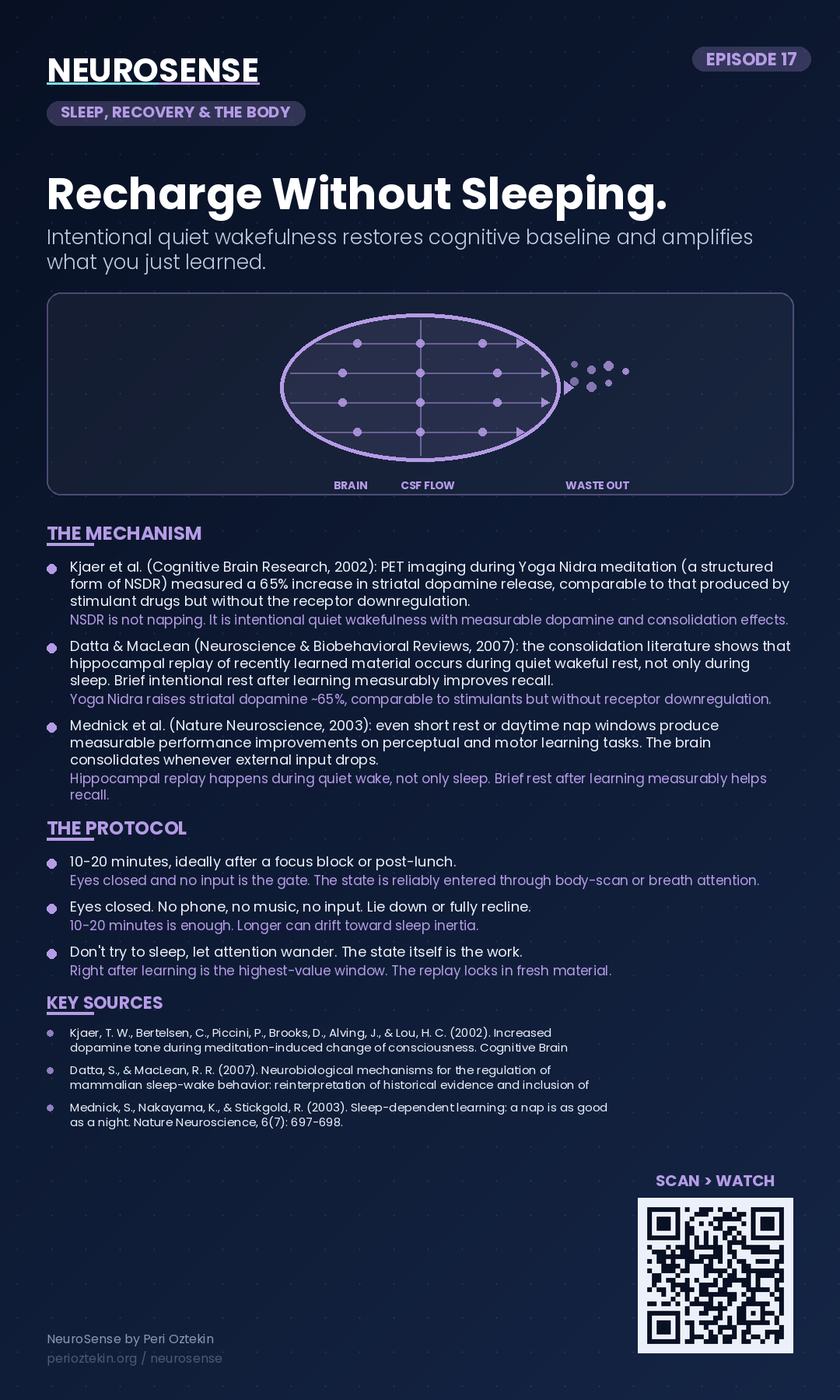
NSDR is deliberate, low-stimulation wakefulness. 10-20 minutes can restore cognitive baseline and amplify what you just learned.
The Science
- Kjaer et al. (Cognitive Brain Research, 2002): PET imaging during Yoga Nidra meditation (a structured form of NSDR) measured a 65% increase in striatal dopamine release, comparable to that produced by stimulant drugs but without the receptor downregulation.
- Datta & MacLean (Neuroscience & Biobehavioral Reviews, 2007): the consolidation literature shows that hippocampal replay of recently learned material occurs during quiet wakeful rest, not only during sleep. Brief intentional rest after learning measurably improves recall.
- Mednick et al. (Nature Neuroscience, 2003): even short rest or daytime nap windows produce measurable performance improvements on perceptual and motor learning tasks. The brain consolidates whenever external input drops.
- NSDR is not falling asleep. It is intentional quiet wakefulness with eyes closed, no input, and no attempt to sleep. The state is reliably entered through body-scan or breath-attention protocols.
The Protocol
- 10-20 minutes, ideally after a focus block or post-lunch.
- Eyes closed. No phone, no music, no input. Lie down or fully recline.
- Don't try to sleep, let attention wander. The state itself is the work.
One-page summary
Right-click → Save As to download. Or scan the QR code in the corner to come back here from print.
The science beat (5-sec loop)
Sources
- Kjaer, T. W., Bertelsen, C., Piccini, P., Brooks, D., Alving, J., & Lou, H. C. (2002). Increased dopamine tone during meditation-induced change of consciousness. Cognitive Brain Research, 13(2): 255-259.
- Datta, S., & MacLean, R. R. (2007). Neurobiological mechanisms for the regulation of mammalian sleep-wake behavior: reinterpretation of historical evidence and inclusion of contemporary cellular and molecular evidence. Neuroscience & Biobehavioral Reviews, 31(5): 775-824.
- Mednick, S., Nakayama, K., & Stickgold, R. (2003). Sleep-dependent learning: a nap is as good as a night. Nature Neuroscience, 6(7): 697-698.
Educational content only. Not medical advice.
Also on Instagram: @neurosensebrain
← Back to all episodes