← All episodes
Episode 16 · How the Brain Works
The Gatekeepers of Consciousness
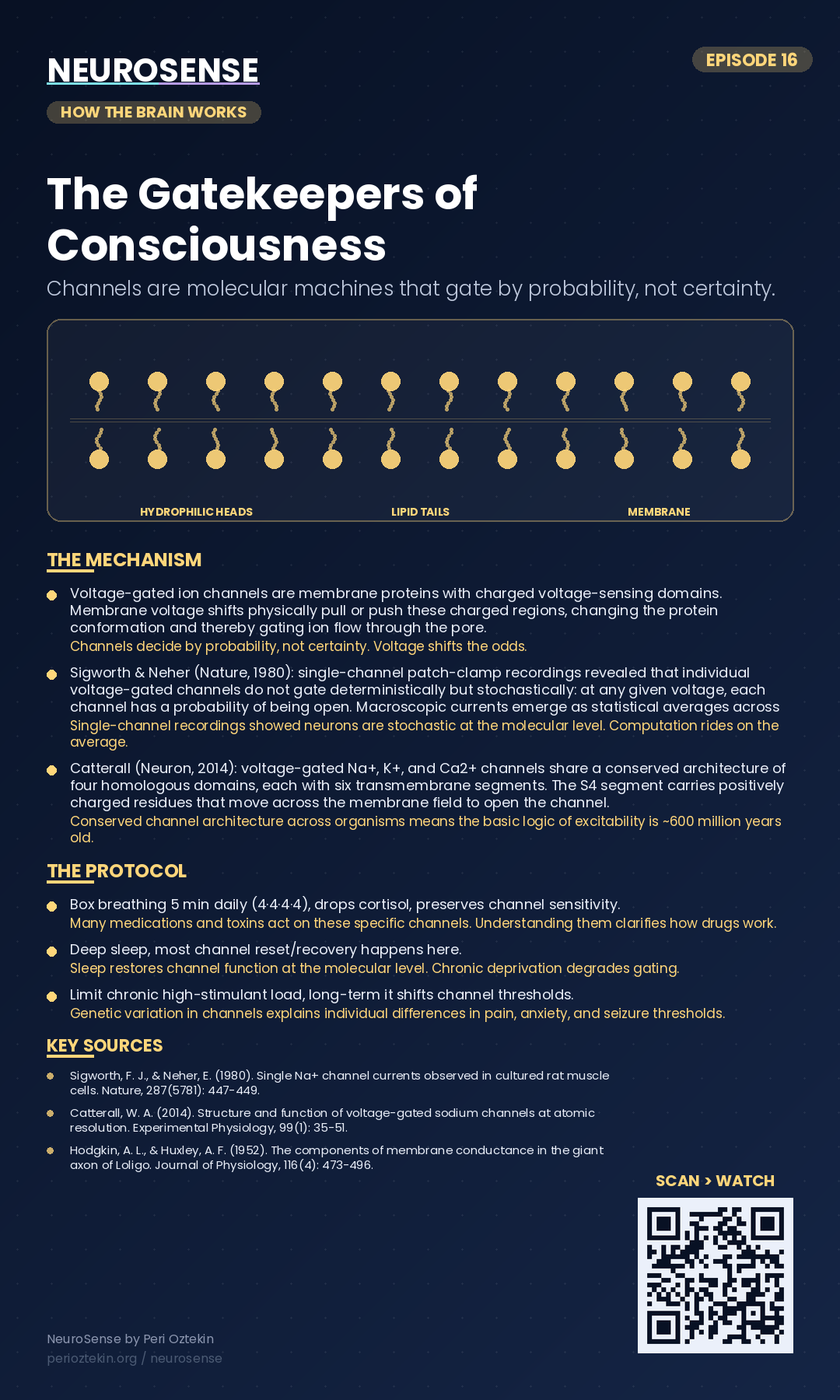
Voltage-gated channels are complex molecular machines just a few nanometers across. They don't decide deterministically; they decide by probability.
The Science
- Voltage-gated ion channels are membrane proteins with charged voltage-sensing domains. Membrane voltage shifts physically pull or push these charged regions, changing the protein conformation and thereby gating ion flow through the pore.
- Sigworth & Neher (Nature, 1980): single-channel patch-clamp recordings revealed that individual voltage-gated channels do not gate deterministically but stochastically: at any given voltage, each channel has a probability of being open. Macroscopic currents emerge as statistical averages across thousands of channels.
- Catterall (Neuron, 2014): voltage-gated Na+, K+, and Ca2+ channels share a conserved architecture of four homologous domains, each with six transmembrane segments. The S4 segment carries positively charged residues that move across the membrane field to open the channel.
- Channel diversity matters: K+ channel families alone include dozens of subtypes with different voltage thresholds, kinetics, and modulation. This diversity shapes the firing patterns that distinguish one neuron type from another.
The Protocol
- Box breathing 5 min daily (4·4·4·4), drops cortisol, preserves channel sensitivity.
- Deep sleep, most channel reset/recovery happens here.
- Limit chronic high-stimulant load, long-term it shifts channel thresholds.
One-page summary
Right-click → Save As to download. Or scan the QR code in the corner to come back here from print.
The science beat (5-sec loop)
Sources
- Sigworth, F. J., & Neher, E. (1980). Single Na+ channel currents observed in cultured rat muscle cells. Nature, 287(5781): 447-449.
- Catterall, W. A. (2014). Structure and function of voltage-gated sodium channels at atomic resolution. Experimental Physiology, 99(1): 35-51.
- Hodgkin, A. L., & Huxley, A. F. (1952). The components of membrane conductance in the giant axon of Loligo. Journal of Physiology, 116(4): 473-496.
Educational content only. Not medical advice.
Also on Instagram: @neurosensebrain
← Back to all episodes