← All episodes
Episode 15 · How the Brain Works
Your Brain Has No Volume Knob
Passive ion gradients can't explain how a neuron sends a signal. The action potential is the brain's solution: a millisecond, all-or-nothing electrical explosion.
The Science
- Hodgkin & Huxley (J Physiol, 1952): when membrane voltage at the axon hillock crosses the threshold (~ -55 mV), voltage-gated Na+ channels open en masse. Na+ floods inward down its electrochemical gradient, driving the membrane to ~ +30 mV in roughly 1 millisecond.
- Voltage-gated K+ channels then open with a delay, allowing K+ to flow outward and repolarize the membrane. A brief hyperpolarization (the refractory period) prevents the action potential from going backward and enforces unidirectional propagation.
- The Hodgkin-Huxley mathematical model quantitatively reproduces action potential shape, threshold, refractory period, and conduction velocity using only Na+ and K+ conductances as functions of voltage and time. This earned the 1963 Nobel Prize in Physiology or Medicine.
- The action potential is all-or-none: subthreshold inputs decay passively; once threshold is crossed, the response amplitude is fixed. Information is encoded in firing rate and timing patterns, not amplitude.
The Protocol
- Hydration: dehydration shifts ion concentrations, destabilizing the threshold.
- Avoid acute stimulant spikes (sugar binges, caffeine overload), they shift firing threshold.
- Sleep, voltage gates reset overnight.
One-page summary
Right-click → Save As to download. Or scan the QR code in the corner to come back here from print.
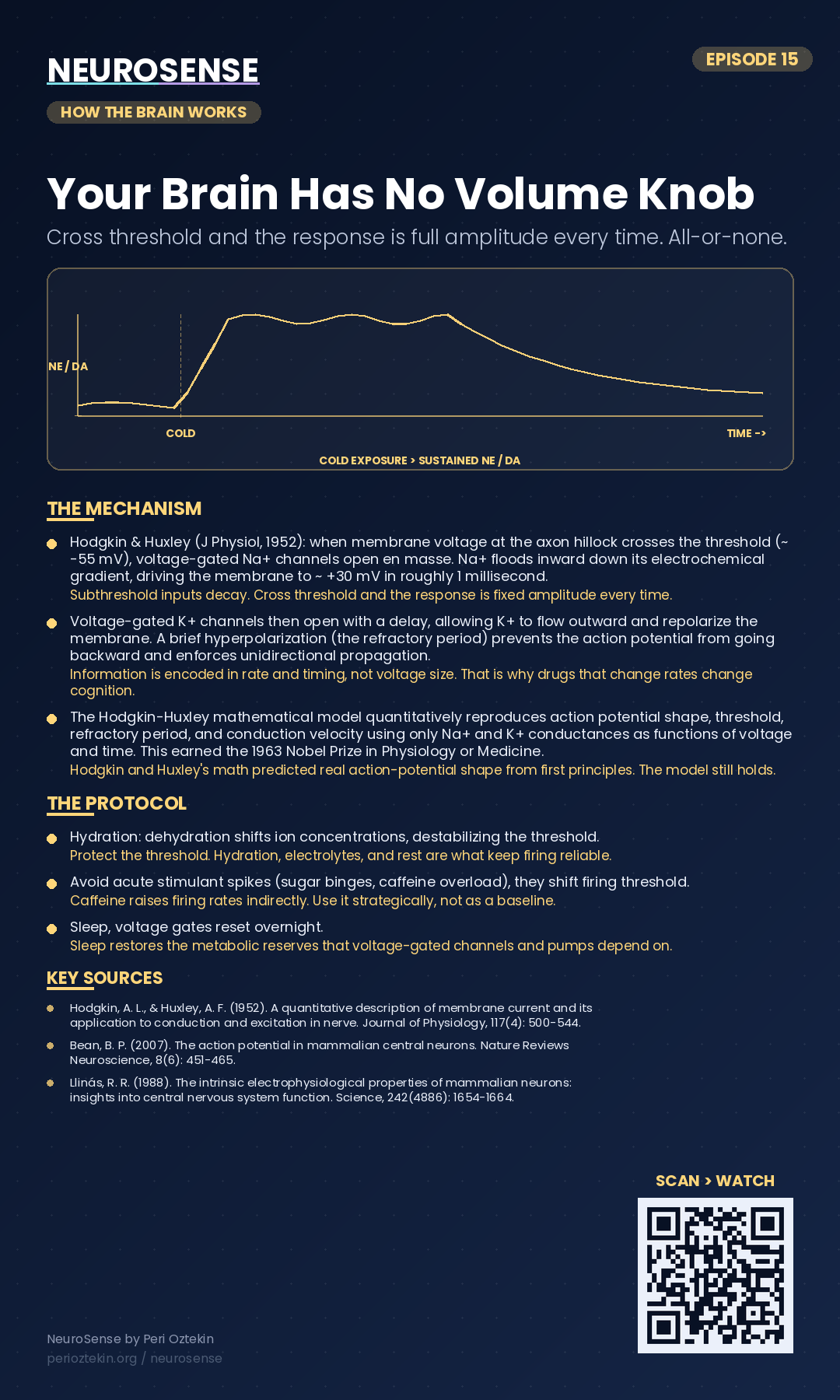
The science beat (5-sec loop)
Sources
- Hodgkin, A. L., & Huxley, A. F. (1952). A quantitative description of membrane current and its application to conduction and excitation in nerve. Journal of Physiology, 117(4): 500-544.
- Bean, B. P. (2007). The action potential in mammalian central neurons. Nature Reviews Neuroscience, 8(6): 451-465.
- Llinás, R. R. (1988). The intrinsic electrophysiological properties of mammalian neurons: insights into central nervous system function. Science, 242(4886): 1654-1664.
Educational content only. Not medical advice.
Also on Instagram: @neurosensebrain
← Back to all episodes