← All episodes
Episode 14 · How the Brain Works
Your Brain Cheats Physics to Be Fast
Action potentials don't crawl down an axon. They leap from gap to gap, and that physical leap is where the brain's reaction speed lives.
The Science
- Huxley & Stämpfli (J Physiol, 1949): action potentials in myelinated axons regenerate only at the Nodes of Ranvier, the small unmyelinated gaps between myelin segments. Between nodes, the voltage propagates passively through the insulated segment.
- The nodes hold a very high density of voltage-gated Na+ channels (clusters of ~1000-2000 per square micron). Each regeneration step at a node restores the action potential to full amplitude before it travels passively to the next node.
- Rasband (Annual Review of Neuroscience, 2010): the molecular architecture of nodes, paranodes, and juxtaparanodes is precisely organized: Na+ channels cluster at nodes, K+ channels at juxtaparanodes, and cell-adhesion molecules secure the structure. Disruption of this organization underlies multiple sclerosis symptoms.
- Without saltatory conduction, the same axon would need to be approximately 330 times wider to achieve the same conduction velocity. Saltatory conduction is what allows fast reflexes to coexist with thin, energetically affordable axons.
The Protocol
- Omega-3 fatty acids (walnuts, flaxseeds, fatty fish), myelin is mostly lipid.
- Same focused practice as V13, myelination and saltatory speed are linked.
- Avoid chronic inflammation (excess sugar, alcohol), it degrades myelin.
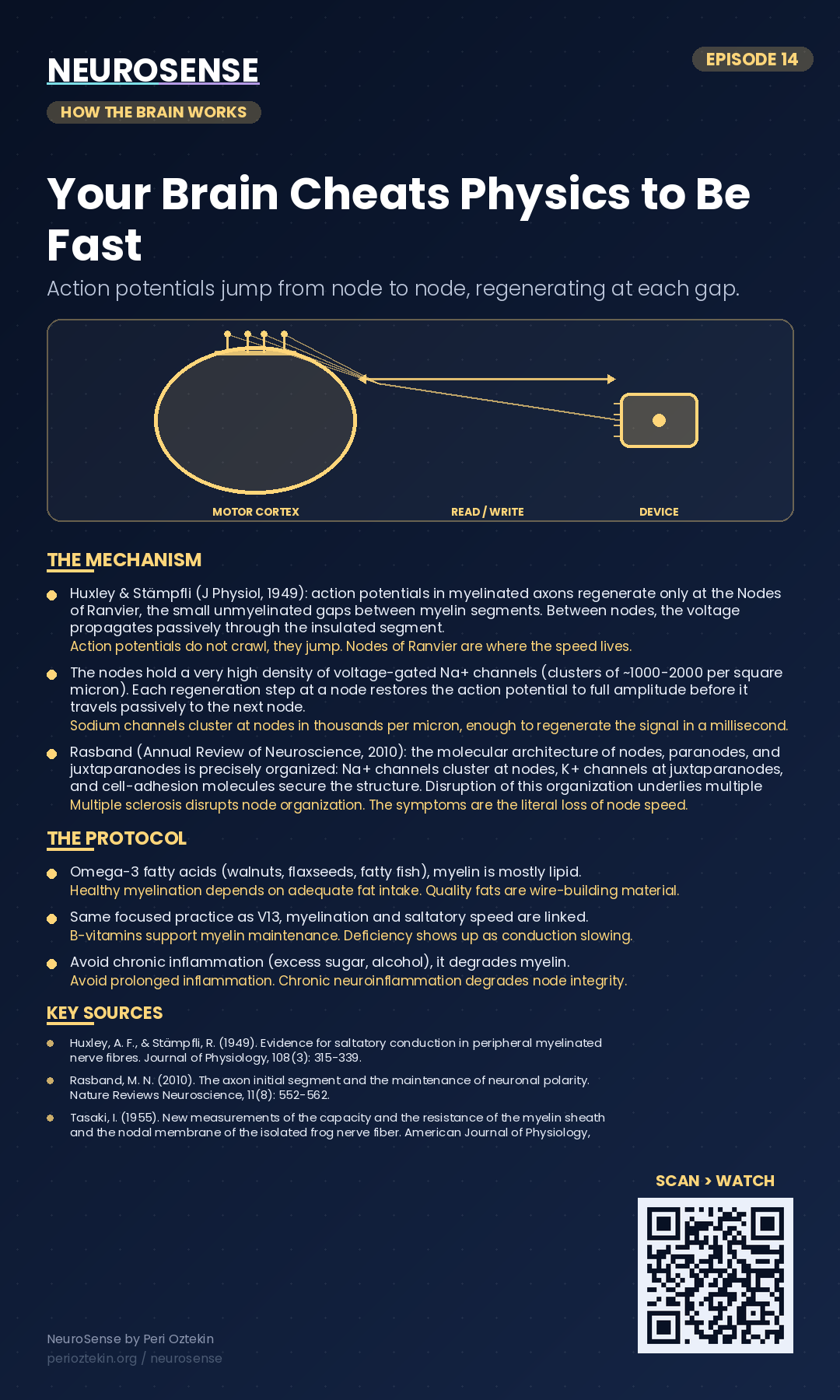
One-page summary
Right-click → Save As to download. Or scan the QR code in the corner to come back here from print.
The science beat (5-sec loop)
Sources
- Huxley, A. F., & Stämpfli, R. (1949). Evidence for saltatory conduction in peripheral myelinated nerve fibres. Journal of Physiology, 108(3): 315-339.
- Rasband, M. N. (2010). The axon initial segment and the maintenance of neuronal polarity. Nature Reviews Neuroscience, 11(8): 552-562.
- Tasaki, I. (1955). New measurements of the capacity and the resistance of the myelin sheath and the nodal membrane of the isolated frog nerve fiber. American Journal of Physiology, 181(3): 639-650.
Educational content only. Not medical advice.
Also on Instagram: @neurosensebrain
← Back to all episodes