← All episodes
Episode 131 · Learning & Memory
Testing Yourself Is the Memory Repetition
Rereading can feel productive because the page looks familiar, but familiarity is not recall.
The Science
- Memory gets stronger when your brain pulls the answer back without seeing it first.
- Retrieval effort rebuilds the route instead of just recognizing the scenery again.
- Memory is not a camera roll; it predicts using context and meaning.
The Protocol
- Close the notes and self-quiz before you reread.
- Explain the idea to a friend or a voice memo.
- Use missed answers as the next repetition, then space the retest.
One-page summary
Right-click → Save As to download. Or scan the QR code in the corner to come back here from print.
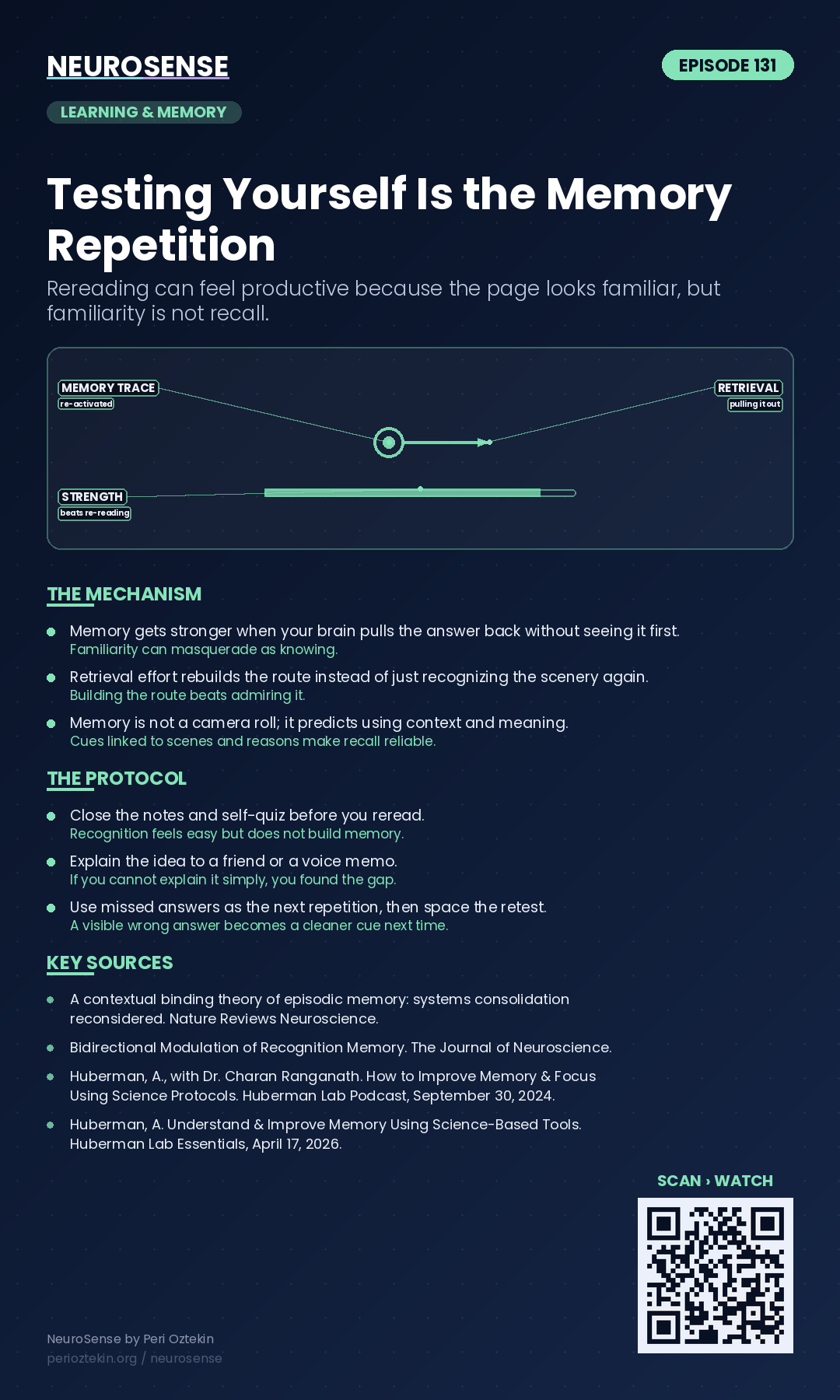
The science beat (5-sec loop)
Sources
- A contextual binding theory of episodic memory: systems consolidation reconsidered. Nature Reviews Neuroscience.
- Bidirectional Modulation of Recognition Memory. The Journal of Neuroscience.
- Huberman, A., with Dr. Charan Ranganath. How to Improve Memory & Focus Using Science Protocols. Huberman Lab Podcast, September 30, 2024.
- Huberman, A. Understand & Improve Memory Using Science-Based Tools. Huberman Lab Essentials, April 17, 2026.
Educational content only. Not medical advice.
Also on Instagram: @neurosensebrain
← Back to all episodes