← All episodes
Episode 13 · How the Brain Works
How Practice Wires Your Brain Faster
Myelin doesn't just protect axons. It drops membrane capacitance, which speeds signal propagation and is built up by deliberate practice.
The Science
- Myelin is wrapped around axons by oligodendrocytes in the central nervous system and Schwann cells in the peripheral nervous system. Each oligodendrocyte can myelinate up to 50 axon segments, forming the insulating sheath in concentric layers.
- Two electrical effects: myelin (1) increases membrane resistance, blocking ion leak, and (2) decreases membrane capacitance, allowing voltage to change faster. The time constant tau = R*C drops, so depolarization propagates farther in less time.
- Bengtsson et al. (Nature Neuroscience, 2005): MRI diffusion-tensor studies of pianists show that years of practice produce region-specific increases in white matter integrity in motor and sensorimotor tracts. Myelination is plastic and trainable in adults.
- Fields (Trends in Neurosciences, 2008): activity-dependent myelination has been confirmed in cellular studies: action potentials in unmyelinated axons trigger ATP release that signals oligodendrocyte precursor cells to wrap. Practice literally rebuilds the wire.
The Protocol
- Deep-focus blocks (60-90 min) with no interruption. Sub-threshold practice doesn't trigger wrapping.
- Prioritize sleep, myelin synthesis peaks in deep sleep.
- Repetition of the SAME circuit beats variety. Plasticity is path-specific.
One-page summary
Right-click → Save As to download. Or scan the QR code in the corner to come back here from print.
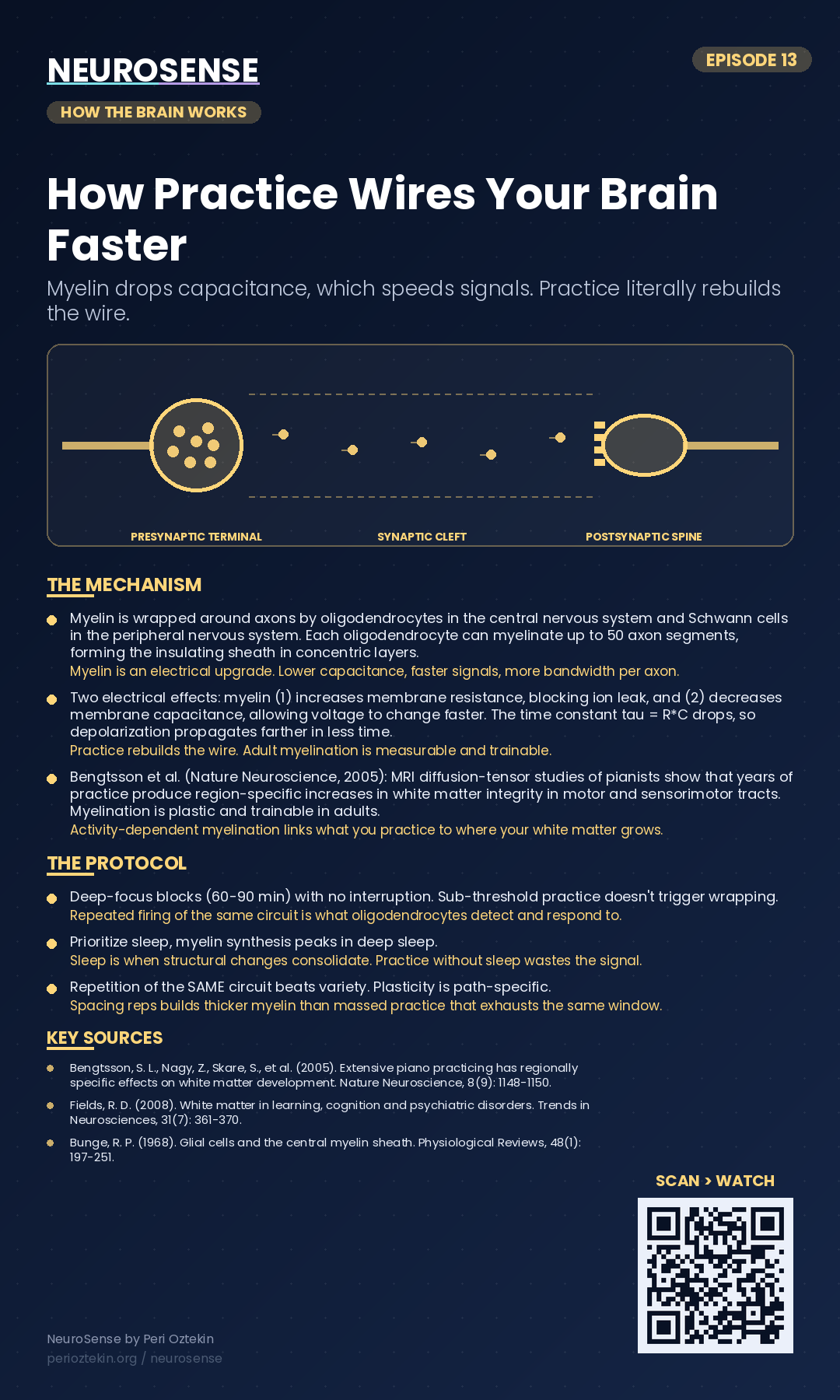
The science beat (5-sec loop)
Sources
- Bengtsson, S. L., Nagy, Z., Skare, S., et al. (2005). Extensive piano practicing has regionally specific effects on white matter development. Nature Neuroscience, 8(9): 1148-1150.
- Fields, R. D. (2008). White matter in learning, cognition and psychiatric disorders. Trends in Neurosciences, 31(7): 361-370.
- Bunge, R. P. (1968). Glial cells and the central myelin sheath. Physiological Reviews, 48(1): 197-251.
Educational content only. Not medical advice.
Also on Instagram: @neurosensebrain
← Back to all episodes